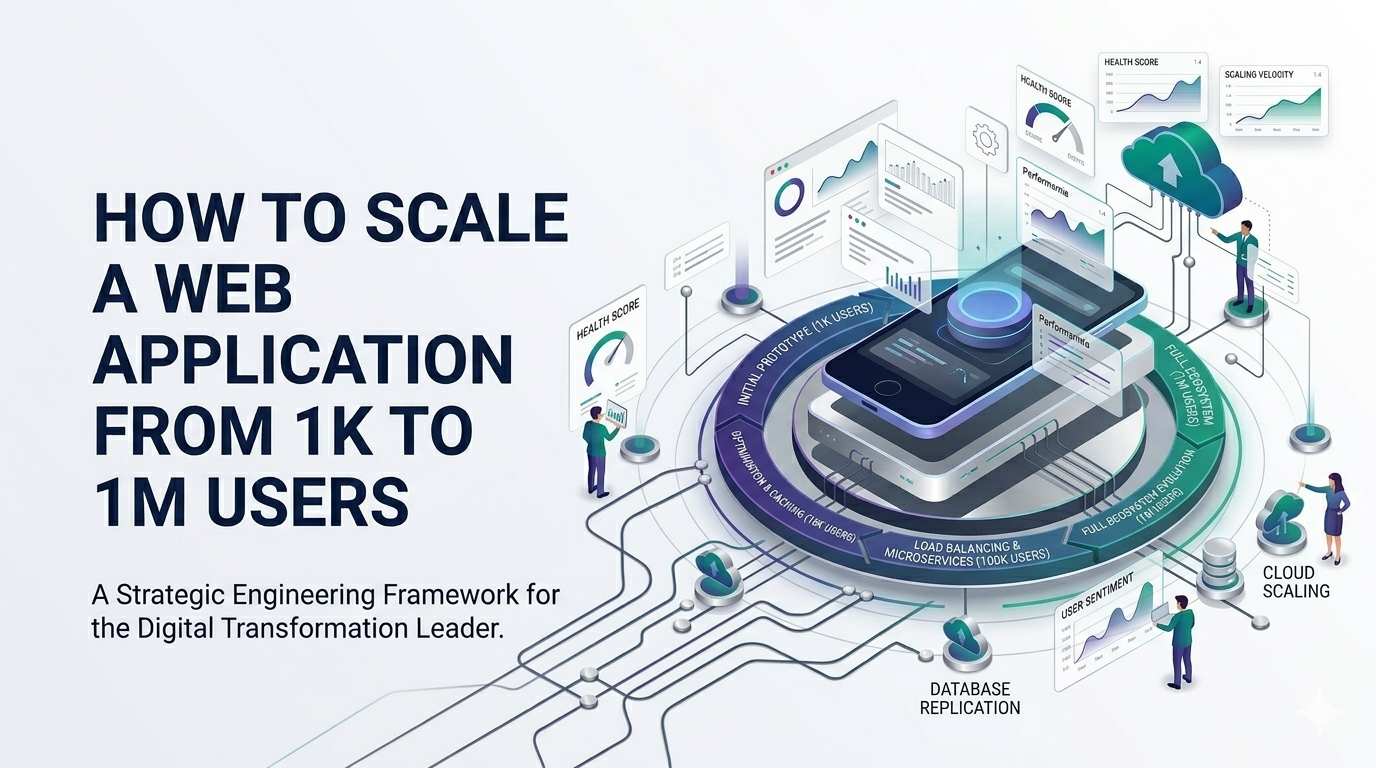
At 1,000 users, most systems look stable. Dashboards are green, response times are predictable, and engineering teams feel in control. By 100,000 users, that same system starts exposing architectural shortcuts. At 1 million users, those shortcuts turn into systemic failures—performance degradation, rising infrastructure costs, and unpredictable outages.
For leadership teams across North America’s large enterprises, scaling is rarely a purely technical challenge. It becomes an operational and strategic problem. The issue is not whether the system can scale—it’s whether the organization can scale with it.
What separates platforms that plateau at 50K users from those that reach millions is not a single technology decision. It is a sequence of deliberate trade-offs made early—and corrected fast enough later.
The Comfort Zone at 1K Users
At a low scale, simplicity wins. A monolithic backend, a single database instance, and basic caching strategies are more than sufficient. Engineering teams prioritize speed of delivery over resilience, and rightly so.
This is the phase where product-market fit matters more than architectural purity. Leaders often push for rapid feature releases, and teams optimize for iteration velocity.
But this phase creates hidden risks.
A single relational database may work well, but it becomes a bottleneck under concurrent load. Synchronous APIs feel manageable, but they introduce cascading failures as traffic grows. Logging is often minimal, making it difficult to diagnose issues later.
Most importantly, teams build habits around “what works now,” not “what will work next.”
That’s the trap.
The Breaking Point: 10K to 100K Users
This is where systems start to show strain—and where leadership decisions begin to matter more than code quality.
Performance issues emerge first. Page load times increase, API latency spikes, and database queries become inefficient under concurrent access. Engineering teams often respond reactively—adding more compute, scaling vertically, or patching performance issues at the query level.
This works temporarily, but costs escalate quickly.
At the same time, deployment cycles slow down. As the codebase grows, release risks increase. Teams hesitate to ship changes because rollback mechanisms are weak or nonexistent.
Two patterns typically emerge here:
- Overengineering too early – Teams introduce microservices prematurely, increasing operational complexity without clear benefits.
- Under-scaling critical components – Teams delay investments in caching, load balancing, and database optimization until outages force their hand.
Neither approach works at scale.
The real challenge in this phase is prioritization. Leadership must decide which parts of the system deserve immediate scaling investment—and which can remain simple.
Designing for 1M Users: Architecture That Holds
Scaling to a million users is not about a single architectural shift. It is about layering capabilities incrementally while maintaining system reliability.
At this stage, three foundational changes typically define success.
First, systems move toward distributed architectures. This does not always mean full microservices adoption, but it does mean decoupling critical components. Services handling authentication, payments, or real-time interactions cannot remain tightly coupled.
Second, data strategy evolves. A single database instance becomes insufficient. Teams introduce read replicas, sharding strategies, or even polyglot persistence—using different databases for different workloads.
Third, traffic management becomes sophisticated. Load balancers, CDNs, and caching layers are no longer optional—they are essential.
But technology alone does not solve scaling challenges.
Engineering leaders often underestimate the importance of observability at this stage. Without deep visibility into system performance—across services, databases, and user interactions—teams operate reactively.
The difference between a scalable system and a fragile one often comes down to how quickly teams can detect and respond to issues.
The Decisions That Define Scale
The most critical scaling decisions are rarely visible in architecture diagrams. They happen in roadmap discussions, budget allocations, and hiring strategies.
One common mistake is treating scaling as a one-time project. In reality, scaling is a continuous process. Systems evolve, user behavior changes, and new features introduce new load patterns.
Another mistake is focusing only on infrastructure. While cloud platforms provide elasticity, they do not eliminate poor architectural decisions. Without proper system design, costs can spiral even as performance remains inconsistent.
Leaders who succeed at scale focus on alignment:
- Engineering teams align on clear ownership of services and components
- Product teams understand the cost implications of new features
- Platform teams build reusable infrastructure instead of one-off solutions
This alignment reduces friction and enables faster, safer scaling.
Scaling the Organization, Not Just the System
By the time a platform approaches one million users, organizational complexity often becomes the bigger bottleneck.
Large teams introduce coordination challenges. Dependencies between services slow down development. Incident response becomes fragmented without clear ownership.
This is where platform engineering and internal tooling play a critical role.
High-performing organizations invest in developer experience as much as user experience. They standardize deployment pipelines, enforce observability practices, and provide self-service infrastructure.
This reduces cognitive load on individual teams and allows them to focus on delivering value rather than managing complexity.
At the same time, leadership must rethink success metrics.
At smaller scales, success is measured by feature velocity. At larger scales, it shifts toward reliability, performance, and cost efficiency. Balancing these metrics requires a different mindset—and often, a different operating model.
What This Means for Leadership Teams
Scaling from 1K to 1M users is not a linear journey. It is a series of inflection points where previous decisions either enable growth or constrain it.
For VP-level leaders, the key questions are not purely technical:
- Are teams building for short-term velocity or long-term resilience?
- Is the architecture evolving with user growth, or reacting to failures?
- Does the organization have the visibility and ownership needed to operate at scale?
These questions determine whether scaling becomes a competitive advantage—or a constant source of friction.
The organizations that scale effectively do not aim for perfect architecture from day one. They build systems that can evolve, teams that can adapt, and processes that can sustain growth
In many cases, the real constraint is not technology—it is clarity. Clarity on what needs to scale now, what can wait, and what trade-offs are acceptable at each stage.
That clarity rarely comes from internal discussions alone. It often emerges through structured evaluation—looking at system architecture, team workflows, and growth projections together.
For leadership teams navigating this transition, the next step is not another tool or framework. It is a sharper perspective on how their current system—and organization—will behave at 10x scale.
Frequently Asked Questions (FAQs)
1. When should a company start planning for scaling beyond 1K users?
Planning should begin earlier than most teams expect—typically when usage patterns become predictable and product-market fit shows early signals. Waiting until performance issues appear at 10K+ users forces reactive decisions, which are often more expensive and less effective than incremental, proactive improvements.
2. Is it necessary to adopt microservices to scale to 1M users?
No. Microservices are not a prerequisite for scale. Many high-performing systems scale effectively with a modular monolith approach. The key is decoupling critical components and ensuring independent scalability where needed. Premature microservices adoption can increase operational complexity without delivering proportional value.
3. What is the most common bottleneck when scaling from 10K to 100K users?
Database performance is typically the first major bottleneck. Inefficient queries, lack of indexing, and a single database instance under heavy concurrent load can degrade system performance quickly. Closely following this are application-layer inefficiencies and insufficient caching strategies.
4. How should leaders balance performance optimization and feature delivery?
This is a prioritization challenge. High-performing teams allocate a fixed engineering bandwidth—often 20–30%—toward scalability and performance improvements while continuing feature development. Ignoring performance entirely slows future delivery, while over-focusing on optimization too early delays growth.
5. What role does cloud infrastructure play in scaling?
Cloud platforms provide elasticity and scalability, but they are not a substitute for good system design. Without efficient architecture, costs can escalate rapidly even as performance issues persist. Cloud should be treated as an enabler, not a solution.
6. When should caching be introduced into the system?
Caching should be introduced as soon as repeated data access patterns are identified—typically between 5K to 20K users. Delaying caching increases database load unnecessarily, while implementing it too early without clear use cases can add complexity.
7. How important is observability at scale?
Observability becomes critical beyond 50K users. Without detailed insights into system behavior—metrics, logs, and traces—teams cannot diagnose issues efficiently. Strong observability reduces downtime, accelerates incident resolution, and improves overall system reliability.
8. What organizational changes are required to support scaling?
Scaling requires clearer ownership models, stronger platform engineering capabilities, and standardized development practices. Teams must shift from ad-hoc processes to structured workflows, including CI/CD pipelines, incident management protocols, and infrastructure automation.
9. How can companies control infrastructure costs while scaling?
Cost control comes from architectural efficiency rather than just budget monitoring. This includes optimizing database usage, leveraging caching, right-sizing compute resources, and continuously evaluating system performance. FinOps practices also help align engineering decisions with cost outcomes.
10. What is the biggest mistake leaders make when scaling systems?
Treating scaling as a one-time initiative instead of an ongoing process. Systems, user behavior, and business requirements evolve continuously. Leaders who fail to revisit architectural and operational decisions regularly often face compounding technical debt and rising inefficiencies.
11. How do you know if your system is ready for 1M users?
There is no single benchmark, but indicators include stable performance under load testing, horizontally scalable components, strong observability, and well-defined incident response processes. Equally important is whether teams can deploy changes confidently without introducing instability.
12. Should scaling decisions be driven by engineering or business leadership?
Scaling decisions require alignment between both. Engineering teams bring technical feasibility, while business leadership defines growth priorities and acceptable trade-offs. Successful scaling happens when both sides operate with shared visibility and goals.