Somewhere between the product roadmap and the sprint kickoff, a question that should have been a strategic conversation becomes a default technical choice. The team picks what they know, the platform ships, and six months later the VP of Digital is asking why the experience doesn’t match what users expect — or why maintenance is consuming more bandwidth than new feature delivery.
The web app vs. website decision sounds like an architectural detail. It is not. It is a business decision with budget, timeline, and user experience consequences that compound over multiple release cycles. And in large organizations, it rarely gets the deliberate attention it deserves.
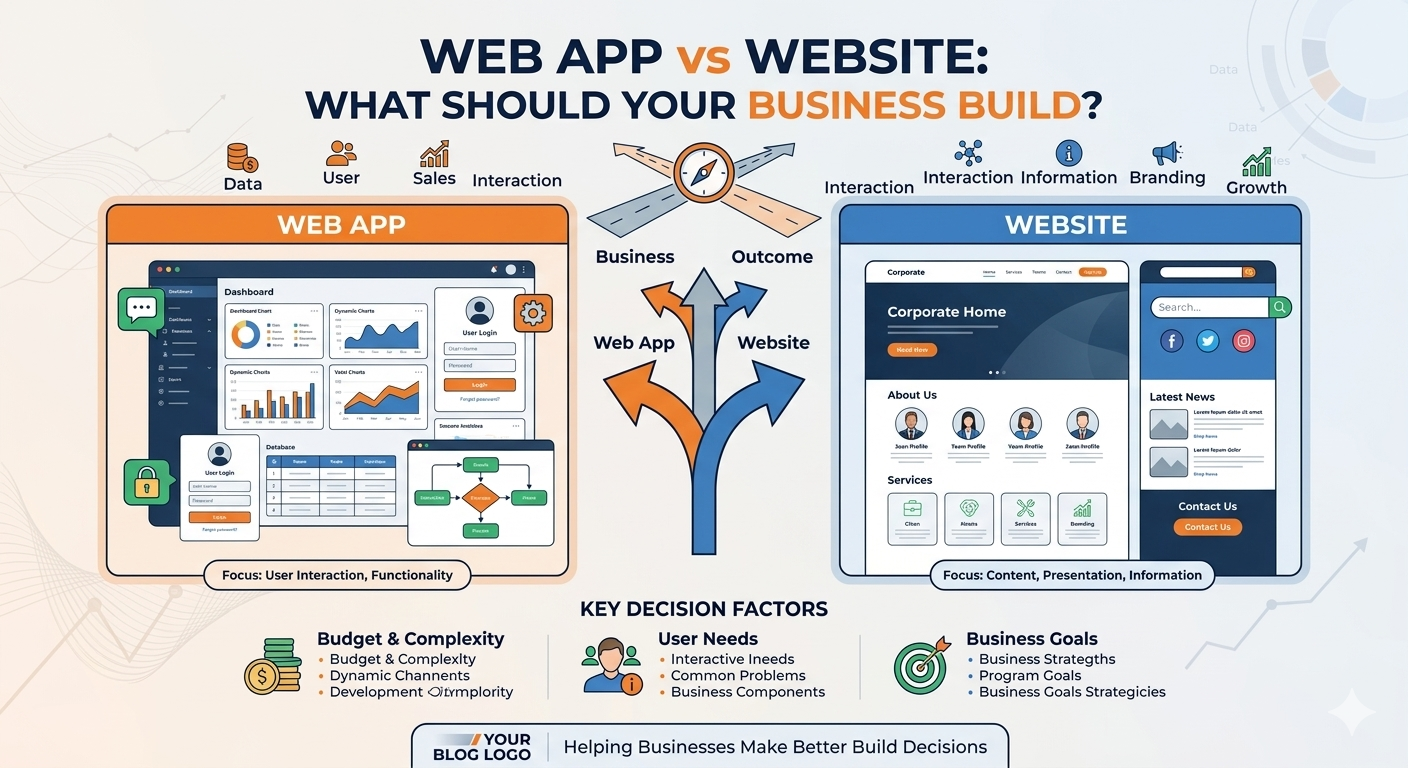
The core distinction matters: a website focuses on delivering content efficiently, while a web application provides an interactive experience — enabling users to transact, collaborate, or customize what they see and do. That difference shapes everything from the development stack and team structure to how the product scales, how it gets maintained, and how it performs under load.
Getting this wrong does not produce a dramatic failure. It produces a slow drift — a platform that technically works but consistently underperforms against user expectations and business targets.
What the Distinction Actually Means for Delivery
The definition that tends to cause confusion in planning meetings is this: a website and a web application can look nearly identical to a user. The difference is in what happens when that user interacts with it.
A web app is a software application that runs on a web server, accessed through a browser, combining the functionality of software with the accessibility of websites. It does not require installation, but it handles user state, processes data, and often integrates deeply with backend systems and third-party services. A website, by contrast, is primarily a content delivery vehicle optimized for discovery, readability, and SEO performance.
For a VP of Engineering overseeing a digital product portfolio, the practical implication is this: a website project and a web application project require different team compositions, different testing frameworks, different security considerations, and different maintenance models. Treating them interchangeably in the planning process is where cost overruns and missed targets begin.
Web apps allow a broader initial audience to reach the platform via search engines and simple sharing links, working across devices instantly. But where high user engagement, state management, and dynamic personalization are requirements, a web application architecture is the only sustainable answer.
The question is not which one is better. It is which one matches what the product actually needs to do — and whether the decision was made explicitly or just inherited from the previous build.
The Signals That Tell You Which Direction to Build
Engineering leaders in large enterprises tend to approach this decision through a technology lens. The more useful lens is user behavior combined with business function.
A website makes sense when the primary job is informational: product documentation, corporate presence, content marketing, regulatory disclosures, event pages. These are discovery and credibility assets. They benefit from strong SEO architecture, fast load times, and content management flexibility. When the goal is sharing information — company details, blog posts, product overviews — a website is the appropriate and cost-effective choice.
A web application is the right call when users are expected to take action, return repeatedly, and have data associated with their session. Customer portals, internal operations dashboards, B2B ordering platforms, SaaS tools, booking and scheduling systems — these are web applications whether they are called that or not. Centralized dashboards for data-driven decision-making, real-time analytics, resource allocation, and compliance tracking built for growing enterprises require the architecture of a web application, not a website.
The decision criteria that matter in practice:
- Frequency and depth of user interaction — If users are completing tasks, managing accounts, or generating data, the platform needs to function as an application. If they are reading and navigating, a website suffices.
- Integration requirements — Web applications typically integrate with payment systems, CRMs, ERPs, and internal APIs. Each integration adds architectural complexity that a standard website is not designed to handle cleanly.
Large enterprises are fueling demand for web applications as part of their digital transformation initiatives — requiring scalable, reliable solutions to handle increasing traffic and enhance digital capabilities. The architecture decision made at the outset determines whether those scalability requirements can be met without a rebuild.
The emerging middle ground worth understanding is the Progressive Web App — a web application that delivers app-like behavior (offline access, push notifications, installability) without requiring native app distribution. The global PWA market was valued at $5.8 billion in 2023 and is projected to exceed $10 billion by 2030, with enterprises reporting development and maintenance cost savings of up to 35% compared to native applications. For enterprises managing multi-platform digital presence, PWAs are increasingly the architecture that resolves the website vs. web app vs. native app tradeoff in one deployment.
How Leading Firms Are Navigating This
The firms executing this well are treating the web app vs. website question as part of a broader product strategy conversation — not a technical default.
GeekyAnts, which has delivered web applications for enterprise clients including Darden Restaurants and PayPoint, builds platforms ranging from operations management systems to customer-facing commerce applications and real-time analytics dashboards. Their expansion into Progressive Web App development reflects the firm’s read that enterprise clients need a path that delivers app-like user experiences while maintaining the cost efficiency and deployment simplicity of web architecture. For one flexible workspace client, their web platform delivered 60% higher scalability against a direct market competitor.
Netguru, which serves fintech, healthcare, and retail clients, consistently approaches the build decision through a scalability-first lens — designing clean architecture that can evolve from content site to full web application without platform replacement. Simform, with over 900 client engagements, integrates product strategy services explicitly to resolve the platform decision before development begins. BairesDev brings the same discipline to enterprise-scale clients — using a discovery phase to align the technical architecture with the actual user workflow before any build commitment is made.
What these firms share is a refusal to let the technology decision precede the use-case definition. The platform choice follows the user journey analysis, not the other way around.
For engineering and digital leaders managing large product portfolios, the question is worth examining at the portfolio level: how many of the platforms currently in production were built with an explicit architecture decision — and how many inherited their form from a previous project or a vendor default?
If the answer is uncertain, it might be worth mapping that out before the next major release cycle commits the budget.
FAQs
Can a website be converted into a web app later, or does that require a full rebuild?
It depends on how the original website was architected. Static sites built on CMS platforms like WordPress or Webflow are not designed for application-level logic and typically require a rebuild when the product needs to handle user authentication, real-time data, or complex integrations. Sites built on modern frameworks like Next.js or Nuxt have more migration flexibility. The cost of conversion almost always exceeds the cost of building correctly from the start — which is why the architecture decision matters before the first line of code.
What is the difference between a web app and a Progressive Web App (PWA)?
A web app is the broad category — any browser-based application that handles user state and interaction. A Progressive Web App is a specific architecture within that category that adds native-app capabilities: offline access via service workers, push notifications, and home screen installability without an app store. PWAs are particularly relevant for enterprises managing both customer-facing and operational platforms, as they eliminate the need to maintain separate native iOS and Android codebases while delivering comparable user engagement.
How does this decision affect compliance and security requirements?
Significantly. Web applications that handle user authentication, payment data, health records, or personal information fall under different compliance obligations than content websites. HIPAA, PCI-DSS, SOC 2, and PIPEDA requirements apply at the application layer — to user data flows, session management, API security, and access controls. A platform architected as a website but functioning as an application often has compliance gaps that only surface during a security audit or a regulatory review.
How should engineering leaders present this decision to non-technical executives?
Frame it around business outcomes rather than technical architecture. The relevant questions for executive alignment are: What do we expect users to do on this platform, and how often? What systems does it need to connect to? What does failure look like — and what does scale look like? The technical architecture is the answer to those questions, not the starting point. Presenting it that way typically shortens the approval cycle and reduces the risk of scope changes mid-build.