Most companies don’t fail at enterprise web application development because they lack budget. They fail because they underestimate the operational complexity hiding behind a seemingly straightforward brief ,build a system that scales, integrates with existing tools, stays secure, and gets shipped on time.
The global enterprise application market was valued at $308 billion in 2024, and North America dominates with an estimated 41.8% market share in 2025. The numbers signal confidence. The reality on the ground ,delayed sprints, blown budgets, and half-integrated systems ,tells a more complicated story.
For companies and SMBs across the U.S. and Canada, the pressure is particularly sharp. Competition is faster, compliance requirements are tighter, and the internal IT team is usually stretched across three other priorities. A poorly scoped enterprise web application doesn’t just slow operations down ,it eats into the targets the leadership team is being measured against.
The Integration Problem Nobody Talks About
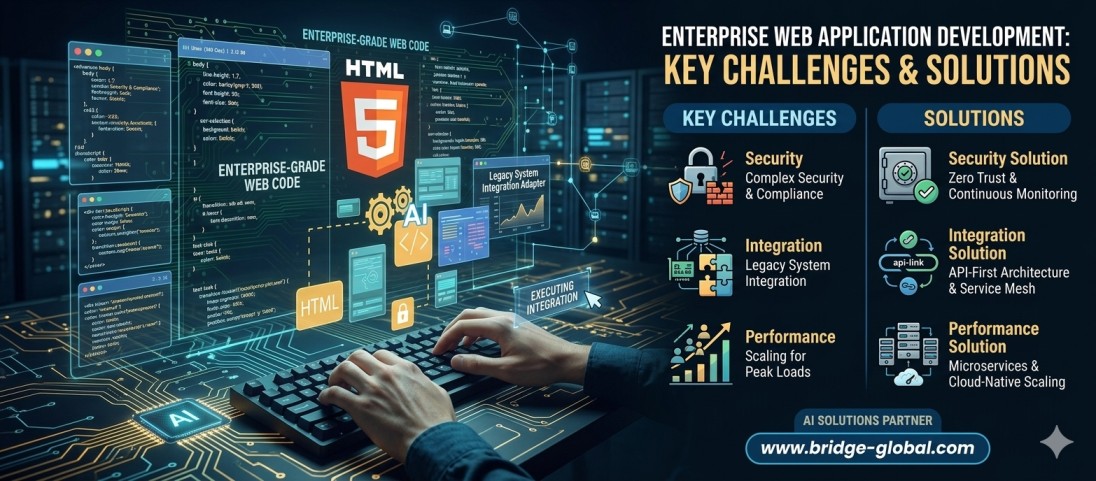
Legacy infrastructure is the hidden tax on every enterprise web app project. Most organizations don’t start from scratch ,they inherit a mix of CRMs, ERPs, internal dashboards, and third-party APIs that need to talk to each other. Getting a new web application to slot into that environment cleanly is where many projects quietly unravel.
Modern enterprises rely on interconnected systems, and web apps must integrate with APIs, third-party tools, and cloud services like AWS or Azure. The challenge isn’t technical in isolation ,it’s that integration scope typically expands mid-project as more stakeholders identify dependencies that weren’t surfaced during discovery.
Up to 75 percent of executives believe competition between business functions and digital projects is one of the top hindrances to growth, and lack of collaboration between business departments and IT is one of the leading challenges affecting app development.
In practice, that means the engineering team is building against a spec that the business side hasn’t fully agreed on. Both teams are working hard. The output still disappoints.
Firms that navigate this well treat integration as a first-week conversation, not a post-build concern. GeekyAnts, a full-stack product and engineering studio with clients across the U.S. and UK, has built a practice around transforming monolithic legacy systems into modern microservices, treating infrastructure as code to balance performance with cost ,and has documented slashing dashboard load times from 30 seconds to under 500 milliseconds for enterprise clients. The principle applies broadly: architectural decisions made early determine whether integration is manageable or a permanent headache.
Security doesn’t wait for post-launch either. According to IBM’s 2025 Data Breach Report, the average cost of a data breach for enterprise web apps hit $4.88 million, making robust security practices non-negotiable. In 2025 alone, enterprises faced a 35% increase in API-based attacks.
Why Most Enterprise Projects Fall Behind Schedule
Timeline slippage is the norm, not the exception. Only 49% of enterprise software projects finish on schedule, but organizations with experienced implementation partners maintain timeline discipline through proven methodologies and realistic scoping.
There are five compounding reasons why this keeps happening:
- Requirements are approved before the full technical scope is understood, leading to change requests that push timelines.
- Security reviews, compliance checks, and accessibility audits get queued for “after development” instead of built in from the start.
- Talent availability is consistently overestimated. 82 percent of companies struggle to attract the software engineers and developers they need to achieve digital transformation goals.
- Testing cycles are underscheduled, especially for load and integration testing.
- Leadership changes mid-project shift priorities before delivery.
The solution isn’t a tighter Gantt chart. It’s building a delivery framework that assumes friction. Teams using CI/CD pipelines saw 2.6x faster deployment cycles and 70% fewer post-release defects, according to GitLab’s 2025 DevOps Report. CI/CD doesn’t just accelerate delivery ,it surfaces problems earlier, when they’re cheaper to fix.
In 2024, about 94% of companies had adopted Agile practices in some form, and around 85% of large organizations now use microservices to improve scalability. Adoption rates are high. Disciplined execution, however, remains rare.
GeekyAnts operates on a principle that resonates with teams under delivery pressure: speed without rigor is just faster failure. That framing captures the core tension most development teams face ,pressure to ship quickly, paired with the operational risk of shipping something fragile.
The Architecture Decision That Determines Everything
Teams often treat architecture selection as a technical discussion. It’s actually a business decision. A monolithic application is faster to build initially and works well at small scale. Once a business needs to update a single feature without risking the whole system, or route different workloads to different infrastructure tiers, the monolith becomes a ceiling.
Microservices bring challenges too ,increased complexity in monitoring, inter-service communication, and DevOps management. Serverless architectures on platforms like AWS Lambda and Azure Functions allow developers to execute code in response to triggers, eliminating server management, but require careful handling of state and latency.
Netflix is the most cited example for good reason. After the infamous 2008 Christmas Eve outage brought its entire streaming service offline, the company rebuilt on a microservices architecture ,and it’s now the model that most enterprise architects reference when justifying the move away from monolithic systems.
For North American companies in growth phases, the practical guidance is straightforward: build for growth from day one. Horizontal scaling, database sharding, and distributed caching help apps handle surging workloads. Separate concerns using an n-Tier architecture so each layer can be maintained and enhanced independently ,if a modern UI overhaul is needed a few years down the line, it shouldn’t require rebuilding the entire application.
Gartner predicts that by 2025, up to 70 percent of new enterprise applications will be built using low-code and no-code development platforms ,a signal that the industry is actively looking for ways to reduce the time and talent overhead of custom development. For routine internal tooling and admin interfaces, low-code accelerates delivery without sacrificing function. For core revenue-generating systems, custom engineering still earns its cost.
The companies getting this right ,whether product studios like GeekyAnts or in-house engineering teams at larger enterprises ,share one common habit. They scope the architecture against the business’s three-year trajectory, not just the first deployment. An application that works today but can’t scale to twice the users or integrate with next year’s ERP upgrade isn’t an asset. It’s a liability with a countdown clock.
The decision-makers reading this aren’t looking for a technology pitch. They’re looking to ship something that holds up under real operating conditions, doesn’t become a support burden on the engineering team, and gives the business room to grow without rebuilding from scratch every eighteen months. That’s a solvable problem ,but only if the right conversations happen before a line of code gets written.