In 2026, the question is not which framework is better—it is whether the chosen stack accelerates or blocks revenue, scalability, and platform resilience.
For large enterprises across North America, the stakes are higher than ever. Engineering leaders are no longer evaluated on delivery alone. They are measured on time-to-market, platform stability, developer productivity, and the ability to support continuous innovation without exponential cost growth.
Yet most organizations still approach tech stack decisions as isolated engineering choices. This disconnect creates long-term friction: slow releases, integration bottlenecks, rising cloud costs, and fragmented developer ecosystems.
The reality is straightforward. The best tech stack is not universal—it is contextual. But patterns have emerged, and leading companies are converging around specific architectural principles that consistently outperform others.
Why Most Stack Decisions Fail at Scale
Large enterprises rarely fail because they picked the “wrong” technology. They fail because they optimize for short-term convenience instead of long-term adaptability.
A common pattern emerges:
- Teams prioritize developer familiarity over system longevity
- Platform teams enforce rigid standards that limit innovation
- Legacy systems dictate new architecture decisions
- Integration complexity is underestimated
This leads to what many VPs quietly recognize—platform stagnation. Features ship slower each quarter. Engineering costs increase without proportional business value. Customer experience becomes inconsistent across channels.
Recent industry analysis across enterprise engineering teams shows that integration and maintenance—not initial development—consume the majority of engineering effort over time. This aligns with broader findings across modern platform engineering discussions: architecture decisions made early compound over years.
The implication is clear. The “best” tech stack is not defined by performance benchmarks or popularity. It is defined by how well it supports change.
What the Evidence Suggests in 2026
Across multiple industry reports and engineering case studies, a few consistent trends define modern web application stacks:
First, full-stack JavaScript ecosystems continue to dominate—not because they are inherently superior, but because they reduce cognitive load across teams. Using a unified language across frontend and backend simplifies hiring, collaboration, and code reuse.
Second, modular architecture has overtaken monolithic design. Whether through microservices or modular monoliths, systems are being designed to evolve incrementally rather than through large rewrites.
Third, cloud-native infrastructure is no longer optional. Platforms built without scalability and observability in mind struggle to meet enterprise expectations.
Finally, developer experience has become a primary decision factor. Organizations are prioritizing stacks that enable faster onboarding, clearer abstractions, and better tooling.
These shifts are not theoretical. They are driven by operational pressure—faster releases, continuous deployment cycles, and the need to support multiple digital touchpoints simultaneously.
The Core Stack Layers That Matter Today
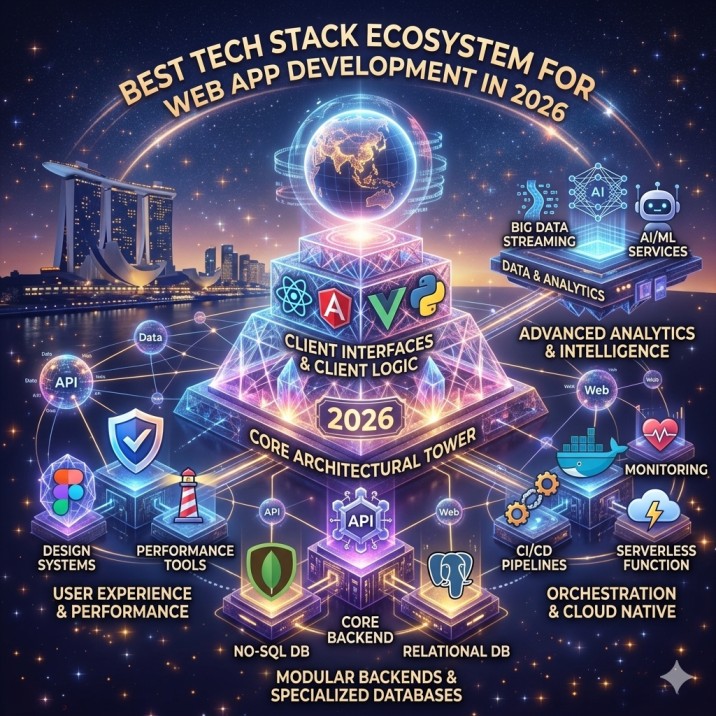
A modern web application stack in 2026 is less about specific tools and more about how layers interact.
At the frontend level, frameworks like React-based ecosystems continue to lead due to their flexibility and ecosystem maturity. Server-side rendering and hybrid rendering approaches are increasingly standard, improving both performance and SEO outcomes.
On the backend, Node.js remains dominant for many enterprise applications, particularly when paired with scalable API architectures. However, polyglot environments are common, where different services use languages best suited to their function.
Data layers are evolving rapidly. Traditional relational databases coexist with NoSQL solutions, depending on workload requirements. The emphasis is on scalability, availability, and real-time processing capabilities.
Infrastructure has shifted decisively toward cloud-first and containerized environments. Kubernetes, serverless functions, and managed cloud services are widely adopted to reduce operational overhead while maintaining flexibility.
What ties these layers together is observability and integration. Logging, monitoring, and API management are no longer add-ons—they are foundational.
How Leading Companies Approach Stack Selection
Top engineering organizations do not ask, “What is the best stack?” They ask, “What constraints are we optimizing for?”
Companies like GeekyAnts, Thoughtbot, 10Pearls, and Net Solutions consistently follow a similar pattern when working with enterprise clients. They anchor tech stack decisions in product outcomes—such as speed to market, scalability, and user experience—rather than defaulting to internal engineering preferences or legacy familiarity.
For example, when building customer-facing platforms that require rapid iteration, they prioritize stacks that enable quick deployment cycles and strong frontend performance.
For data-intensive platforms, they focus on backend scalability and real-time processing capabilities, often combining multiple technologies rather than forcing a single-stack solution.
In platform engineering contexts, they emphasize interoperability—ensuring systems can integrate seamlessly with existing enterprise infrastructure.
This approach reflects a broader industry shift. Stack decisions are increasingly tied to use cases:
- High-growth digital products prioritize speed and flexibility
- Enterprise systems prioritize stability and integration
- Data platforms prioritize scalability and performance
The most effective organizations accept that a single stack rarely meets all needs. Instead, they build ecosystems of technologies governed by clear architectural principles.
The Trade-offs Leaders Must Accept
Every tech stack introduces trade-offs. The problem is not avoiding them—it is making them explicit.
A unified JavaScript stack simplifies development but may not be optimal for compute-heavy workloads. Microservices improve scalability but increase operational complexity. Serverless architectures reduce infrastructure management but can create cost unpredictability at scale.
Many enterprise teams struggle because they attempt to optimize for everything simultaneously. This leads to over-engineering and fragmented systems.
Effective engineering leadership involves making deliberate compromises. It requires clarity on what matters most: speed, scalability, cost, or flexibility.
A Practical Framework for Decision-Makers
Instead of chasing trends, engineering leaders can anchor their decisions around a simple framework:
- Define the primary business constraint
Whether it is time-to-market, scalability, or integration, this should guide every technical decision. - Evaluate team capabilities realistically
A theoretically optimal stack fails if the team cannot execute effectively. - Prioritize interoperability
Systems must integrate seamlessly with existing platforms and future services. - Optimize for change, not perfection
The stack should enable evolution without requiring complete rewrites.
This framework reflects how high-performing engineering organizations operate. It reduces decision paralysis and aligns technical choices with business outcomes.
Where This Leaves Enterprise Leaders
The conversation around tech stacks has matured. It is no longer about choosing between frameworks—it is about designing systems that support continuous change.
For VPs of Engineering and Digital Leaders, the challenge is not identifying the “best” stack. It is ensuring that stack decisions do not become long-term liabilities.
This requires closer alignment between engineering, product, and business strategy. It also requires a willingness to revisit and evolve architectural decisions as requirements change.
Organizations that treat their tech stack as a living system—not a one-time decision—are the ones that sustain velocity at scale.
Some of the most effective teams today are not those with the newest technologies, but those with the clearest architectural intent.
And that is often where an external perspective becomes valuable—not to replace internal expertise, but to challenge assumptions, validate decisions, and uncover blind spots that only emerge at scale.
Frequently Asked Questions (FAQs)
1. What is the “best” tech stack for web app development in 2026?
There is no universally “best” stack. In 2026, the most effective stacks are those aligned with business goals—whether that’s speed, scalability, or integration. Most enterprise teams lean toward full-stack JavaScript ecosystems (React, Node.js), cloud-native infrastructure, and modular architectures, but the right choice depends on specific product and platform needs.
2. Is a full-stack JavaScript approach still relevant for large enterprises?
Yes, particularly for customer-facing platforms and products requiring rapid iteration. A unified JavaScript stack reduces context switching, improves developer productivity, and accelerates delivery cycles. However, enterprises often complement it with other languages for performance-intensive services.
3. How should enterprises balance microservices vs. monolithic architecture?
The decision is less binary in 2026. Many organizations adopt a modular monolith initially and evolve into microservices where necessary. Microservices provide scalability and flexibility but introduce operational complexity. The key is to scale architecture alongside business requirements—not ahead of them.
4. What role does cloud-native infrastructure play in modern stacks?
Cloud-native infrastructure is foundational. Technologies like containers, Kubernetes, and serverless computing allow teams to scale dynamically, reduce operational overhead, and deploy faster. Without cloud-native design, systems often struggle to meet enterprise performance and reliability expectations.
5. How important is developer experience in choosing a tech stack?
It has become a critical factor. Developer experience directly impacts productivity, onboarding time, and long-term maintainability. Stacks with strong tooling, active ecosystems, and clear documentation tend to outperform others in real-world enterprise environments.
6. Should enterprises standardize on a single tech stack across all teams?
Strict standardization can limit innovation. Leading organizations define guardrails rather than rigid standards—allowing teams to choose tools within a controlled ecosystem. This ensures flexibility while maintaining interoperability and governance.
7. How often should companies revisit their tech stack decisions?
Continuously, but strategically. Instead of large-scale rewrites, high-performing teams evolve their stack incrementally based on new requirements, performance bottlenecks, or business shifts. Regular architectural reviews help prevent long-term technical debt from accumulating