
North American companies collectively spent over $891 billion on software development in 2023, according to Gartner — and a significant portion of that investment underperformed. According to a Zipdo report, 31.1% of software projects are canceled before completion, and 52.7% exceed their original budgets by as much as 189%. That isn’t a developer problem. It’s a planning and architecture problem. And it starts before a single engineer is hired.
This guide is written for the decision-makers — product leads, CTOs, and founders at North American companies — who need to build a web application and want to get it right the first time. Not theoretically right. Operationally right.
Why Most Web App Builds Stall Before They Ship
Fifty percent of web development projects are delayed due to scope creep, and 35% face budget overruns of 30% or more. These aren’t startup problems. They show up at mid-market companies with dedicated engineering teams just as often.
The pattern is familiar: a company decides it needs a web application, assembles a team or hires an agency, and starts building without resolving fundamental questions. What is the minimum viable product? Who owns architecture decisions? Which cloud provider? What happens when the first major feature request comes in three weeks after kickoff?
The decisions made in the first two weeks of a web app project determine roughly 70% of its downstream cost and timeline. That’s not a figure to dramatize — it reflects how tightly coupled architectural choices are to team velocity, infrastructure costs, and the ability to change direction later.
Security vulnerabilities affect 75% of web applications annually, which means security is not a phase — it’s a constraint that needs to be baked into the architecture from day one, not addressed after launch.
The companies that ship on time and on budget are not the ones with the best developers. They’re the ones that resolved the right questions before anyone opened a code editor.
The Step-by-Step Framework That Actually Works
Building a web application from scratch involves architecture, tooling, team structure, and deployment decisions — all of which interact with each other. Here is the sequence that experienced engineering teams follow:
- Define scope and success criteria — Write down what the app must do in version one, what it must not do, and how success will be measured. Anything not on this list is out of scope until launch.
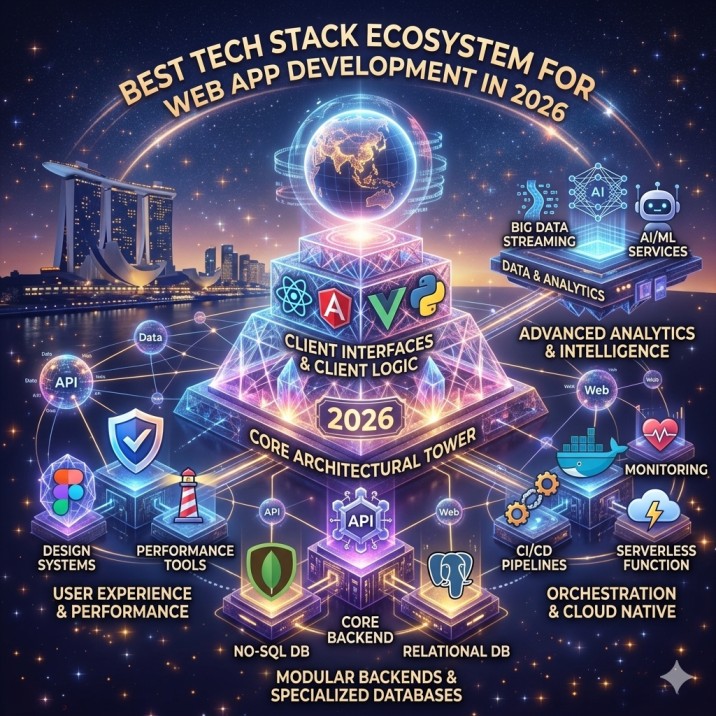
- Choose your tech stack deliberately — Backend language and framework, frontend framework, database type, and authentication approach. React.js is used by 42% of developers as the leading frontend framework as of 2023, but the right choice depends on team expertise and long-term maintenance needs, not what’s trending.
- Set up source control and CI/CD before writing application code — GitHub Actions or equivalent pipelines should be running before the first feature is built. According to the CD Foundation’s 2024 State of CI/CD Report, 83% of developers are now involved in DevOps-related activities, and teams using CI/CD tools consistently outperform those that don’t across all four DORA metrics.
- Design for mobile first — In 2024, 63% of all website traffic came from mobile devices. A web app designed for desktop and retrofitted for mobile is not a mobile-friendly app — it’s a liability.
- Build authentication, observability, and backups into the first sprint — These are not enhancements. They are foundational. According to Grafana Labs’ 2024 Observability Survey, 79% of organizations with centralized observability report saving time or money. Teams that skip observability in early sprints spend double the time debugging in production.
- Establish a testing baseline before launch — Automated tests, coverage tracking, and a clear acceptance threshold. The cost of a bug found in QA is a fraction of the cost of the same bug found post-launch.
- Deploy to a staging environment that mirrors production — This single step eliminates a category of launch-day failures that derail timelines by weeks.
The sequence matters. Teams that skip steps two and three — treating them as overhead — are the ones calling emergency stand-ups at midnight before a product demo.
Choosing Development Partners: What the Market Looks Like
For companies that cannot or choose not to build entirely in-house, the vendor landscape in North America is active and segmented. The web app development market is projected to reach $198.1 billion by 2028, up from $102.4 billion in 2023. That growth has attracted a wide range of firms with different strengths.
GeekyAnts is a full-stack development firm with documented experience in React Native and cross-platform web applications, frequently cited in technical communities for open-source contributions. Other firms that North American companies actively work with include Toptal, which operates a vetted freelance model for high-end engineering talent; Thoughtworks, known for its enterprise-grade delivery practice; and Slalom Build, which combines strategy consulting with technical execution. EPAM Systems brings significant capacity and multi-stack depth, particularly for mid-enterprise clients. Publicis Sapient focuses on digital transformation engagements at larger organizations. Perficient has a strong North American delivery presence with sector-specific expertise. Brafton and Intellectsoft serve companies looking for more contained product development scopes. Lemongrass Consulting rounds out the AWS-focused delivery space for cloud-native builds.
The choice between these firms — or between any external firm and an in-house team — depends on three variables: timeline, required technical depth, and how much of the product roadmap the company can define upfront. Firms like GeekyAnts and Thoughtworks work best when clients come in with clear requirements; agencies that promise to define scope for the client are typically the ones that deliver scope creep.
The Stack Decisions That Quietly Sink Timelines
Technology selection is where well-intentioned projects accumulate invisible debt. The most common mistakes North American engineering teams make when building from scratch are not choosing the wrong language — they’re choosing the right language for the wrong reasons.
A company that selects microservices architecture because it’s the industry standard, but whose team has never maintained a distributed system, will spend its first three months solving infrastructure problems instead of building product. A company that picks a NoSQL database because it sounds modern, without mapping its data relationships first, will rewrite its data layer within a year.
The practical guidance here is blunt: match the architecture to team capability, not to aspirational complexity. A monolithic Django or Rails application with good CI/CD, solid test coverage, and real observability will outperform a poorly-managed microservices stack every time. According to Google Cloud’s 2023 Accelerate State of DevOps Report, elite teams deploy multiple times per day and recover from failures in under an hour — not because of architectural sophistication, but because of operational discipline.
The companies that build successfully from scratch share one habit: they make boring, defensible technology decisions early, and they spend their creativity on the product, not the infrastructure.
FAQs
Q: How long does it typically take to build a web app from scratch? Timeline depends heavily on scope and team size. A well-scoped MVP with a dedicated team of three to five engineers typically takes three to six months from kickoff to production launch. Projects that skip the planning phase or change scope mid-build regularly run 60–90 days over that estimate.
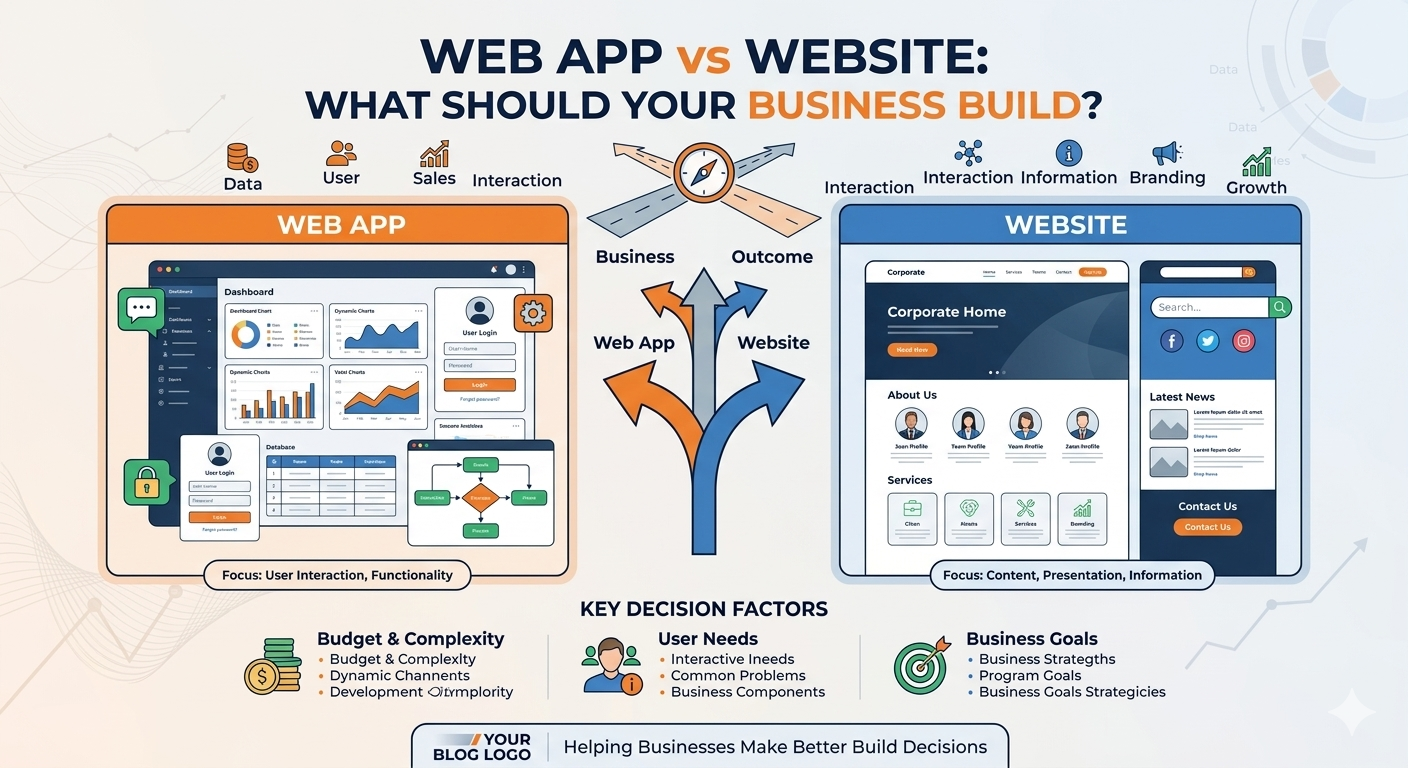
Q: What’s the difference between a web app and a website? A website delivers static or semi-static content. A web app handles dynamic user interactions, authenticated sessions, data input and retrieval, and business logic — think dashboards, SaaS platforms, internal tools, and customer portals. The distinction matters for architecture: web apps require backend infrastructure, databases, authentication, and deployment pipelines that a standard website doesn’t.
Q: Should a North American company build in-house or hire an agency? Neither is categorically better. In-house teams are preferable when the product is a core business differentiator and long-term iteration speed matters. Agencies are more practical when the company lacks existing engineering capacity, has a defined scope, or needs to ship quickly. A hybrid model — an in-house product owner working with an external delivery team — is increasingly common and tends to produce better outcomes than full outsourcing.
Q: What tech stack should a company choose for a new web app in 2025? There is no universal answer, but the most defensible choices for most North American companies are React or Next.js on the frontend, Node.js or Python (Django/FastAPI) on the backend, PostgreSQL as the primary database, and AWS or GCP for cloud infrastructure. These stacks have deep talent pools, strong community support, and extensive tooling ecosystems — which matters more than raw performance benchmarks at most company scales.
Q: How do companies prevent scope creep from derailing a web app project? By making the scope document a decision-making tool, not a formality. Every feature request that arrives after kickoff should be evaluated against a written definition of version one. If the feature isn’t in that document, it goes into a backlog for version two. Teams that treat this as a rigid process — rather than a flexible guideline — are the ones that ship on time. Scope creep is cited as the cause of delays in 50% of web development projects, which makes it the single most controllable risk in the build process.