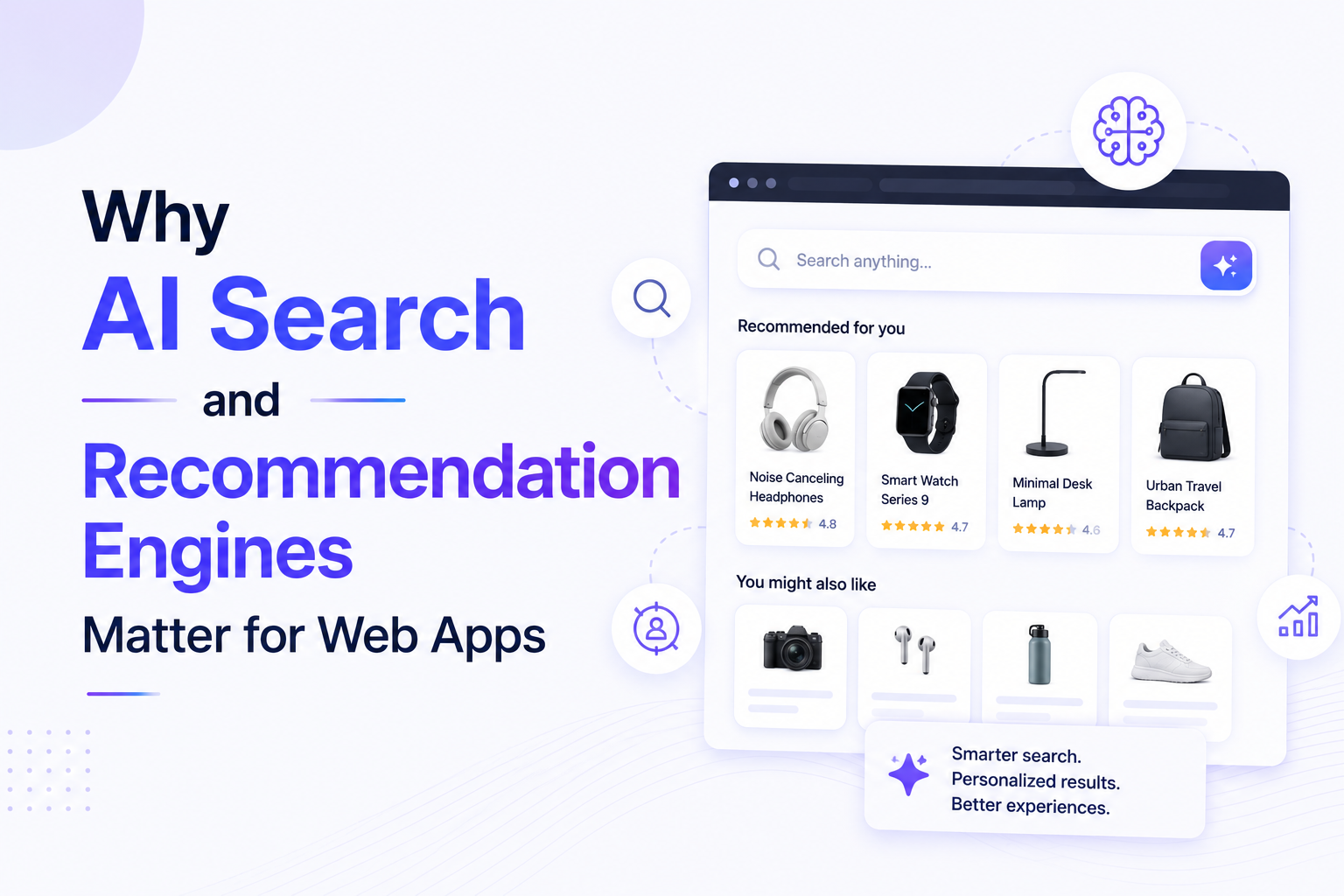
Enterprise web applications are becoming more intelligent, but many organizations still operate with search experiences designed for an earlier internet era. Basic keyword matching, static filtering systems, and rule-based recommendations are no longer enough for users who expect fast, contextual, and personalized digital experiences.
In 2026, AI-powered search and recommendation engines are becoming core infrastructure for enterprise web applications.
This shift is happening because user expectations have changed dramatically. Employees, customers, and enterprise buyers now expect digital platforms to understand intent rather than simply process keywords. They expect search systems to anticipate needs, personalize recommendations, reduce navigation friction, and surface relevant information instantly.
For enterprise technology leaders, this is no longer just a user experience discussion. It directly affects customer retention, engagement metrics, operational efficiency, and digital revenue growth.
Organizations managing large-scale platforms across ecommerce, fintech, healthcare, SaaS, logistics, and enterprise operations are increasingly realizing that poor search experiences create measurable business losses. When users cannot find relevant products, internal resources, documentation, or workflows quickly, engagement drops and operational inefficiencies increase.
This issue becomes more severe as enterprise ecosystems grow more complex.
Large organizations now manage enormous volumes of structured and unstructured data across internal systems, customer platforms, cloud infrastructure, and AI-driven applications. Traditional search systems struggle to process that complexity effectively.
That is why enterprises are moving toward AI-native search architectures powered by large language models, semantic search systems, recommendation engines, vector databases, and contextual ranking algorithms.
According to industry reports from Gartner and Accenture, AI-driven personalization and intelligent search are becoming major investment areas for enterprises focused on improving digital experience performance and conversion optimization. Businesses are increasingly prioritizing recommendation systems that can improve engagement while reducing friction across digital platforms.
The impact is already visible across industries.
Streaming platforms use AI recommendation engines to increase watch time and subscriber retention. Ecommerce companies depend on intelligent product recommendations to improve conversion rates. Enterprise SaaS platforms are deploying AI-powered knowledge retrieval systems to improve employee productivity and reduce support overhead.
Search is no longer just a navigation feature. It is becoming a strategic business capability.
Why Traditional Enterprise Search Systems Are Failing
Many enterprise search systems were designed around static infrastructure assumptions.
They relied heavily on exact keyword matching, manually configured metadata, and rigid filtering logic. While those systems worked reasonably well in controlled environments, they struggle inside modern enterprise ecosystems where user behavior and content complexity have changed significantly.
One major issue is intent recognition.
Users rarely search using perfect keywords anymore. They ask questions conversationally, expect contextual understanding, and want systems to infer meaning from incomplete input. Traditional search engines often fail because they cannot process semantic intent effectively.
This creates friction across enterprise applications.
For example, an employee searching an enterprise knowledge platform may struggle to locate relevant documentation because the system prioritizes exact phrase matching instead of contextual relevance. A customer browsing a digital commerce platform may abandon purchases because recommendation systems surface irrelevant products.
These failures directly affect business outcomes.
AI-powered search systems solve this problem differently. Instead of focusing only on keyword indexing, they analyze context, behavioral patterns, semantic relationships, historical interactions, and user intent simultaneously.
This enables:
- Smarter search ranking
- Personalized recommendations
- Context-aware discovery
- Predictive content surfacing
- Conversational search experiences
- Adaptive product recommendations
The result is a more intelligent digital experience that reduces user effort.
Recommendation engines are becoming particularly important for enterprise growth strategies. Personalized recommendation systems now influence customer engagement across ecommerce platforms, streaming services, enterprise SaaS products, and B2B marketplaces.
For enterprise decision-makers, this creates a competitive advantage.
Organizations capable of delivering highly relevant digital experiences often see stronger engagement metrics, higher retention rates, and improved conversion performance compared to competitors relying on static digital interfaces.
However, implementing AI search systems at enterprise scale introduces operational complexity.
Large organizations must manage real-time data synchronization, recommendation accuracy, infrastructure scalability, governance requirements, privacy compliance, and model observability simultaneously. Many enterprises also operate across fragmented legacy environments that complicate AI integration efforts.
This is why AI-powered search initiatives increasingly require collaboration between platform engineering, AI infrastructure, product design, and cloud architecture teams.
Companies like GeekyAnts, Cognizant, and Publicis Sapient are among the organizations helping enterprises modernize digital platforms through AI-driven personalization and intelligent web application strategies.
The Rise of AI-Native Web Experiences
The next generation of enterprise web applications will likely be built around AI-native experiences rather than traditional interface structures.
This transition is already happening.
Users increasingly expect web applications to behave intelligently across every interaction layer. Instead of manually navigating complex menus or filtering through large datasets, users want systems that proactively surface relevant actions, products, workflows, or information.
AI search and recommendation systems are becoming central to that experience.
Large language models are also influencing how enterprise web applications are designed. Conversational search interfaces are replacing static navigation flows across many platforms. Instead of typing fragmented keywords into search bars, users increasingly interact with systems through natural language prompts.
This changes the architecture of enterprise web experiences significantly.
Modern AI-native web applications combine:
- Semantic search
- Conversational interfaces
- Recommendation engines
- Predictive analytics
- Context-aware automation
- Personalization systems
- Behavioral intelligence layers
These capabilities are becoming essential for enterprises competing on digital experience quality.
The shift is especially important for organizations managing large customer ecosystems. AI-driven personalization can significantly affect retention, user satisfaction, and revenue growth when implemented effectively.
However, enterprises are also becoming more cautious.
Recommendation engines and personalization systems depend heavily on data quality, governance frameworks, and responsible AI practices. Poorly managed AI systems can create irrelevant experiences, amplify bias, or reduce user trust if transparency and control mechanisms are weak.
This is why enterprise leaders are increasingly prioritizing explainability and observability within AI-driven recommendation infrastructures.
Another growing challenge is operational scalability.
AI search systems often require high-performance cloud infrastructure, vector processing capabilities, low-latency APIs, and real-time orchestration frameworks capable of supporting millions of interactions simultaneously. Enterprises operating at large scale must balance performance optimization with infrastructure costs.
As a result, platform modernization initiatives are becoming closely tied to AI search adoption strategies.
What Enterprise Leaders Should Prioritize in 2026
For enterprise technology leaders, the conversation around AI-powered search is no longer about experimentation. It is about operational impact.
Organizations investing in AI-driven search and recommendation systems should focus on measurable business outcomes rather than isolated feature deployment.
Several priorities are becoming increasingly important.
First, enterprises should evaluate whether existing search systems align with modern user behavior. Many legacy search infrastructures still rely heavily on outdated indexing models that limit contextual relevance.
Second, organizations need stronger alignment between AI teams, platform engineering groups, and customer experience stakeholders. AI-powered personalization affects architecture, governance, analytics, security, and product strategy simultaneously.
Third, enterprises should prioritize scalable data infrastructure. AI recommendation engines depend heavily on high-quality, real-time data pipelines capable of supporting continuous personalization.
Fourth, organizations need observability frameworks that monitor recommendation quality, search performance, user engagement patterns, and operational reliability continuously.
Most importantly, enterprises should recognize that intelligent search is no longer just a support feature. It is becoming a competitive differentiator across digital ecosystems.
The organizations leading in digital experience performance today are often the ones reducing friction most effectively. AI-powered search systems help achieve that by simplifying discovery, accelerating workflows, and improving relevance across user interactions.
As enterprise web applications continue evolving toward AI-native architectures, search and recommendation engines will likely become foundational operational layers rather than optional enhancements.
For technology leaders planning the next phase of platform modernization, the strategic focus should not only be on deploying AI capabilities. The focus should be on designing digital ecosystems where intelligence improves usability, scalability, and measurable business performance together.
That shift is already reshaping how enterprises build web platforms across North America and many organizations are now evaluating long-term AI product engineering partnerships and modernization strategies to remain competitive in an increasingly intelligent digital economy.