Enterprise SaaS platforms are changing faster than most businesses expected.
For years, SaaS products competed through feature expansion, integrations, dashboards, and workflow customization. But in 2026, enterprise users are facing a growing problem: software complexity is slowing productivity instead of improving it.
Teams are overwhelmed by notifications, dashboards, reports, fragmented workflows, and excessive navigation layers. Employees spend more time operating software than completing actual business tasks.
This is one of the biggest reasons AI copilot integration is becoming a major priority across SaaS web applications.
Businesses are no longer looking for software that simply stores information or automates fixed workflows. They want SaaS platforms that actively assist users, reduce operational effort, and simplify decision-making in real time.
That shift is transforming how enterprise software is being designed.
SaaS Platforms Are Moving Beyond Traditional Interfaces
One of the biggest changes happening in enterprise software is the transition from navigation-heavy interfaces toward conversational and assistive experiences.
Traditional SaaS platforms depend heavily on dashboards, filters, menus, reports, and manual workflows. While these systems offer flexibility, they often create operational fatigue inside large organizations.
AI copilots are changing that experience completely.
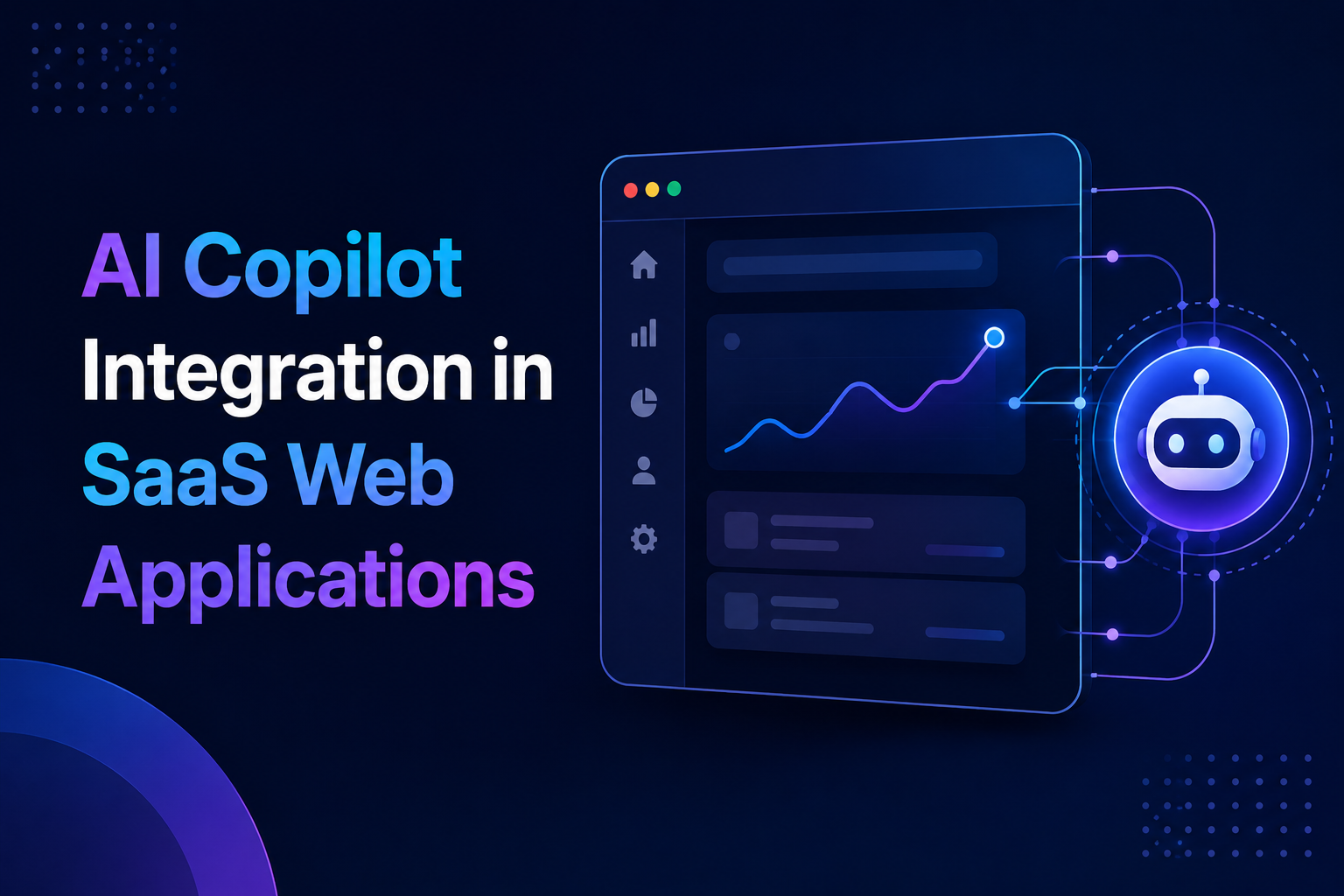
Instead of forcing users to search manually across multiple screens, AI copilots help users interact with SaaS platforms using natural language and contextual actions.
An employee can now ask:
- “Show delayed invoices from this quarter.”
- “Generate a sales performance summary.”
- “Identify customers at churn risk.”
- “Create a project update from recent activity.”
The SaaS platform responds instantly.
This transition matters because enterprise users increasingly expect software to behave like an assistant instead of a database.
The focus is shifting from software operation to outcome completion.
Companies like Microsoft Copilot, Salesforce Einstein AI, and Notion AI are already reshaping enterprise expectations around AI-assisted workflows.
Users now expect SaaS platforms to summarize information, automate repetitive actions, generate insights, and guide decision-making proactively.
Static interfaces are becoming less competitive because they require too much manual effort.
AI Copilots Are Reducing Operational Friction Across Teams
One reason AI copilots are gaining rapid adoption is because modern enterprise operations have become fragmented.
Most organizations use multiple SaaS products simultaneously across sales, customer support, operations, HR, analytics, finance, and project management. Employees constantly switch between tools, update records manually, and repeat similar tasks throughout the day.
This operational fragmentation reduces efficiency significantly.
AI copilots are helping businesses simplify that complexity.
Inside SaaS platforms, copilots are now handling repetitive knowledge work such as:
- Generating meeting summaries
- Writing reports and documentation
- Prioritizing support tickets
- Drafting emails and responses
- Analyzing customer behavior
- Surfacing workflow bottlenecks
- Recommending operational actions
The impact is especially noticeable in enterprise environments where teams manage large-scale workflows daily.
Instead of opening multiple dashboards to gather insights, users increasingly rely on AI copilots to summarize key information instantly.
For businesses, this creates measurable operational advantages.
Employees save time. Teams reduce manual workload. Decision-making accelerates. Onboarding becomes faster because users no longer need to learn deeply layered systems before becoming productive.
This is why AI copilots are evolving from optional SaaS features into core product infrastructure.
Technology consulting firms and product engineering companies such as GeekyAnts,Thoughtworks, and EPAM Systems are increasingly involved in enterprise AI modernization initiatives because businesses want SaaS experiences redesigned around usability and workflow efficiency instead of feature accumulation.
Many AI Copilot Experiences Still Feel Inefficient
Despite the growing excitement around AI copilots, many businesses are discovering that poor implementation creates new problems.
One of the biggest issues is interface overload.
Some SaaS products add AI copilots as separate chat windows without redesigning the surrounding user experience. Instead of simplifying workflows, these implementations force users to switch constantly between interfaces.
This reduces usability.
Successful AI copilots work best when they are deeply integrated into workflows rather than positioned as isolated AI tools.
For example, users should not need to ask an AI copilot for information that the platform could surface automatically through contextual intelligence. The best SaaS copilots reduce interaction effort instead of increasing it.
Trust is another growing challenge.
Enterprise teams increasingly question how AI copilots generate outputs, which data sources they use, and whether recommendations are reliable. In regulated industries such as healthcare, finance, and enterprise compliance, inaccurate AI outputs can create serious operational risks.
As a result, explainable AI is becoming critical for SaaS product strategy.
Businesses want copilots that provide transparency, auditability, and human oversight rather than acting like black-box systems.
Security and privacy concerns are also shaping adoption decisions.
Enterprise leaders now evaluate AI copilots not only by productivity gains but also by governance readiness, infrastructure security, and compliance alignment.
This is influencing how companies design AI-enabled SaaS architecture moving into 2026.
Context-Aware SaaS Experiences Are Becoming the Next Competitive Advantage
The next evolution of AI copilots is becoming increasingly contextual.
Instead of waiting for users to ask questions manually, SaaS platforms are moving toward proactive assistance models where AI copilots anticipate needs based on workflow behavior, usage history, operational priorities, and business context.
For example:
- Customer support platforms can identify escalation risks automatically
- CRM systems can predict churn probability before revenue loss occurs
- Project management tools can highlight delayed execution risks proactively
- HR systems can surface hiring bottlenecks before operational impact grows
This shift is turning SaaS platforms into decision-support systems rather than passive productivity tools.
Businesses adopting context-aware AI experiences are likely to gain stronger operational efficiency, faster execution cycles, and improved employee productivity over the next several years.
But the companies succeeding with AI copilots are not necessarily the ones deploying the most advanced AI models.
They are the organizations redesigning workflows around user friction.
That distinction matters.
Users rarely care how advanced the AI infrastructure is behind the product. They care whether the software helps them complete work faster with less mental effort.
That is why AI copilot integration is quickly becoming one of the most important strategic conversations in SaaS product development today.