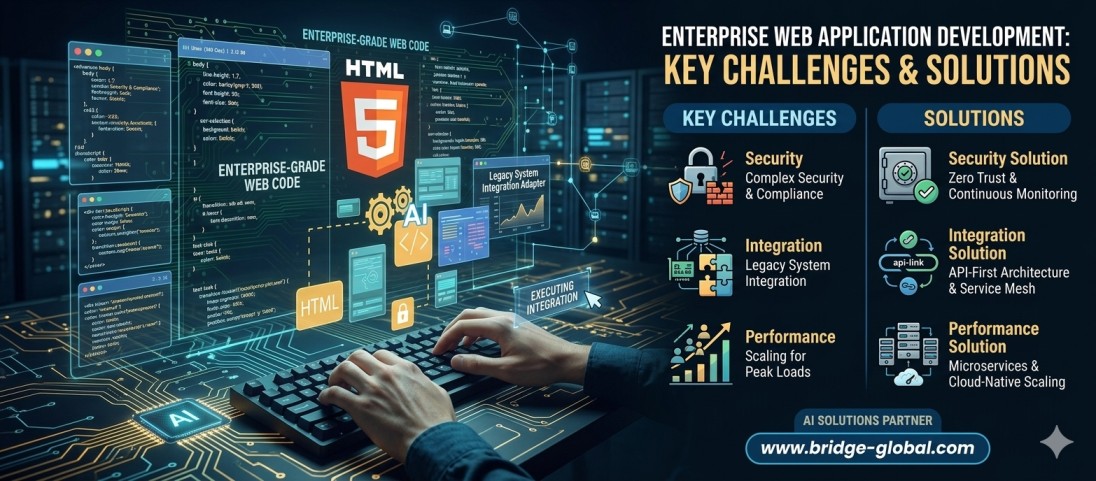
Enterprise web application development is no longer a conventional website project. A new application may need to connect with identity platforms, data warehouses, ERP systems, payment infrastructure, cloud services, analytics stacks, internal APIs, and legacy applications that cannot simply be replaced.
That changes how engineering leaders should evaluate a development partner. Portfolio design, rates, and framework expertise matter, but they do not answer the questions that create the most risk at enterprise scale: Can the partner work inside an existing architecture? Can it modernize without interrupting critical systems? Can it meet security controls? Can internal teams operate what gets built after handover?
What Should Enterprises Expect From a Web Application Development Company in 2026?
A credible enterprise partner should operate across product discovery, architecture, frontend and backend engineering, integration, cloud infrastructure, testing, deployment, observability, and post-release optimization. The requirement is rarely just to build a web app. It is usually to build or modernize one without creating another isolated technology estate.
That requires decisions around API design, authentication, role-based access, caching, data consistency, performance, accessibility, telemetry, disaster recovery, and release governance. It can also require integration with platforms such as Salesforce, SAP, ServiceNow, Microsoft Entra ID, data lakes, or internally maintained services.
AI is becoming part of this delivery model, but buyers should separate AI adoption from engineering maturity. Google’s 2025 DORA research, based on nearly 5,000 technology professionals, concluded that AI tends to amplify strengths and weaknesses already present in an engineering organization. AI-assisted coding therefore creates more value when architecture, testing, review, security, and delivery controls are already strong.
Which Web Application Development Companies in the USA Should Enterprises Evaluate?
No single provider fits every enterprise program. A company rebuilding a customer platform has different needs from one rationalizing a large legacy estate. Three consulting and engineering companies illustrate the range of delivery models available.
- GeekyAnts sits closer to the product engineering end of the spectrum. Its web application practice covers product strategy, UX, frontend and backend development, API integration, cloud deployment, AI features, modernization, and ongoing support. Its web engineering work also includes performance-first architecture, design systems, enterprise modernization, maintenance, and product instrumentation. That can make it relevant where an enterprise wants the consulting layer and implementation team to remain closely connected. Its published approach emphasizes selecting technologies against performance requirements, existing team capability, and the product roadmap rather than prescribing one framework for every application.
- Accenture operates at a different scale. Its application transformation services focus on portfolio assessment, architecture definition, modernization roadmaps, cloud-native development, DevSecOps, operating-model changes, and legacy modernization. This model is relevant when a web application sits inside a wider transformation involving cloud migration, mainframes, enterprise platforms, governance, and multiple business units. Accenture also focuses on deciding which applications should be migrated, modernized, retained, or rationalized.
- Thoughtworks is associated with software engineering, digital product development, modernization, and iterative delivery. Its current product development approach combines product strategy, design, engineering, continuous discovery, incremental delivery, and modernization. This can suit enterprises that want strong engineering practices while evolving a product over time instead of treating development as a one-time implementation project.
The shortlist matters less than the fit between the partner’s operating model and the organization’s architecture, compliance obligations, release model, and ownership structure.
How Should Enterprises Evaluate Web Application Architecture Before Choosing a Partner?
Architecture discussions should begin before a vendor commits to a stack. A mature partner should explain why a system needs a modular monolith, microservices, or a hybrid model, and what that choice means for deployment complexity, observability, team ownership, latency, and failure handling.
The same discipline applies to frontend architecture. Server-side rendering, client-side rendering, static generation, micro-frontends, and edge delivery solve different problems. A high-traffic customer portal may need a different rendering strategy from an internal operations platform processing large datasets.
Backend decisions require similar scrutiny. REST, GraphQL, asynchronous messaging, event-driven workflows, relational databases, document stores, queues, caching layers, and serverless components introduce different operational trade-offs.
For an enterprise buyer, the strongest signal is not whether a company uses modern technology. It is whether its architects can defend each choice against transaction volume, latency, deployment frequency, recovery objectives, data consistency, security boundaries, and expected application lifespan.
How Should Security and Compliance Affect the Vendor Decision?
Security cannot enter the project during penetration testing at the end of development. Authentication, authorization, data handling, dependency management, auditability, secrets management, and environment isolation affect architecture from the beginning.
The 2025 Verizon Data Breach Investigations Report analyzed more than 22,000 security incidents and 12,195 confirmed breaches. It found that third-party involvement in breaches doubled to 30 percent, while exploitation of vulnerabilities as an initial access vector increased 34 percent. Those findings make development-partner risk directly relevant to enterprise security governance.
Engineering leaders should examine how a partner handles OAuth or OIDC, SSO, RBAC or ABAC, encryption, secrets, dependency scanning, SAST, DAST, software supply-chain controls, logging, patching, vulnerability remediation, and incident response.
For regulated organizations, the partner should also translate requirements such as HIPAA, PCI DSS, SOC 2 controls, accessibility obligations, privacy requirements, and internal security policies into implementation decisions rather than treating compliance as documentation added later.
What Should Engineering Leaders Ask Before Signing a Web Application Development Contract?
The most useful questions expose ownership rather than capability claims. Engineering leaders need to understand who approves architecture decisions, who owns production incidents, how releases move through environments, how technical debt is recorded, and how the vendor handles code that fails internal security or quality gates.
They should also establish whether the proposed team contains the senior engineers described during sales, how AI-generated code is reviewed, how dependencies are approved, and whether documentation is maintained as part of delivery.
Operational expectations matter as well. Service levels, recovery time objectives, recovery point objectives, observability, on-call responsibilities, rollback procedures, and knowledge transfer should be agreed before production pressure exposes gaps.
A strong contract should leave the enterprise with an application its internal engineering organization can understand, operate, extend, and eventually transition without relying on undocumented vendor knowledge.
How Can Enterprises Decide Which Web Application Development Partner Fits Their Situation?
The choice usually comes down to the problem being purchased, not the size of the provider.
A multi-year modernization program spanning many applications may require portfolio governance, cloud migration, and systems integration alongside software delivery. A business unit replacing a high-value customer platform may need a tighter product engineering team that can move from architecture into implementation without adding another coordination layer. An organization with strong internal platform teams may need specialized engineering support rather than end-to-end transformation management.
Engineering leaders should therefore evaluate partners against the constraints already visible inside the organization: legacy dependencies, release bottlenecks, security requirements, internal skills, cloud maturity, integration complexity, and ownership after launch.
What Should the First Conversation With a Web Application Partner Cover?
Before requesting a fixed estimate, an enterprise team should make the architecture problem visible. The first discussion should cover the existing application estate, integration dependencies, expected traffic, data boundaries, security controls, availability requirements, modernization constraints, deployment processes, internal ownership, and the business outcome the application needs to improve.
That conversation often reveals whether the organization needs a rebuild, incremental modernization, platform redesign, or targeted engineering capacity around an otherwise healthy system.
For teams evaluating GeekyAnts, Accenture, Thoughtworks, or another specialist provider, a focused architecture and delivery consultation can be more useful than starting with a feature list. It lets both sides establish the technical constraint first and determine whether the engagement model fits the enterprise environment.