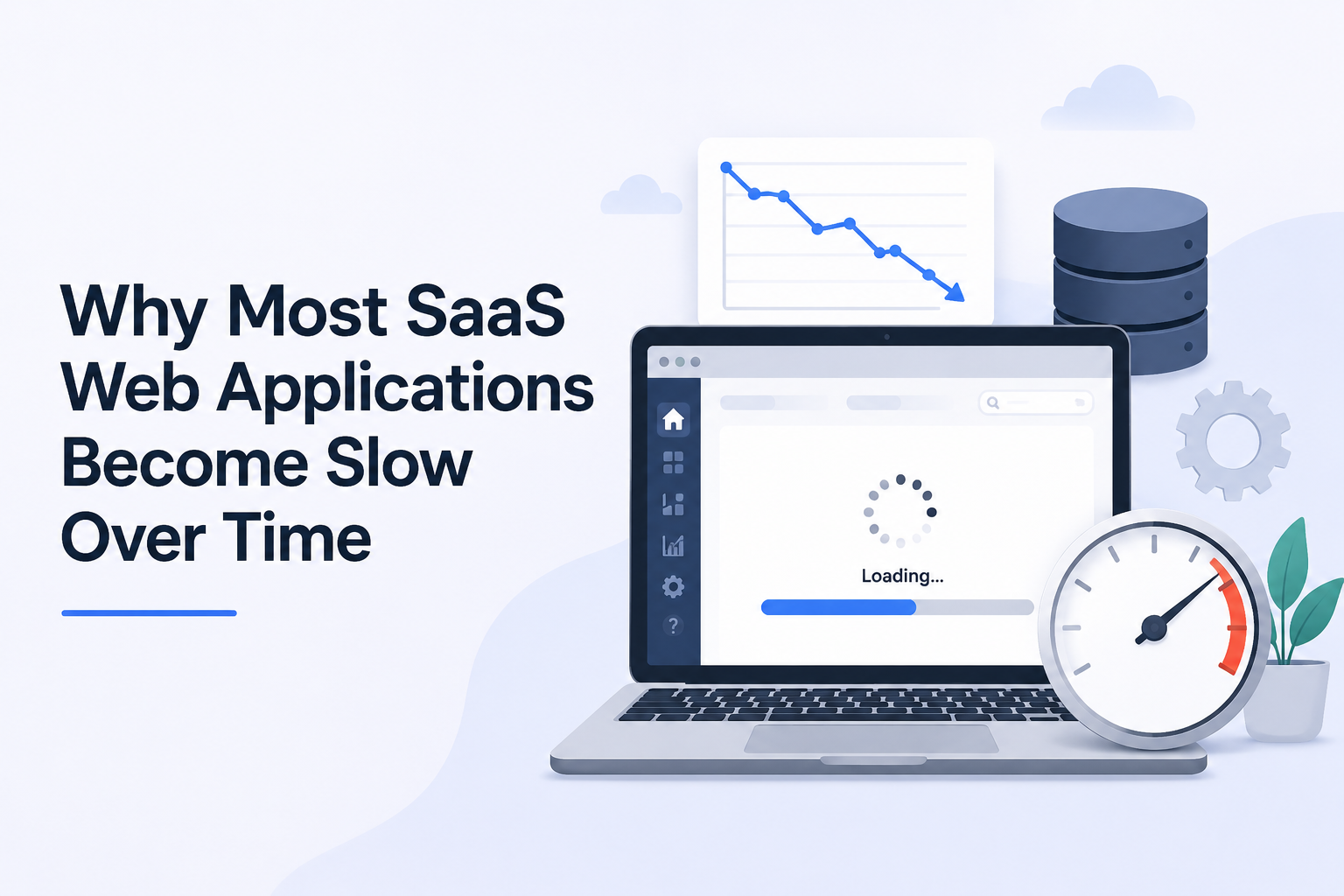
Enterprise SaaS platforms are growing more complex every year. Across North America, organizations continue expanding digital ecosystems to support customer engagement, operational workflows, analytics environments, AI integrations, and distributed enterprise teams. However, as SaaS platforms scale, many enterprises encounter the same operational problem: applications that initially felt fast and responsive gradually become slower, heavier, and more difficult to maintain.
For enterprise technology leaders, this is no longer just a technical inconvenience. SaaS performance directly affects customer retention, employee productivity, infrastructure costs, platform adoption, and long-term digital transformation outcomes. Even small delays in application responsiveness can reduce user engagement, slow workflow completion, and increase customer dissatisfaction across enterprise environments.
According to Google research, page responsiveness and load performance significantly influence user behavior and conversion outcomes across digital platforms. Gartner and Forrester industry analyses also continue highlighting application performance as a growing enterprise concern as organizations scale cloud-native ecosystems and AI-powered services simultaneously.
The problem is that most SaaS platforms are not originally designed for the operational complexity they eventually reach.
Many enterprise applications launch successfully during early growth stages because user bases remain relatively manageable and engineering environments are still simple. Over time, however, organizations continuously add features, integrations, third-party services, analytics layers, AI functionality, security controls, and personalization systems. Each new capability increases architectural complexity, infrastructure consumption, and frontend overhead.
Eventually, performance degradation becomes unavoidable unless organizations actively prioritize scalability and optimization from the beginning.
The challenge for enterprise leaders is that SaaS slowdowns rarely happen all at once. Performance erosion happens gradually across APIs, frontend rendering, cloud infrastructure, databases, and workflow orchestration layers. By the time performance issues become highly visible to customers or employees, operational complexity has often already expanded significantly.
Rapid Scaling Often Creates Hidden Technical Debt
One of the biggest reasons SaaS applications slow down over time is uncontrolled technical debt accumulation. Many enterprise engineering teams operate under constant pressure to release new features, improve competitive positioning, and support evolving business requirements quickly. Speed often becomes the primary success metric during growth phases.
As a result, long-term architectural optimization gets delayed repeatedly.
This creates environments where multiple systems, frameworks, and integrations evolve independently without strong platform standardization. Over time, SaaS ecosystems become increasingly fragmented, making performance optimization more difficult and operationally expensive.
Several common patterns contribute to SaaS slowdowns:
- Excessive third-party API dependencies.
- Poor frontend state management.
- Unoptimized database queries.
- Redundant backend services.
- Legacy code accumulation.
- Inconsistent cloud resource allocation.
Many enterprises also underestimate how rapidly frontend complexity grows as products mature. SaaS applications often begin with relatively focused workflows but gradually expand into large operational ecosystems supporting analytics dashboards, collaboration systems, AI tools, notifications, integrations, and real-time processing environments.
Each additional layer increases browser workload, API communication overhead, and rendering complexity.
This becomes especially problematic in enterprise environments where users frequently operate across multiple dashboards, large datasets, and highly interactive workflows simultaneously. Even small inefficiencies in frontend architecture can compound significantly at scale.
At the same time, feature prioritization frequently overshadows performance optimization initiatives. Product teams often focus heavily on delivering visible capabilities because those improvements are easier to measure commercially. Performance engineering, however, usually remains less visible until operational problems become severe enough to affect user retention or infrastructure stability.
This imbalance is one reason many enterprise SaaS platforms eventually struggle with scalability despite strong early adoption.
Frontend Complexity Is Becoming a Major Performance Bottleneck
Modern SaaS platforms increasingly rely on highly dynamic frontend architectures involving real-time analytics, AI-driven personalization, live collaboration systems, and interactive dashboards. While these capabilities improve functionality, they also create significant performance challenges.
Frontend performance is now directly connected to business outcomes.
Users expect enterprise applications to feel as responsive as consumer-grade platforms such as Notion, Slack, Figma, Spotify, or ChatGPT. Unfortunately, many enterprise SaaS products still operate on frontend systems that were never optimized for modern interaction demands.
Large JavaScript bundles, excessive client-side rendering, fragmented component systems, and inefficient state synchronization often reduce responsiveness significantly. As applications grow, browser memory usage and rendering latency increase steadily.
This creates noticeable workflow friction.
Users may experience:
- Slower dashboard loading times.
- Delayed search responses.
- Laggy interactions.
- Freezing during high-data operations.
- Poor mobile responsiveness.
- Inconsistent cross-platform experiences.
These issues directly affect operational efficiency inside enterprise environments where employees rely heavily on digital workflows to complete time-sensitive tasks. Even small delays repeated across thousands of daily interactions can reduce productivity substantially over time.
Another growing challenge is AI integration. Many SaaS platforms are rapidly embedding AI-powered assistants, predictive systems, intelligent search environments, and automation workflows into existing architectures. While these capabilities improve functionality, they also introduce additional API traffic, inference processing, real-time orchestration demands, and backend coordination complexity.
Without strong optimization strategies, AI features can unintentionally increase application latency instead of improving user experience.
This is why many organizations are shifting toward performance-first engineering models where scalability, frontend optimization, and observability become continuous priorities rather than reactive initiatives.
Across the enterprise technology landscape, engineering consultancies and digital modernization firms such as Thoughtworks, Globant, and GeekyAnts are increasingly helping enterprises modernize SaaS ecosystems through scalable frontend architectures, cloud-native optimization strategies, and long-term platform engineering initiatives.
Cloud Infrastructure Complexity Is Expanding Rapidly
While frontend systems play a major role in SaaS slowdowns, infrastructure complexity is often the larger operational issue underneath the surface.
Many enterprises initially migrate toward cloud-native environments expecting unlimited scalability. However, cloud scalability depends heavily on architecture quality, observability maturity, workload optimization, and operational governance. Poorly optimized SaaS systems can become increasingly inefficient as usage grows.
This creates several enterprise-level challenges.
Rising infrastructure consumption often increases operational costs significantly over time. Inefficient APIs, redundant microservices, fragmented databases, and overprovisioned cloud environments can create substantial waste inside large SaaS ecosystems.
Latency becomes another major concern.
As enterprise platforms expand globally, distributed users expect consistent responsiveness across regions and devices. Applications relying on fragmented backend systems or overloaded orchestration layers frequently struggle to maintain low-latency experiences under scale.
Security and compliance requirements add another layer of complexity. Enterprise SaaS platforms operating across healthcare, finance, insurance, and regulated industries must maintain strict governance, auditability, and resilience standards while continuing to scale rapidly.
This operational pressure forces technology leaders to balance:
- Performance optimization.
- Cloud cost management.
- Scalability requirements.
- Security governance.
- AI infrastructure demands.
- Continuous feature delivery.
The organizations handling this transition successfully are typically the ones investing early in observability systems, infrastructure automation, scalable frontend architecture, and centralized platform engineering strategies.
Instead of treating performance issues as isolated technical problems, these enterprises approach scalability as a long-term operational discipline.
The Future of SaaS Will Depend on Performance Sustainability
The enterprise SaaS market is entering a new phase where performance quality is becoming a competitive differentiator rather than just a technical expectation. Users increasingly evaluate platforms based on responsiveness, reliability, workflow efficiency, and operational consistency instead of feature quantity alone.
This shift is changing enterprise product strategy significantly.
Organizations can no longer rely solely on rapid feature expansion if application performance continues declining over time. Customers and employees expect digital platforms to remain fast, scalable, and seamless regardless of ecosystem complexity.
For enterprise technology leaders, the challenge is no longer whether scalability matters. Most organizations already recognize the importance of performance optimization. The larger challenge is building SaaS ecosystems capable of evolving continuously without creating operational bottlenecks that slow growth later.
This requires stronger alignment between frontend engineering, cloud infrastructure, platform operations, AI integration strategies, cybersecurity, and digital product management.
Organizations that continue prioritizing short-term delivery speed over long-term platform sustainability will likely face rising infrastructure costs, weaker user engagement, and increasing operational instability over time. Meanwhile, enterprises investing in scalable engineering foundations, performance-first architectures, and observability-driven operations will be better positioned to support future growth efficiently.
Across industries, the conversation is shifting away from simple cloud adoption and toward sustainable SaaS scalability. Enterprises increasingly evaluate digital platforms based on infrastructure resilience, frontend responsiveness, operational efficiency, and long-term adaptability rather than launch momentum alone.
The broader industry lesson is becoming increasingly clear: most SaaS applications do not become slow because of one major failure. They become slow because operational complexity grows faster than the architecture designed to support it.