For enterprise technology leaders, the difference between a website and a web application is not just terminology. It affects architecture, security controls, engineering ownership, release processes, operating cost, and the risk attached to every change.
The traditional explanation is simple: a website primarily presents information, while a web application lets users perform tasks. That distinction still works, but it is incomplete for large organizations. A corporate site can include personalization, search, calculators, forms, and authenticated areas. A web application can also contain public, indexable content.
The more useful enterprise question is whether the browser experience only delivers content or whether it also maintains business state, processes transactions, enforces permissions, connects to core systems, and participates in operational workflows. Once those responsibilities appear, the platform needs to be treated as application software rather than only a publishing layer.
What Is the Real Difference Between a Website and a Web Application?
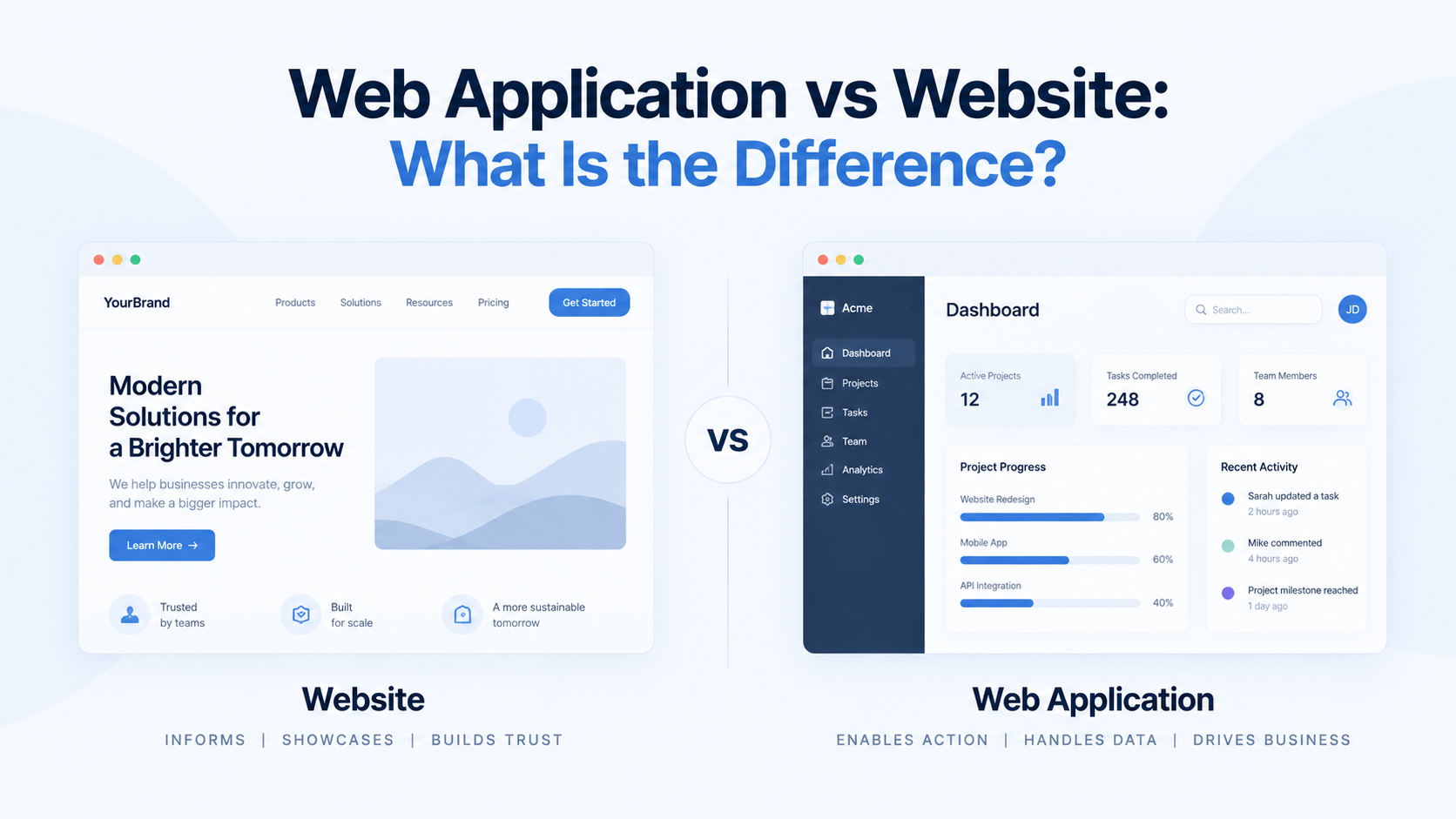
A website is usually content-led. Its primary job is to help visitors discover, understand, compare, or consume information. A product site, investor relations portal, documentation hub, or corporate website may be highly dynamic without becoming a full application.
A web application is task-led. It accepts user input, processes data, changes state, and returns results that depend on identity, permissions, stored data, or business logic. Online banking, claims portals, procurement systems, customer dashboards, workforce platforms, and SaaS products fit this model.
The distinction is therefore not based on frontend technology. React, Next.js, Angular, Vue, APIs, and cloud infrastructure can support either model. The difference lies in system responsibility.
Many enterprise platforms are hybrids. A financial services domain may contain public product pages for acquisition, a CMS for marketers, and an authenticated application for account servicing. They may share a domain and design system, but their security boundaries, performance priorities, architecture, and release controls differ.
Current search results often summarize the difference as websites providing information and web applications enabling interaction. GeeksforGeeks also distinguishes web applications through backend processing, authentication, data handling, and user actions.
How Do Websites and Web Applications Differ Technically?
A content-heavy website can often optimize for stateless delivery. Pages may be generated through static site generation or server-side rendering, cached at a CDN or edge layer, and backed by a headless CMS. Most requests can remain relatively simple because visitors often receive the same or similar content.
A web application carries more runtime responsibility. It may require authenticated sessions, token management, role-based or attribute-based access control, API gateways, databases, queues, event streams, WebSockets, background workers, and third-party integrations. The frontend becomes one component of a larger distributed system.
Rendering strategy also becomes more nuanced. Server-side rendering can improve initial delivery and search visibility for public routes. Client-side rendering can support highly interactive authenticated experiences. Hybrid frameworks let teams combine server rendering, static generation, hydration, and client-side components according to workload.
Performance matters in both models. The HTTP Archive 2025 Web Almanac reports a median desktop home page weight of 2.86 MB, including about 697 KB of JavaScript, while 98.1 percent of analyzed pages made at least one JavaScript request. For enterprise platforms, unnecessary client-side execution increases CPU work and makes performance regressions harder to isolate.
Google’s current Core Web Vitals guidance defines “good” performance at the 75th percentile as LCP of 2.5 seconds or less, INP of 200 milliseconds or less, and CLS of 0.1 or less. Applications must meet these expectations while also managing state, asynchronous requests, personalization, and complex UI transitions.
Why Does the Difference Matter for Enterprise Engineering Teams?
The biggest consequence is risk classification.
A content platform failure may hurt traffic, brand perception, or lead generation. A web application failure can interrupt revenue, block customer service, expose protected data, duplicate transactions, or stop an operational process. Engineering controls should reflect that difference.
Identity and authorization make the contrast clear. A public website may use authentication only for CMS administrators. A web application may require enterprise identity federation, multi-factor authentication, session expiry, fine-grained permissions, privileged workflows, audit logs, and policy enforcement across APIs. OWASP’s 2025 Top 10 keeps Broken Access Control in the number-one position. Its contributed data recorded more than 1.8 million occurrences associated with that category.
The operating model also changes. Application teams need observability across frontend errors, APIs, infrastructure, queues, databases, and dependencies. They need SLOs, incident response, rollback strategies, automated testing, dependency governance, secrets management, vulnerability remediation, and release telemetry.
Calling a customer portal “just a website” can therefore become expensive. The label can lead to underfunded testing, unclear security accountability, weak platform ownership, and modernization plans that focus on visual redesign while fragile business logic remains untouched.
When Should an Enterprise Build a Website, a Web Application, or Both?
The decision should follow the value the platform creates and the responsibilities it carries.
- A website-first architecture fits platforms where discovery and information distribution create most of the value. Corporate sites, documentation platforms, campaign ecosystems, publishing properties, and public knowledge centers benefit from strong CMS governance, accessibility, localization, structured content, server-rendered or statically generated pages, CDN caching, search optimization, and performance budgets. Engineering effort should center on content velocity, design-system consistency, resilience under traffic spikes, analytics quality, and minimizing unnecessary client-side code.
- A web application architecture fits platforms where users complete business tasks. If the experience authenticates customers, changes account state, processes payments, handles claims, modifies records, coordinates workflows, or provides role-specific dashboards, it needs application-grade controls. Architecture should account for API contracts, database consistency, idempotency, authorization, asynchronous processing, observability, recovery objectives, integration failure, and release isolation. In regulated environments, auditability and data handling requirements must be designed into the system.
- A hybrid architecture fits enterprises that must acquire users publicly and serve them transactionally after login. Public routes can use server rendering, static generation, edge caching, and CMS workflows, while authenticated routes can use richer client state, application APIs, domain services, and stricter security boundaries. Shared design systems can preserve consistency, while separate deployment boundaries reduce the chance that a content release affects a critical transaction path.
Which Approach Should Technology Leaders Take Before Modernizing a Web Platform?
Large organizations rarely start from a clean slate. The harder decision is determining what should remain, what should be separated, and what should be modernized incrementally.
A useful assessment maps public content, authenticated journeys, application state, API dependencies, data ownership, security boundaries, rendering patterns, traffic characteristics, SLOs, and release coupling. It should distinguish presentation problems from architectural ones. A slow customer portal may not need a frontend rewrite if latency originates in synchronous backend dependencies. A hard-to-update corporate site may not need microservices if the real constraint is its CMS model and deployment pipeline.
External consulting can help when the application estate crosses organizational boundaries. Among prominent consulting companies enterprises may evaluate, Accenture focuses on portfolio assessment, architecture definition, DevSecOps, and progressive modernization, while IBM Consulting emphasizes brownfield modernization, hybrid cloud, containerization, and incremental enhancement. GeekyAnts operates at a more product-engineering-focused layer, including enterprise web application modernization through frontend audits, modularization, and incremental migration patterns intended to keep live systems operational.
The important decision is not whether an organization “needs a website or a web app.” It is whether the platform behaves like content infrastructure, application infrastructure, or both, and whether its engineering model matches that reality.
Before funding another redesign, framework migration, or full rewrite, technology leaders can gain more value from a focused architecture review that identifies where business state lives, where risk concentrates, which dependencies slow delivery, and which components can be modernized independently. That conversation often provides a clearer modernization path than choosing a new technology stack first.