A web application can take a few months to more than a year to reach production. For enterprise teams, however, the useful question is not how long developers need to write the code. It is how long the organization needs to move from an approved idea to a secure, integrated, production-ready system.
Current industry estimates show the range. OTG Lab places a simple MVP at roughly 2 to 4 months, a mid-level application at 4 to 8 months, and a complex enterprise system at 6 to 12 months or more. Ramotion estimates 8 to 12 months or longer for highly complex applications, while Itransition reports 7 to 12 months or more for complex applications.
Those numbers are useful starting points, but enterprise delivery rarely fits neatly into a complexity label. A customer portal with 20 screens can take longer than a larger internal application if it must integrate with a mainframe, enforce several authorization layers, pass security review, migrate sensitive data, and support high availability.
For engineering leaders, timeline accuracy depends on identifying the application’s critical path before a launch date becomes a commitment.
What Actually Determines How Long a Web Application Takes to Build?
Feature count is only one variable. The biggest schedule risks often sit around the application rather than inside its visible interface.
- Architecture and integration complexity: A greenfield application with clean APIs can move quickly. An enterprise application that depends on ERP, CRM, payments, identity, data warehouses, event streams, or legacy services cannot. Teams may need API contracts, adapters, data-model reconciliation, retry logic, idempotency, and coordinated releases with upstream system owners. Microservices can add further operational overhead if service boundaries and ownership are unclear.
- Security, compliance, and data requirements: Authentication is rarely just a login screen. Enterprise systems may require SSO, OAuth or OIDC, role-based or attribute-based access control, audit trails, secrets management, encryption, retention policies, penetration testing, threat modeling, and cybersecurity approval. These controls need architecture and test coverage, not a final security check before release.
- Product and experience complexity: Multiple personas, workflow states, localization, accessibility, real-time updates, dashboards, large datasets, design systems, and responsive behavior all add engineering effort. One screen that changes by role, account type, jurisdiction, or workflow state can create a large testing matrix.
- Team and organizational dependencies: Adding engineers does not always shorten the critical path. Delivery also depends on architecture decisions, domain expertise, QA automation, platform readiness, stakeholder availability, procurement, security reviews, and other internal teams. More developers cannot remove delays caused by dependent teams or approval queues.
A useful estimate therefore starts with dependencies and non-functional requirements, then works backward into implementation effort.
How Much Time Does Each Stage of Web Application Development Usually Need?
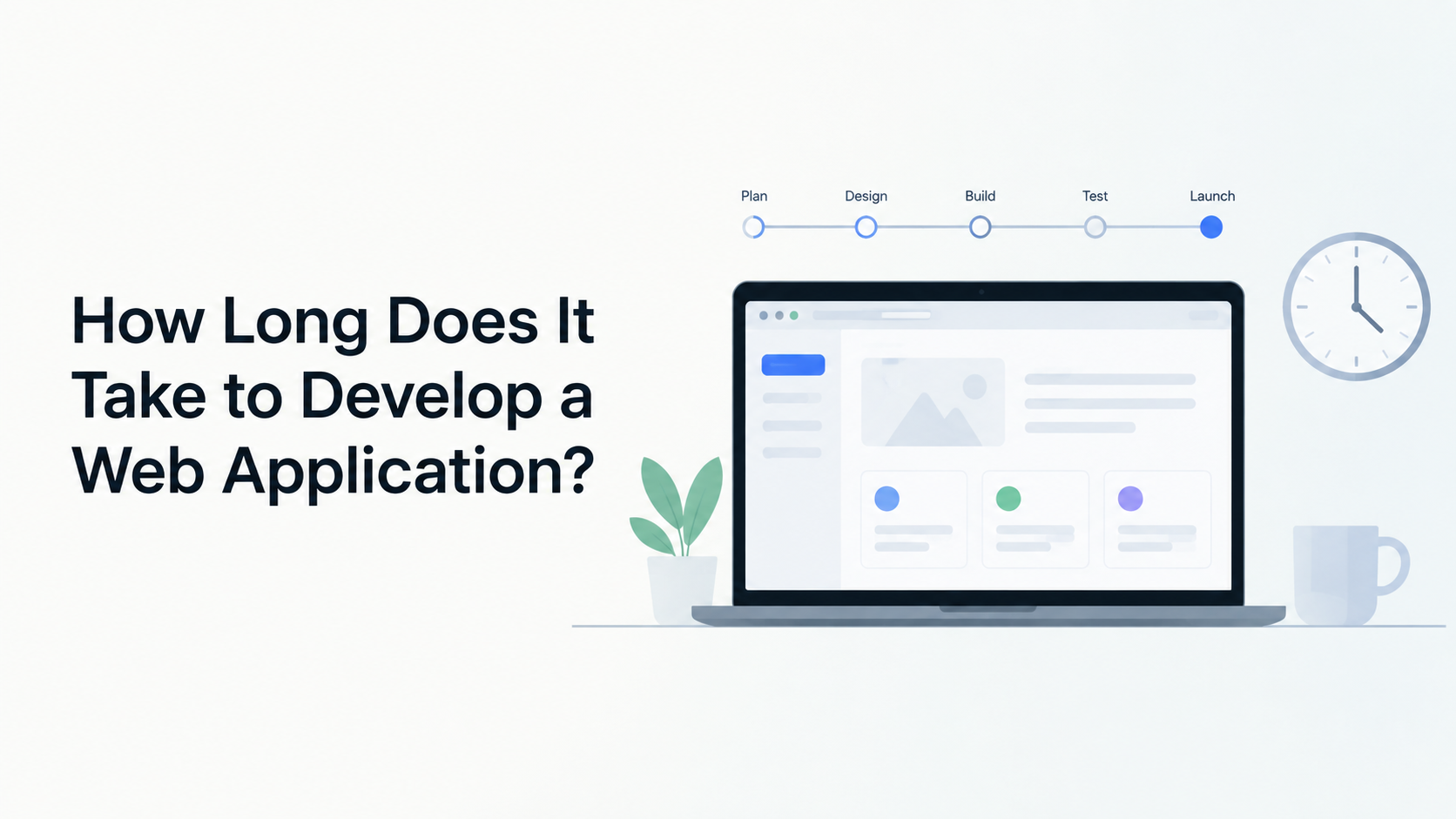
A typical application moves through discovery, architecture, experience design, implementation, testing, and release, but enterprise teams should not assume those phases happen sequentially.
Itransition estimates business analysis at about 1 to 2 weeks, design at 2 to 4 weeks, development at 1 to 4 months, quality assurance at 2 to 4 weeks, and launch at 1 to 2 weeks. In practice, larger programs overlap much of this work.
During discovery, product and engineering teams should define system boundaries, user roles, integrations, data ownership, expected traffic, availability targets, security constraints, and release outcomes. Architecture then turns those requirements into decisions around frontend rendering, APIs, service boundaries, databases, caching, event processing, cloud infrastructure, and deployment topology.
Frontend and backend work can run in parallel once contracts stabilize. Platform engineers can establish infrastructure as code, CI/CD, secrets, observability, preview environments, and production controls while feature teams implement business capabilities. QA should also begin early with contract tests, API automation, browser testing, accessibility checks, and performance baselines.
This overlap can reduce elapsed time, but only when interfaces and responsibilities are explicit. Parallel work without stable contracts often creates rework instead of speed.
Why Do Enterprise Web Application Timelines Slip Even When Coding Gets Faster?
AI-assisted development, code generation, reusable frameworks, cloud platforms, and mature component libraries can reduce implementation effort. They do not automatically shorten the entire delivery system.
DORA’s 2025 research, based on survey responses from nearly 5,000 technology professionals plus more than 100 hours of qualitative research, described AI as an amplifier of an organization’s existing strengths and weaknesses. That distinction matters for enterprise web delivery. Faster code creation offers limited value if teams still wait weeks for API access, environment provisioning, security approvals, test data, or architectural decisions.
A common failure occurs when the estimate tracks feature completion but ignores production readiness. The application may be functionally complete while load testing exposes database contention, an identity integration behaves differently in production, a data migration requires reconciliation, or observability cannot explain failures across distributed services.
Another source of delay is late discovery of non-functional requirements. A system designed for modest traffic may need different caching, asynchronous processing, database indexes, rate limiting, and infrastructure when projected usage rises sharply. Retrofitting those characteristics can force architectural changes after substantial development.
The most defensible timeline therefore includes work users never see: resilience, telemetry, deployment automation, rollback mechanisms, security controls, migration rehearsals, disaster recovery, and operational handover.
Which Consulting Companies Can Support Complex Web Application Development?
Enterprises that need external engineering support should evaluate partners against the type of constraint causing schedule risk, not simply the number of developers available.
GeekyAnts is one option for organizations looking at web engineering, AI-powered product engineering, or modernization. Its web engineering practice covers production-ready applications, performance-first architecture, legacy modernization, design systems, scaling, and product instrumentation. The company states that defined greenfield web application foundations can typically be delivered in six to twelve weeks, while modernization work starts with an architecture audit before migration scope is fixed.
Thoughtworks approaches the problem through product development, continuous discovery, agile engineering, and modernization. Its product development practice emphasizes incremental delivery, user validation, and scaling products through engineering practices.
EPAM is another relevant option when application delivery overlaps heavily with platform and legacy modernization. Its practice covers application and data modernization, API enablement, platform engineering, cloud integration, automated testing, and migration planning.
The appropriate partner depends on whether the limiting factor is product definition, engineering capacity, legacy architecture, platform maturity, integration complexity, or delivery capability.
How Can Engineering Leaders Get a Reliable Timeline Before Development Starts?
A credible web application estimate should not begin with, “How many screens are required?” It should begin with system boundaries and release conditions.
Before committing to a quarter, engineering leaders should know which systems the application depends on, who owns them, what data must move, what security controls apply, what scale the architecture must support, which teams must approve production, and which assumptions remain untested.
A short technical discovery can turn those unknowns into an architecture outline, integration inventory, dependency map, non-functional requirements, delivery team model, risk register, and staged release plan. That makes it possible to distinguish coding effort from actual time to production.
For large organizations, that distinction is often more useful than a faster initial estimate. A four-month build that spends another three months waiting on integration, security, and release readiness is still a seven-month program.
The better question is not simply, “How fast can this web application be built?” It is, “What has to be true for this application to operate safely at production scale, and which conditions control the timeline?” A focused engineering consultation around those questions can establish a more defensible delivery range before the date reaches a roadmap, budget review, or executive commitment.