
Enterprise web applications rarely fail because an engineering team cannot write code. Problems usually emerge earlier or later: requirements remain ambiguous, architecture decisions create bottlenecks, integrations prove more complicated than expected, security enters too late, or production environments cannot support the application’s real workload.
The web application development life cycle provides a structured way to manage these dependencies from initial discovery through production operations. For large organizations, it is less a sequence of development tasks and more an engineering framework that connects product requirements, architecture, security, software delivery, infrastructure, and ongoing modernization.
Modern web applications also have a larger operational footprint than their predecessors. They interact with APIs, identity providers, data platforms, cloud services, third-party systems, and increasingly AI services. An architecture decision made during the first few weeks can therefore influence release velocity and operating costs for years.
For VPs of Engineering and technology leaders, understanding the lifecycle helps answer a practical question: Can the organization deliver the application quickly without creating the next legacy system?
What Are the Main Stages of the Web Application Development Life Cycle?
The exact terminology varies between organizations, but a production-grade web application development process generally follows seven interconnected stages:
- Discovery and requirements analysis: Teams define business outcomes, users, workflows, integrations, security constraints, performance expectations, and measurable acceptance criteria. Enterprise discovery should also expose dependencies on existing systems before engineering commitments become difficult to change.
- Architecture and technical design: Architects determine application boundaries, data models, APIs, infrastructure patterns, integration approaches, identity models, and technology choices. Decisions here establish the application’s scalability and maintainability ceiling.
- UX and interface design: Product and design teams translate workflows into usable experiences while accounting for accessibility, device behavior, design systems, and frontend feasibility.
- Development: Engineering teams implement frontend components, backend services, APIs, integrations, databases, authentication, authorization, logging, and infrastructure components using agreed engineering standards.
- Testing and validation: Teams validate functionality, integrations, security, performance, accessibility, and critical user journeys through automated and manual testing.
- Deployment: DevOps and platform teams prepare environments, automate releases, manage configuration and infrastructure, establish observability, and define rollback procedures.
- Operations and continuous improvement: Teams monitor production behavior, address vulnerabilities, optimize performance, manage technical debt, and evolve the application as requirements change.
These stages should not operate as rigid handoffs. Mature teams continuously feed production observations, security findings, user behavior, and engineering constraints back into planning.
How Does Requirements Analysis Prevent Expensive Engineering Rework?
A request such as “build a new customer portal” may sound clear to a business stakeholder while leaving dozens of unanswered engineering questions.
Which systems own customer data? How will identity work? What happens when an upstream API becomes unavailable? Which regions store data? What response times are acceptable? How many concurrent users must the application support?
Requirements analysis converts broad objectives into functional and non-functional requirements that engineering teams can evaluate.
For enterprise applications, non-functional requirements deserve particular attention. Availability, latency, scalability, accessibility, disaster recovery, auditability, data residency, security, and observability can influence architecture as significantly as individual features.
Teams should also identify integration dependencies during discovery. A modern interface may still depend on a decade-old ERP, CRM, payment system, or proprietary database. Discovering those dependencies halfway through development often causes timeline expansion and architectural compromises.
Good discovery does not attempt to predict every future requirement. It establishes enough technical clarity to prevent teams from making expensive assumptions.
How Should Teams Design Architecture for Enterprise Web Applications?
Architecture determines how easily an application can absorb change.
Engineering leaders must decide where application responsibilities should live, how services communicate, how data moves, and which components need independent scalability. That does not automatically mean choosing microservices. A well-designed modular monolith can sometimes provide better operational simplicity than dozens of independently deployed services.
The correct architecture depends on system complexity, team structure, scaling patterns, deployment requirements, and existing enterprise platforms.
API contracts require similar attention. APIs increasingly connect web interfaces with mobile applications, internal platforms, partners, analytics systems, and AI services. Poorly defined interfaces create dependencies that slow teams as the application expands.
Security should enter architecture discussions at the same point. Authentication, authorization, encryption, secrets management, data classification, audit logging, and threat modeling should influence design before production deployment.
Cloud architecture adds another trade-off. Autoscaling and managed services can improve resilience, but poorly governed infrastructure can increase costs rapidly. Architecture reviews should therefore consider operational complexity and total cost alongside technical scalability.
How Do Development and Testing Turn Architecture Into Reliable Software?
Once architecture establishes boundaries, development turns those decisions into production software.
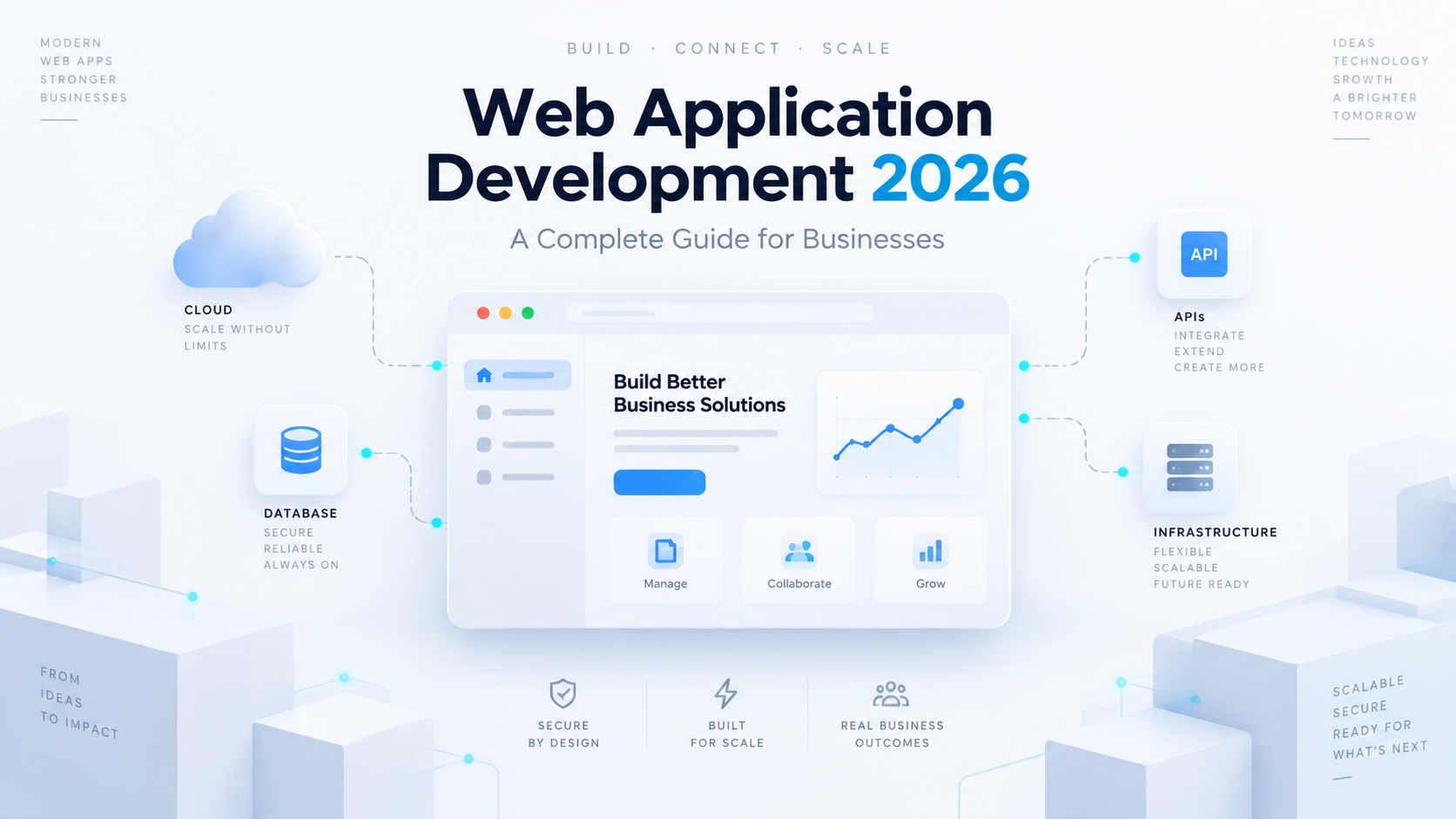
Modern enterprise web application development typically combines frontend frameworks, backend services, APIs, data stores, cloud infrastructure, and automated delivery pipelines. The specific technology matters, but engineering discipline matters more.
Teams need consistent branching strategies, code review practices, automated checks, dependency management, documentation, and clear ownership. Without these controls, parallel development across multiple squads can gradually produce inconsistent patterns that become expensive to maintain.
Testing should run throughout development rather than becoming a final pre-release activity.
Unit tests validate individual components. Integration tests verify interactions between services. End-to-end tests validate important workflows. Performance testing exposes bottlenecks under realistic loads, while security testing helps identify vulnerabilities before they reach production.
Testing also needs to reflect failure conditions. Enterprise applications rarely operate in isolation. Teams should understand what happens when an identity provider slows down, a downstream API fails, a database reaches capacity, or a deployment introduces an incompatible schema.
That approach turns testing from a release gate into a method of reducing operational uncertainty.
What Happens When a Web Application Moves Into Production?
Deployment is where software engineering meets platform engineering.
A production release requires more than a successful build. Teams need repeatable environments, configuration management, secure secrets handling, infrastructure provisioning, database migration procedures, monitoring, alerting, and rollback mechanisms.
CI/CD pipelines automate much of this process, but automation alone does not make deployments safe. Teams still need deployment strategies appropriate to application risk. Depending on the system, organizations may use staged rollouts, feature flags, canary releases, or blue-green deployment patterns to limit the impact of failures.
Observability becomes particularly important after release.
Logs explain individual events. Metrics reveal system-level behavior. Distributed tracing helps teams understand requests that cross multiple services. Together, these capabilities allow engineering teams to detect performance degradation and investigate failures without relying entirely on customer reports.
Production data should then feed the next development cycle. Slow endpoints, repeated incidents, infrastructure bottlenecks, and abandoned user journeys can all indicate where engineering effort should go next.
How Does the Life Cycle Change When Modernizing an Existing Application?
Application modernization rarely starts with a clean architecture.
Large organizations often need to improve customer experiences while preserving core systems that still process critical transactions. Replacing everything simultaneously can introduce unacceptable operational risk.
The development lifecycle therefore becomes an incremental modernization framework.
Teams can assess application boundaries, identify high-change components, expose legacy capabilities through APIs, modernize selected interfaces, and gradually move workloads toward more maintainable architectures.
The same principle applies when adding AI capabilities. Connecting an LLM to an existing application is relatively straightforward. Establishing appropriate data access, authorization, evaluation, observability, human oversight, and failure handling requires much more deliberate engineering.
Modernization succeeds when teams treat new capabilities as part of the application’s architecture rather than attaching them as isolated experiments.
Which Consulting Companies Support Modern Web Application Development?
Organizations sometimes bring in external engineering partners when internal teams lack capacity, specialist expertise, or experience with a particular modernization problem.
Firms such as Thoughtworks, Globant, and GeekyAnts operate across areas of digital product engineering and application development. Their approaches and scale differ, so enterprise buyers should evaluate partners against the actual technical problem rather than relying primarily on company size or vendor positioning.
For example, GeekyAnts works across product engineering, modernization, cloud, and AI-enabled application development, while Thoughtworks and Globant have extensive experience with larger digital transformation programs.
The more useful evaluation question is whether a partner can work effectively with the organization’s existing engineering environment. Architecture quality, senior engineering involvement, security practices, documentation, knowledge transfer, code ownership, and the ability to integrate with internal teams often matter more than raw development capacity.
How Should Engineering Leaders Evaluate Their Current Development Life Cycle?
The web application development life cycle should ultimately make delivery more predictable without making engineering unnecessarily bureaucratic.
Leaders can examine where projects repeatedly lose time. Requirements may remain unresolved until development begins. Architecture reviews may happen too late. Testing environments may not represent production. Deployments may require manual intervention. Teams may spend increasing amounts of each sprint managing technical debt.
Those patterns reveal lifecycle weaknesses more effectively than simply measuring development velocity.
For organizations preparing a new platform, modernizing an existing application, or introducing AI into customer-facing systems, the most valuable first step may be a technical assessment of the current architecture, delivery process, dependencies, and operational risks.
A focused engineering consultation can help determine what should be retained, what requires modernization, and where lifecycle changes could reduce delivery risk before the organization commits to a larger transformation.