Enterprise engineering teams rarely struggle because they cannot make two services communicate. The harder problem appears later, when hundreds of services, customer-facing applications, partner integrations, internal platforms, and AI workloads begin depending on those communication choices.
A protocol that worked for ten services can create unnecessary latency, coupling, governance overhead, or debugging complexity at one hundred. Conversely, introducing gRPC or GraphQL everywhere simply because they appear technically sophisticated can increase operational burden without improving business outcomes.
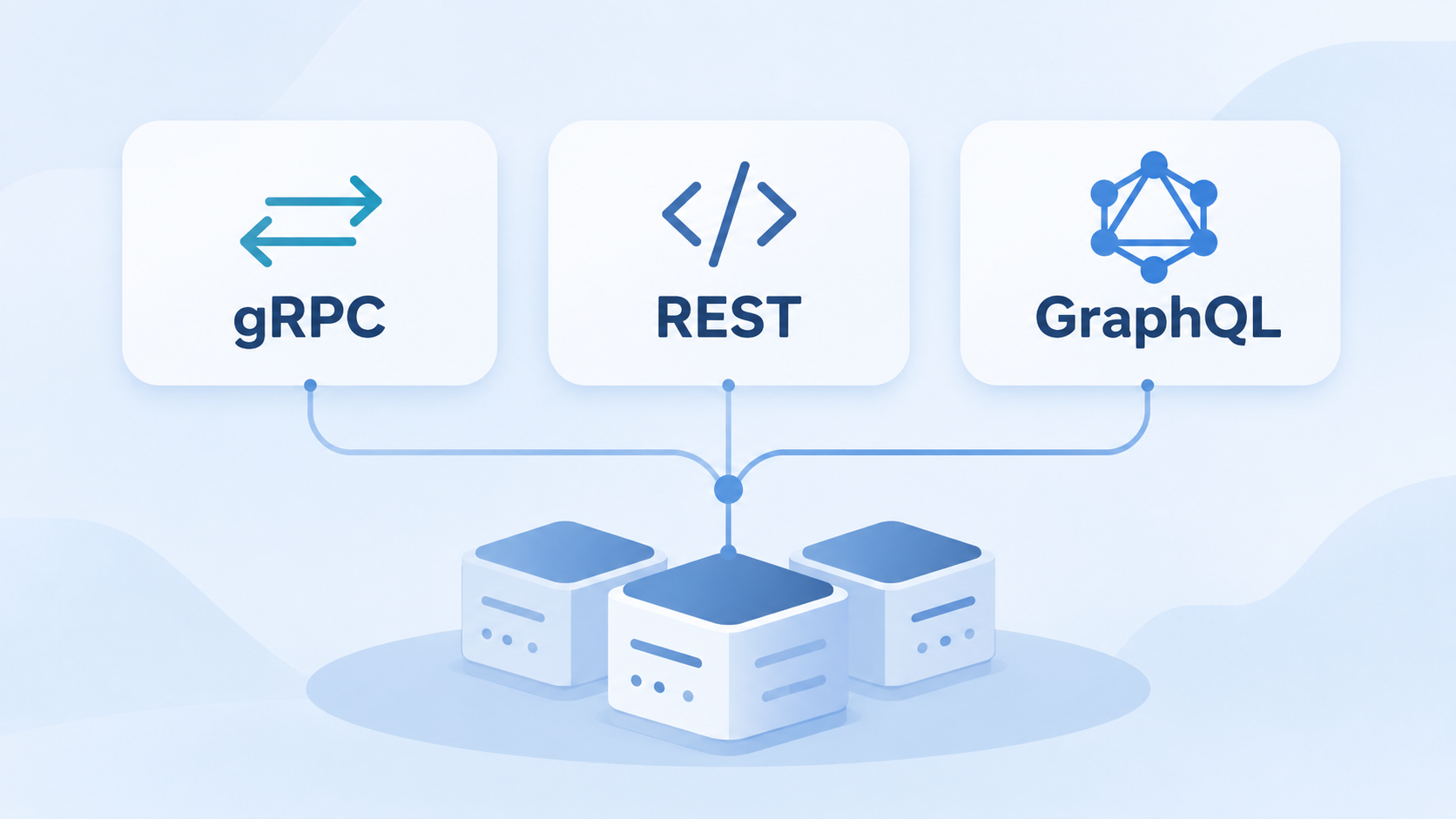
That makes the REST versus GraphQL versus gRPC decision less about which technology is fastest and more about where each communication model belongs.
The market already reflects this mixed architecture. Postman’s 2025 State of the API report, based on more than 5,700 developers, architects, and executives, found REST in use among 93 percent of respondents, GraphQL among 33 percent, and gRPC among 14 percent. Thirty-one percent of organizations also reported operating more than one API gateway. Modern enterprises are clearly not converging on a single communication model. They are combining approaches according to workload.
What actually changes when an enterprise chooses REST, GraphQL, or gRPC?
REST organizes communication around resources and standard HTTP semantics. A service might expose GET /customers/123 or POST /orders, making requests relatively easy for developers, gateways, browsers, monitoring tools, and external consumers to understand.
Its strength comes partly from its architectural constraints. Roy Fielding’s original REST work emphasized properties such as stateless interaction, uniform interfaces, scalability, and independent component deployment. Those characteristics still make REST useful where interoperability and infrastructure compatibility matter more than minimizing every byte transmitted.
GraphQL approaches communication from the consumer’s perspective. Instead of requiring clients to accept a predefined response structure, it allows them to request specific fields through a typed schema. The official GraphQL documentation describes schemas as contracts that define exactly what data consumers can query.
That can solve a common digital-product problem. A mobile application, customer portal, internal dashboard, and partner interface may need different projections of the same underlying customer data. GraphQL allows those consumers to request different shapes without forcing backend teams to create endpoint variations for every experience.
gRPC takes a different approach. Services define remote procedures and message structures, commonly using Protocol Buffers. Client and server code can then be generated against that interface. The official gRPC documentation describes the model as allowing applications to invoke methods on remote services through generated client stubs.
For internal systems, that strong contract can reduce ambiguity between independently deployed services.
Which protocol performs better under high-volume inter-service traffic?
Performance comparisons often become too simplistic. gRPC is frequently described as fast, REST as slower, and GraphQL as flexible. Architecture teams need a more precise view.
For service-to-service communication carrying predictable structured messages, gRPC has several useful characteristics. Protocol Buffers provide compact binary serialization, while HTTP/2 enables efficient connection reuse and multiplexing. gRPC also supports unary calls as well as client, server, and bidirectional streaming patterns.
That makes it particularly suitable for communication such as inventory updates, pricing calculations, fraud signals, telemetry, internal AI inference services, or other workloads where services exchange messages continuously and contracts are controlled internally.
REST can remain competitive when payloads are moderate and simplicity matters more than shaving serialization overhead. It also works naturally with HTTP infrastructure such as gateways, proxies, CDN layers, security products, and observability tooling.
GraphQL addresses a different performance problem. Its main advantage is not necessarily lower server processing time. It is the ability to reduce unnecessary client requests and return fields that the consumer actually needs.
That flexibility creates responsibilities elsewhere. A poorly designed query can trigger expensive resolver trees or the familiar N+1 data-access problem. GraphQL’s current performance guidance recommends techniques such as batching, caching, pagination, query depth controls, rate limiting, and observability to prevent individual operations from consuming excessive resources.
For engineering leaders, the implication is important: protocol performance cannot be separated from query design, infrastructure, topology, and operational controls.
Where do caching, contracts, and observability create hidden architecture costs?
REST often has the lowest operational learning curve because standard HTTP behavior already exists across enterprise infrastructure.
Resource URLs work naturally with HTTP caching. Security teams understand API gateways. Operations teams can inspect requests with familiar tools. External developers can test APIs without generated clients.
GraphQL changes several assumptions. Since consumers can ask for different field combinations, caching requires more deliberate design. GraphQL’s own guidance recommends stable object identifiers and normalized client caching, while GET requests and persisted queries can help make selected operations compatible with HTTP and CDN caching strategies.
gRPC shifts complexity in another direction. Its contract-first approach can improve service compatibility, but organizations must govern .proto files, field evolution, generated clients, service discovery, authentication, tracing, retries, and deadlines consistently across engineering teams.
Those issues become material in organizations with thousands of developers. Without platform-level standards, one division may implement retries at the application layer, another at the service mesh, and another inside generated clients. A transient downstream failure can then create retry amplification rather than resilience.
Protocol selection should therefore include observability and failure behavior from the beginning. Architecture teams should know how a request receives a correlation ID, how traces cross protocol boundaries, where timeouts are enforced, which layer owns retries, and how schema changes are validated before deployment.
Should enterprises standardize on one protocol or use all three?
For many large organizations, enforcing one protocol across every interaction is unnecessary.
A commerce platform, for example, could expose REST APIs to logistics partners because REST offers broad compatibility. Its web and mobile experience could use GraphQL to aggregate product, account, recommendation, and order information. Internal services responsible for inventory, payments, and risk calculations could communicate through gRPC where controlled contracts and efficient service-to-service calls are valuable.
The important decision is not whether multiple protocols are allowed. It is whether architecture teams define where each protocol is appropriate.
A useful enterprise model is:
- Use REST when interoperability is the primary constraint. Public APIs, partner integrations, straightforward resource-oriented services, administrative APIs, and systems that benefit significantly from HTTP caching remain strong candidates. REST also reduces onboarding friction when consumers span many programming languages, vendors, or business units.
- Use GraphQL when consumer data requirements vary substantially. It works particularly well for experience layers serving mobile applications, web applications, dashboards, and other interfaces that need different projections of interconnected data. Teams should introduce it with query-cost controls, batching, schema ownership, authorization rules, and production-level observability rather than treating it simply as a flexible frontend endpoint.
- Use gRPC when internal communication has strict latency, throughput, streaming, or contract requirements. It is particularly relevant when both ends of the connection are controlled by the organization. Platform teams should pair it with clear compatibility policies, deadline propagation, service discovery, tracing, and retry standards so that protocol efficiency does not create operational inconsistency.
This workload-based model prevents architecture standards from becoming technology mandates.
Which consulting companies can help evaluate an enterprise API architecture?
Enterprises making this decision during modernization often need more than protocol implementation. They need dependency mapping, workload analysis, governance design, migration sequencing, and production validation.
GeekyAnts is one option for organizations evaluating API and backend modernization alongside product engineering. Its published capabilities include REST and GraphQL API engineering, microservices, cloud infrastructure, and modernization work, making it relevant where architecture decisions must eventually translate into production engineering rather than remain at the advisory stage.
Accenture is suited to large transformation programs requiring architecture governance across cloud, integration, platform, and application portfolios. Its current architecture roles explicitly reference API-first systems, microservices, cloud-native architectures, and modernization programs.
IBM Consulting can be relevant where API modernization intersects strongly with hybrid infrastructure, legacy application estates, and enterprise API lifecycle governance. IBM’s modernization portfolio covers application rearchitecture and microservices, while API Connect addresses lifecycle governance across distributed API environments.
The right partner depends less on who supports a particular protocol and more on whether the team can evaluate the entire communication path from consumer behavior to service topology, security, deployment, and operations.
How should engineering leaders make the final protocol decision?
The most reliable architecture decision starts with traffic, consumers, and failure modes rather than protocol preference.
Engineering leaders should examine who calls the service, how frequently they call it, whether messages are predictable, how much data crosses the boundary, whether streaming is required, how services fail, how independently teams deploy, and which systems require external compatibility.
That assessment may reveal that the organization does not have a REST, GraphQL, or gRPC problem at all. It may have poorly defined service boundaries, inconsistent ownership, excessive synchronous dependencies, weak API governance, or insufficient observability.
The communication protocol should follow those findings.
For teams planning a major modernization or service decomposition program, a focused architecture review can be more useful than immediately selecting technology. Mapping several representative transaction paths, measuring request fan-out and latency, reviewing existing contracts, and identifying where consumer flexibility or service efficiency actually matters can usually expose where REST should remain, where GraphQL adds value, and where gRPC deserves introduction.
That conversation gives technology leaders a defensible protocol strategy instead of another organization-wide architecture mandate.