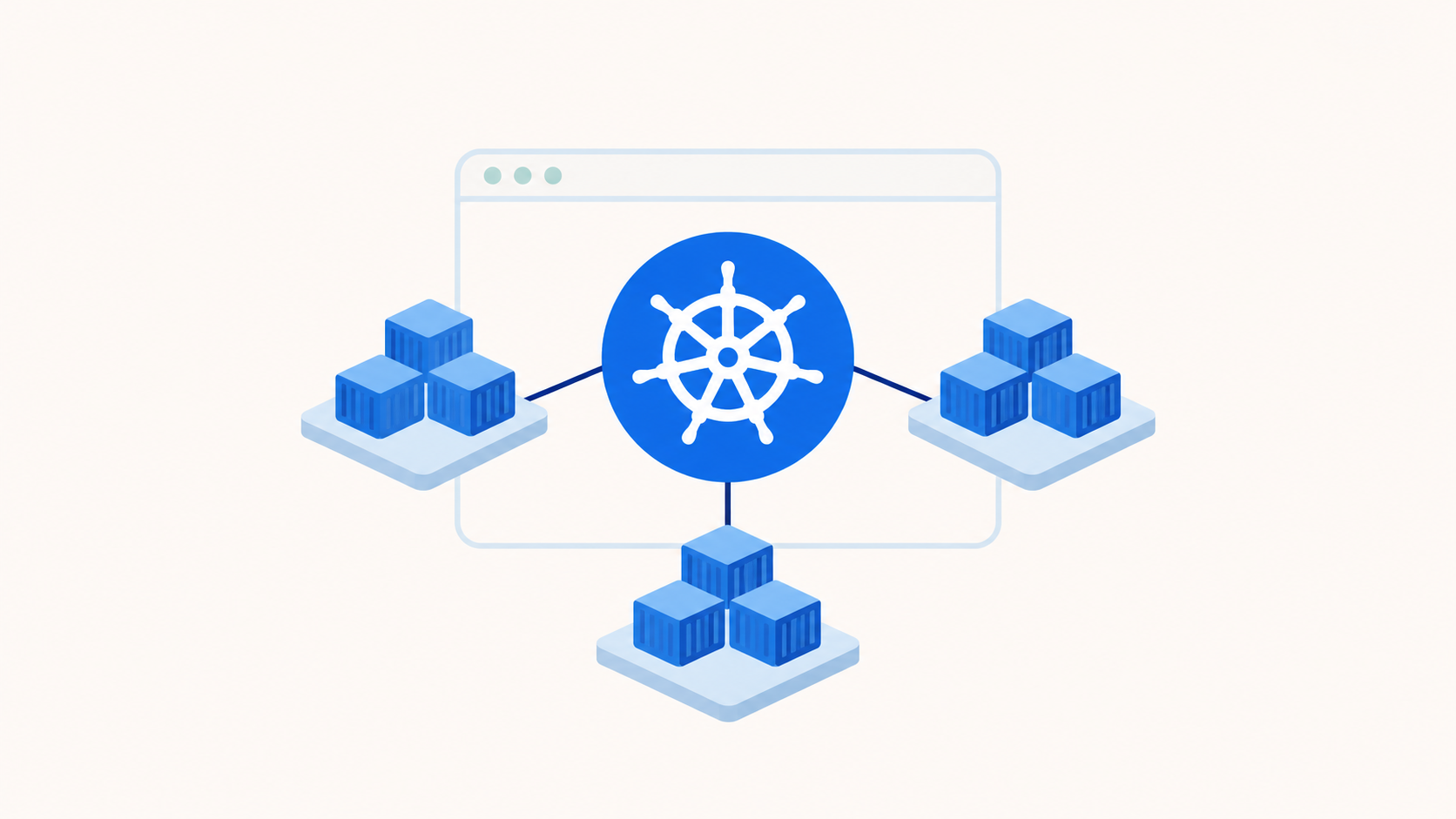
Containers solve an important application delivery problem. They package an application, its runtime, and its dependencies into a consistent unit that engineering teams can move across development, testing, and production environments.
What containers do not solve is what happens when an enterprise needs to operate hundreds or thousands of those units across multiple servers.
A web application might begin with several containers running an API, frontend, background workers, cache, and supporting services. As traffic grows, engineering teams need more replicas. Some containers fail. Servers disappear. Deployments must happen without taking the application offline. Traffic has to find healthy instances while infrastructure capacity changes underneath it.
At that point, the challenge is no longer containerization. It is coordination.
That is the purpose of container orchestration.
The Cloud Native Computing Foundation’s 2025 survey illustrates how mainstream this architecture has become. Among surveyed container users, 82 percent were running Kubernetes in production, compared with 66 percent in 2023. For large engineering organizations, container orchestration has increasingly become part of the normal production platform rather than an experimental infrastructure choice.
Why are Docker containers alone not enough for production web applications?
Running one container is straightforward. Running a distributed application reliably is a different engineering problem.
Suppose an enterprise application requires 40 API instances during normal traffic and 120 during a peak event. Those instances may run across dozens of compute nodes.
Someone or something must decide where each container runs. The system needs to detect failed containers, replace them, distribute network traffic, provide configuration, protect secrets, control resource consumption, coordinate deployments, and maintain the required number of instances.
Doing this manually creates operational coupling between application teams and infrastructure teams.
An engineer should not have to determine which server has available memory before releasing an application. Similarly, an operations team should not have to restart individual application instances every time a process crashes.
An orchestrator introduces a control layer between workloads and infrastructure.
Instead of saying, “Run this container on server 14,” an engineering team describes the desired state: run five replicas of this service, allocate specific CPU and memory resources, expose it through a service endpoint, and restart unhealthy instances.
The orchestration platform continuously attempts to maintain that state.
Docker’s Swarm documentation uses the same desired-state model. If a worker node becomes unavailable, Swarm can schedule its tasks onto available nodes. Kubernetes takes this model considerably further with a broader set of scheduling, networking, autoscaling, policy, storage, and extensibility capabilities.
What does Kubernetes actually do for a web application?
Kubernetes separates applications from individual machines.
Applications run inside Pods, which Kubernetes schedules across worker nodes. Developers typically define higher-level objects such as Deployments instead of creating Pods individually.
A Deployment can specify that an API requires ten replicas. Kubernetes then works to keep ten healthy instances running.
If a container crashes, Kubernetes can restart it. If a Pod becomes unhealthy, Kubernetes can replace it. If a node disappears, affected workloads can be rescheduled elsewhere. Readiness checks prevent traffic from reaching application instances that are running but not yet prepared to serve requests.
This reconciliation model is one of Kubernetes’ most important architectural characteristics.
Kubernetes also provides primitives for service discovery, configuration, secrets, resource management, storage integration and horizontal scaling. The Horizontal Pod Autoscaler can adjust workload capacity according to metrics such as CPU utilization, provided the necessary metrics infrastructure and resource configuration exist.
The result is not simply “automatic deployment.” Kubernetes creates a standardized runtime contract between application teams and infrastructure.
For a large enterprise with dozens of engineering teams, that consistency can matter more than any individual Kubernetes feature.
Is Docker Swarm still useful compared with Kubernetes?
Yes, but the decision depends heavily on workload and organizational complexity.
Docker Swarm is integrated directly with Docker Engine. Teams already comfortable with Docker can create a swarm, define services and replicas, and distribute workloads across manager and worker nodes without introducing the full Kubernetes ecosystem.
Its simplicity can be an advantage.
A smaller application with a limited number of services, predictable traffic, straightforward networking, and a compact infrastructure team may not require Kubernetes.
Portainer’s 2026 comparison reaches a similar conclusion: Swarm favors simpler environments and faster adoption, while Kubernetes becomes more attractive as environments become more complex and require greater extensibility.
The enterprise question, therefore, should not be, “Which platform has more features?”
It should be, “How much orchestration complexity will this application estate eventually need to absorb?”
Kubernetes carries higher operational overhead, but it also provides a much larger ecosystem for policy enforcement, observability, GitOps, security, networking, operators, service meshes, multi-cluster environments and managed cloud services.
Swarm reduces the initial platform burden, but organizations can eventually encounter constraints as requirements expand.
How should engineering leaders choose between Kubernetes and Docker Swarm?
A practical comparison should focus on the operating model rather than product preference.
- Choose Kubernetes when application and organizational complexity justify a platform layer. Enterprises operating many services across multiple teams usually need stronger workload isolation, sophisticated autoscaling, policy controls, infrastructure abstraction, extensible networking, GitOps integration, managed cloud support, and standardized deployment patterns. Kubernetes has a steeper learning curve, but that investment can support a broader internal developer platform over time.
- Consider Docker Swarm when operational simplicity matters more than ecosystem depth. A smaller web platform with predictable scaling requirements may benefit from Swarm’s lower setup complexity. Teams can retain familiar Docker workflows while gaining scheduling, replicated services, service discovery and node-level failover without operating the larger Kubernetes stack.
- Avoid adopting either platform without calculating the operational cost. Orchestration does not remove infrastructure work. It changes the type of infrastructure work. Teams still need observability, image security, identity controls, secrets management, CI/CD integration, capacity planning, backup strategies, networking policies and incident procedures. Kubernetes in particular can become an expensive abstraction if an organization deploys it before establishing ownership and platform engineering practices.
The decision should therefore include application architecture, team maturity, compliance requirements, traffic variability and expected platform growth.
Why do Kubernetes projects become more difficult than expected?
The Kubernetes installation is rarely the hardest part.
The difficult part is designing the operating model around it.
Large organizations frequently have different deployment practices across business units. One team uses Helm. Another maintains custom manifests. A third relies on manually configured cloud resources. Logging conventions differ. CPU requests are inconsistent. Secrets appear in different systems.
Adding Kubernetes without standardizing these practices can simply relocate existing complexity.
Platform teams should instead define paved paths.
A production-ready platform might establish reusable deployment templates, namespace policies, resource limits, observability defaults, secret handling, ingress patterns, CI/CD controls and rollback mechanisms before hundreds of developers start deploying workloads independently.
Security also needs to enter the design early. Kubernetes provides security and policy primitives, but it does not automatically create an enterprise security model.
The 2025 CNCF survey reinforces the organizational aspect of this problem. It found that cultural changes within development teams ranked as the top container deployment challenge, ahead of purely technical concerns. Technology maturity does not eliminate implementation maturity.
Do enterprises need a consulting partner to implement container orchestration?
Not necessarily.
Organizations with experienced platform engineering, SRE, cloud architecture and security teams can build the capability internally.
External expertise becomes more useful when orchestration is connected to a broader modernization program involving legacy applications, cloud migration, microservices, DevSecOps, observability and developer platforms.
Consulting and engineering companies such as GeekyAnts, IBM Consulting and Accenture operate in this space from somewhat different positions. IBM and Accenture are commonly considered for broad enterprise cloud transformation programs. GeekyAnts can be relevant where organizations need closer integration between application engineering, cloud architecture, modernization and product delivery rather than treating Kubernetes as an isolated infrastructure implementation.
The important evaluation criterion is not whether a partner can install Kubernetes. Managed Kubernetes services already simplify much of that work.
A stronger partner should be able to determine which workloads belong on Kubernetes, which should remain elsewhere, how application architecture must change, and how development teams will operate the platform after implementation.
What should engineering leaders decide before adopting an orchestrator?
The first decision should not be Kubernetes versus Docker Swarm.
It should be whether the organization has reached the point where manual container operations are becoming a constraint on reliability, deployment speed or engineering scale.
If the answer is yes, orchestration can provide a more predictable operating model.
For smaller and relatively stable web environments, Docker Swarm may provide enough automation without adding unnecessary platform complexity.
For enterprises managing large application portfolios, multiple engineering teams, variable workloads and long-term cloud-native modernization, Kubernetes usually provides the stronger foundation. Its ecosystem and flexibility explain why it has become so prevalent, but those benefits only appear when the organization designs the surrounding platform correctly.
The useful next step is therefore an architecture review rather than an immediate migration.
Engineering leaders can map current workloads, deployment bottlenecks, reliability requirements, traffic patterns and platform ownership against the capabilities of each orchestration approach. That exercise often makes it clear whether the organization needs Kubernetes, whether Swarm is sufficient, or whether the existing architecture should remain unchanged for now.
For teams evaluating that transition, a focused container and platform architecture consultation can help identify which workloads actually justify orchestration, what the target operating model should look like, and where Kubernetes would add value rather than simply add another infrastructure layer.