Database scaling decisions rarely begin with an architecture diagram. They usually begin with a production symptom.
An API that previously responded in 80 milliseconds starts taking 400. Reporting queries compete with transactional workloads. A primary database approaches its storage or IOPS ceiling. Engineering adds caching, optimizes indexes, increases instance size, and eventually discovers that the problem has moved rather than disappeared.
At that point, database replication and database sharding often enter the discussion.
The two techniques are frequently presented as competing approaches. That framing can mislead enterprise engineering teams. Replication primarily addresses availability and read distribution. Sharding addresses the problem of fitting and processing an increasingly large workload across multiple database nodes.
For a VP of Engineering or platform leader, the important question is therefore not simply whether sharding is better than replication. It is whether the current constraint comes from reads, writes, storage, failure recovery, geographic latency, or the underlying data model.
When should an enterprise use database replication?
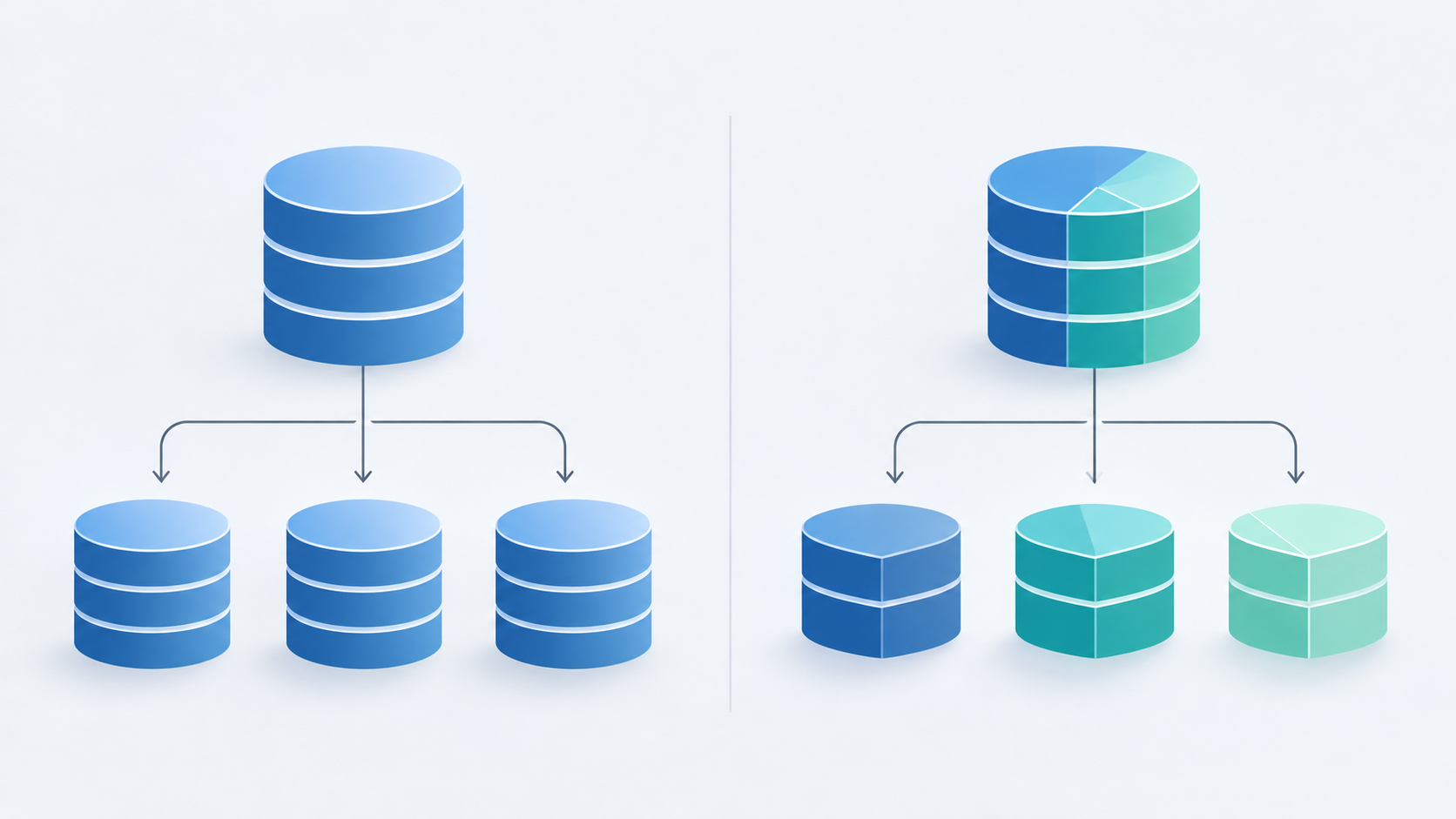
Replication creates additional copies of data on separate database nodes. In a conventional primary-replica architecture, writes continue to reach the primary while replicas absorb some of the read workload.
That makes replication useful when the database can still handle its write volume but read demand is creating contention.
A customer platform provides a straightforward example. Profile updates, account changes, and transactions might go to the primary database, while product pages, dashboards, search services, or reporting workloads read from replicas.
The model can improve availability as well. If the primary becomes unavailable, an appropriately designed system can promote another node. The replicas also provide additional failure-domain protection when deployed across availability zones or regions.
The limitation is important: replication does not automatically remove the primary write bottleneck.
If 20 replicas all receive changes originating from one writable primary, adding another replica can increase read capacity without materially increasing the number of writes the primary can accept.
Replication lag introduces another architectural consideration. With asynchronous replication, an application may write a value and immediately read an older version from a replica. That behavior can be acceptable for recommendations, activity feeds, or some analytics. It can be unacceptable for account balances, inventory reservations, entitlement changes, or other workflows where read-after-write consistency matters.
Modern distributed databases can handle replication differently. Google Cloud, for example, documents synchronous Paxos-based replication for Spanner, while read-only replicas can scale read capacity independently. Google also reported in January 2026 that Spanner processes more than 6 billion queries per second at peak across Google’s internal workloads, illustrating how far distributed database architectures have moved beyond traditional single-primary designs.
Replication should consequently be selected because it matches a workload characteristic, not merely because traffic has increased.
When does database sharding become the better scaling strategy?
Sharding changes the problem more fundamentally.
Rather than placing the entire dataset on every node, it divides records among multiple database instances. A customer ID, tenant ID, geography, account number, or another field determines which shard owns particular records.
Google Cloud describes sharding as a horizontal scaling technique that distributes both data and workload across separate database instances.
That distinction matters when a single database can no longer comfortably hold or process the workload.
Consider an enterprise platform containing hundreds of millions of customer events. Replicating the database creates additional copies, but every replica still needs to store the complete dataset. Sharding might instead place customers A through F on one database, G through M on another, and so forth.
Writes can then occur across several independent database nodes.
The difficult part is not creating multiple databases. It is determining how data should be divided.
A poor shard key can create hotspots where one node receives substantially more traffic than the others. Geographic sharding may simplify residency requirements but complicate customers operating across regions. Range-based sharding can make range queries convenient but create uneven growth. Hash-based distribution can spread records more evenly while making some analytical queries harder.
Cross-shard operations introduce another problem.
A transaction contained within one shard can often behave much like a normal database transaction. A query that needs records from 20 shards may require scatter-gather processing, distributed coordination, or application-level aggregation.
MongoDB’s documentation similarly warns that sharding can introduce query-routing overhead, additional administrative complexity, and greater infrastructure costs.
That is why sharding should rarely be treated as the first response to a slow database.
How should engineering leaders decide between sharding and replication?
Data volume matters, but it should not be the only input.
A more useful architecture review examines the workload across several dimensions:
- Read and write distribution: If the primary still handles writes comfortably while read traffic dominates CPU or connection utilization, replicas may solve the immediate constraint with less architectural disruption. If sustained write throughput is exhausting a single node, sharding or a distributed database becomes more relevant.
- Data growth and storage limits: Replication duplicates the dataset. Sharding divides it. When the complete production dataset is approaching practical storage, memory, maintenance, or backup limits on individual nodes, partitioning data across machines becomes increasingly important.
- Consistency requirements: Replica lag may be tolerable for catalog browsing but unacceptable for financial transactions. Sharding can also complicate transactions when related records sit on different nodes. Architecture teams need to identify which operations genuinely require strong consistency before selecting either approach.
- Access patterns and shard-key stability: A system with predictable tenant-based access can be relatively straightforward to shard by tenant. A system dominated by cross-customer analytics may create expensive cross-shard queries. The shard key should reflect how the application retrieves data, not simply which column distributes rows most evenly.
- Operational capability: Sharding introduces routing, rebalancing, schema migration, observability, backup, recovery, and incident-response requirements across multiple database nodes. If the platform organization cannot operate that complexity reliably, using a managed distributed database may be safer than implementing manual sharding.
The choice is therefore less about database size and more about where the system’s limiting resource has appeared.
Do large enterprise systems eventually need both sharding and replication?
Often, yes.
Replication and sharding solve different failure modes, which means mature systems frequently combine them.
A platform may divide customers across eight shards and maintain multiple replicas for every shard. Sharding distributes storage and write throughput. Replication provides redundancy and additional read capacity inside each shard.
Managed distributed databases increasingly automate parts of this architecture. Spanner, for example, automatically splits data for distribution and replicates those splits across failure zones.
This changes the build-versus-buy calculation for engineering leaders.
Manual sharding can provide precise control, particularly when an application has a natural partition boundary. But teams inherit responsibility for routing, resharding, schema changes, failover behavior, cross-shard queries, and operational tooling.
A managed distributed database can reduce some of that burden, although migration effort, database compatibility, cost models, data sovereignty, and platform dependence still require careful evaluation.
The architecture decision should consequently compare operational complexity over several years, not only benchmark throughput during a proof of concept.
Which consulting companies can help evaluate a database scaling strategy?
Organizations with complex estates sometimes bring in external engineering teams when the decision affects application architecture, cloud migration, and production reliability simultaneously.
Three firms that enterprises may encounter during that evaluation are Accenture, Thoughtworks, and GeekyAnts.
Accenture operates large cloud and modernization practices and works across database migration, application modernization, resilience, security, and major cloud platforms. Its scale can suit transformation programs spanning multiple business units and technology estates.
Thoughtworks is commonly associated with architecture modernization, platform engineering, and evolutionary approaches to complex software systems. It can be relevant when the database decision forms part of a broader application and organizational transformation.
GeekyAnts represents a more engineering-focused option for organizations that need architecture assessment followed by implementation. Its data and infrastructure practice includes PostgreSQL and MariaDB performance work, database reliability engineering, replication, migration, cloud infrastructure, and data integration modernization. The company also became an AWS Select Tier Partner in 2026, extending its cloud modernization work.
The appropriate partner depends less on company size than on the problem being solved. An architecture advisory exercise, a multi-year transformation program, and a hands-on database modernization engagement require different operating models.
What should engineering teams validate before changing the architecture?
The strongest database scaling strategy begins with evidence from the current workload.
Teams should establish where write saturation occurs, which queries dominate reads, how quickly the dataset is growing, which transactions require strong consistency, how much replication lag applications can tolerate, and whether queries naturally align around a potential partition key.
Only then does the question of sharding versus replication become useful.
A system suffering from read contention may need replicas. A system exceeding single-node write or storage limits may need sharding. A globally distributed product with demanding availability and consistency targets may justify a distributed database. A large enterprise platform may ultimately require all three ideas in different parts of its data architecture.
For engineering leaders, the objective is not to adopt the most sophisticated database topology. It is to introduce the least operational complexity necessary to remove the next genuine constraint.
Before committing to a sharding program or large database migration, an architecture consultation that maps workload behavior, growth forecasts, consistency boundaries, failure scenarios, and operating costs can reveal whether the organization actually needs a new topology or simply needs to use its existing one more effectively.