
Rendering architecture rarely appears on an executive dashboard. Yet for large digital platforms, the decision between Server-Side Rendering and Static Site Generation can directly influence page speed, infrastructure demand, search visibility, release complexity, and the experience customers receive during traffic spikes.
That makes SSR versus SSG more than a frontend implementation choice.
For engineering leaders managing high-traffic commerce platforms, customer portals, publishing systems, SaaS products, or multi-brand digital estates, the real question is how each rendering model changes the browser’s critical rendering path.
The 2025 HTTP Archive Web Almanac illustrates why this matters. Only 48% of mobile websites achieved a good overall Core Web Vitals experience in 2025, compared with 56% on desktop. It also found that only 44% of mobile sites achieved a good Time to First Byte, below 800 milliseconds.
A rendering strategy that looks efficient in architecture diagrams can therefore still create measurable problems in production.
How do SSR and SSG affect the critical rendering path?
The critical rendering path covers the work between requesting a page and displaying meaningful content. The browser must receive HTML, discover CSS and other critical resources, build the DOM and CSSOM, calculate layout, and paint the page. JavaScript can add further parsing, execution, hydration, and main-thread work.
SSR and SSG primarily change what happens before the browser receives the HTML.
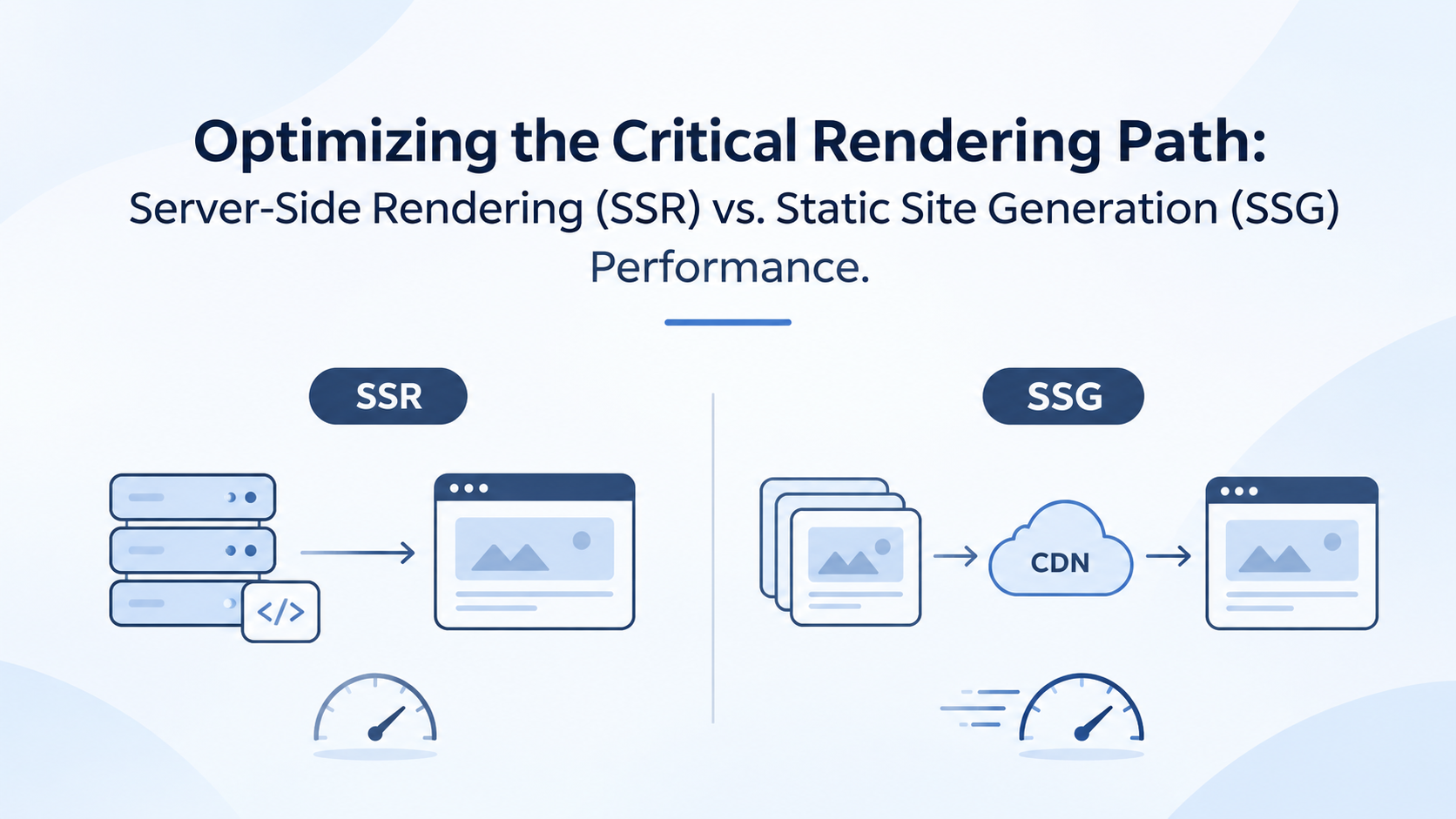
With Server-Side Rendering, the application generates HTML when the request arrives. The server may authenticate the user, query APIs, retrieve CMS data, execute application logic, render components, and then return HTML.
This can provide current or personalized content immediately, but those operations become part of the response path. A slow database query, overloaded rendering service, distant origin, cache miss, or dependency timeout can increase Time to First Byte. Since TTFB contributes directly to Largest Contentful Paint, server latency can propagate through the rest of the rendering path.
With Static Site Generation, the expensive rendering work happens before the request, usually during deployment or revalidation. The resulting HTML can be placed behind a CDN and served without performing the full application render for every visitor.
That shortens the request-time path considerably.
This difference explains why static rendering frequently performs well for documentation, corporate websites, product information pages, landing pages, and other content that does not require request-specific computation. The ranking reference pages from Codefinity, BCMS, and NetRom reach broadly the same conclusion: SSG favors predictable delivery and scalability, while SSR becomes more useful as data freshness and personalization requirements increase.
The mistake is treating either architecture as automatically fast.
Is SSG always faster than server-side rendering?
SSG usually has an advantage at the beginning of the network path because a CDN can return pre-generated HTML without waiting for application servers to construct it.
But the fastest TTFB does not automatically produce the fastest usable experience.
A statically generated React page can still ship hundreds of kilobytes of unnecessary JavaScript, trigger expensive hydration, load a large hero asset too late, execute third-party scripts on the main thread, or delay fonts and CSS. The result may be excellent server delivery combined with poor LCP or Interaction to Next Paint.
SSR faces the opposite problem. The browser may receive useful HTML quickly enough, but the architecture becomes sensitive to server execution time.
Consider a personalized commerce page. Before returning the document, an SSR application might need inventory, pricing, customer segmentation, promotion eligibility, localization, and recommendation data. If these calls execute sequentially, the organization has moved a frontend performance problem into a distributed backend request waterfall.
Modern frameworks make the boundary less binary. Next.js, for example, supports static rendering, dynamic rendering, caching, revalidation, server components, streaming, and route-level decisions. Its current architecture allows teams to cache reusable data while keeping request-dependent sections dynamic.
For enterprise platforms, this is usually more useful than declaring an entire application “SSR” or “SSG.”
The better question becomes: which parts of this route genuinely need to execute at request time?
If the answer is only a small percentage of the experience, rendering the complete page dynamically may be unnecessary.
Which rendering strategy improves Core Web Vitals?
Rendering strategy has its strongest direct influence on TTFB and LCP, but engineering leaders should resist using framework choice as a proxy for performance.
Google defines good Core Web Vitals as LCP within 2.5 seconds, INP within 200 milliseconds, and CLS at or below 0.1. HTTP Archive notes that LCP itself contains multiple phases: TTFB, resource load delay, resource load duration, and element render delay.
This makes performance diagnosis more useful than an SSR versus SSG benchmark in isolation.
A practical evaluation should examine:
- Request-time work and cacheability. Teams should measure how much computation happens before HTML leaves the infrastructure. For SSR routes, database access, API calls, authentication checks, rendering time, cache hit ratios, regional latency, and dependency failures all matter. For SSG routes, teams should instead investigate CDN hit rates, regeneration behavior, invalidation delays, and whether static assets are actually being served near the user.
- The LCP resource discovery path. Fast HTML provides limited benefit when the browser discovers the primary image, CSS, or font late. Engineering teams should identify whether the LCP resource appears directly in the initial HTML, whether it receives appropriate fetch priority, and whether client JavaScript unnecessarily controls its discovery.
- JavaScript and hydration cost. Both strategies can return pre-rendered HTML and still make users wait for large JavaScript bundles. Component boundaries should therefore reduce client-side execution instead of simply moving HTML generation to the server. Interactive code should be shipped because the interaction requires it, not because the framework permits it.
- Performance under production load. Median laboratory results can conceal architecture problems. Teams should test cold caches, regional users, backend degradation, flash traffic, lower-end mobile devices, third-party script failures, and high-percentile response times. An SSR architecture that performs well with warm caches may behave very differently during an invalidation event or traffic surge.
This is where architecture decisions become operational decisions.
When should enterprise platforms choose SSR instead of SSG?
SSR becomes valuable when the initial response depends on information that cannot safely or practically be determined ahead of the request.
Authenticated dashboards, account portals, frequently changing inventories, localized availability, request-specific pricing, regulated workflows, and certain search or booking experiences are common examples.
SSG fits routes where users can share substantially the same initial document. Documentation, editorial resources, corporate pages, campaign pages, evergreen product content, and many SEO landing pages typically fall into this category.
Search visibility alone should not force teams toward SSR. Google explicitly recommends server-side rendering, static rendering, or hydration for JavaScript applications, and notes that pre-rendering or server-side rendering can help both users and crawlers.
Large organizations should therefore classify routes according to freshness, personalization, cacheability, traffic behavior, and failure tolerance, rather than choosing one rendering strategy globally.
A multinational website may statically render thousands of editorial and service pages, periodically regenerate product catalog pages, dynamically render authenticated account areas, and stream selected request-specific components.
That hybrid model reduces unnecessary runtime work without forcing dynamic requirements into a static architecture.
How should engineering leaders approach SSR and SSG optimization at scale?
The hardest performance problems rarely come from selecting the wrong acronym. They come from unclear rendering boundaries, fragmented ownership, overloaded client bundles, inefficient APIs, poor cache strategy, and teams optimizing individual components without measuring the complete request-to-render path.
A useful architecture review should trace representative user journeys from CDN to origin, data services, HTML generation, browser resource discovery, hydration, and interaction. The team can then decide which work should be removed, cached, precomputed, streamed, deferred, or executed closer to the user.
Organizations undertaking larger frontend modernization programs sometimes bring in specialist engineering consultancies for this type of assessment. Firms such as GeekyAnts, Thoughtworks, and EPAM can be considered when internal teams need additional expertise around modern frontend architectures, platform engineering, application modernization, or performance optimization. The important selection criterion is not the framework on a consultancy’s capability page. It is whether the team can connect browser performance evidence with application architecture, cloud infrastructure, caching behavior, and production constraints.
The final objective is not to prove that SSR is better than SSG, or vice versa.
It is to make fewer requests expensive than they need to be.
For engineering leaders seeing inconsistent LCP, rising rendering infrastructure costs, cache complexity, or performance regressions after frontend modernization, a focused architecture and critical rendering path review can reveal whether the bottleneck sits in server execution, CDN configuration, data dependencies, JavaScript delivery, or the rendering model itself.
That discussion is considerably more useful than beginning another framework migration.
A good next step is to review several high-value production routes, map their complete rendering paths, and determine which parts genuinely require request-time execution. From there, teams can decide where SSR, SSG, caching, revalidation, or a hybrid architecture will produce measurable improvements rather than architectural change for its own sake.