
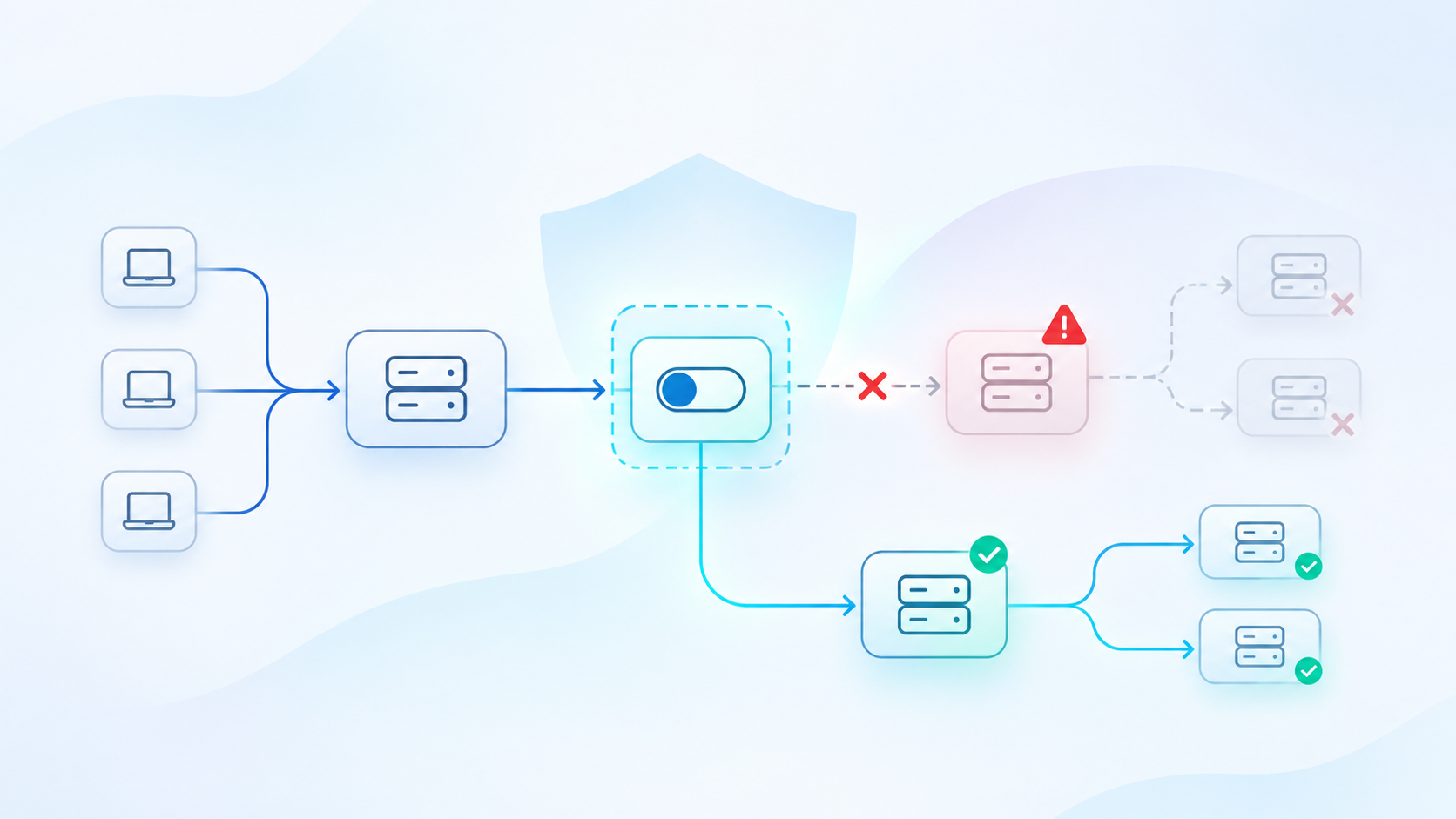
A distributed web system rarely fails because one component stops working. It fails because the rest of the system keeps behaving as though that component is healthy.
A payment API becomes slow. An identity service starts timing out. A recommendation engine experiences database contention. Upstream services keep waiting, retrying, and occupying threads, sockets, connection pools, and worker capacity. The original fault stays local for only a short time. Then latency spreads, queues deepen, and healthy services begin missing their own service-level objectives. That is the operating problem the circuit breaker pattern is designed to contain.
AWS describes the pattern as a way to stop a caller from repeatedly invoking a dependency that is already producing timeouts or failures. Microsoft similarly positions circuit breakers as a mechanism for preventing excessive calls to an unhealthy dependency and supporting graceful degradation. For enterprise engineering teams, the value is preserving capacity in the rest of the platform while a dependency is unstable.
Why can one slow service destabilize an otherwise healthy web platform?
A slow dependency can be more damaging than one that immediately returns a 500 response because it holds scarce resources while callers wait.
Consider an order workflow that synchronously calls inventory, pricing, fraud, payment, and notification services. If payment latency rises sharply, the order service may keep connections open until its timeout expires. Incoming requests continue arriving. Thread pools fill, database connections remain checked out, and load balancers keep routing traffic to instances that are technically alive but increasingly unable to complete work.
Retries can amplify the pressure. A user request that normally produces one downstream call may produce several attempts from the application, API gateway, SDK, or service mesh. When multiple layers retry independently, a dependency failure can become a traffic multiplier.
Short-lived network errors may justify retry with exponential backoff and jitter. A dependency already failing at scale needs a different response: stop sending it normal traffic until there is evidence that recovery has started.
The circuit breaker creates that boundary. Microsoft specifically describes fault isolation as an important property of microservices architectures, provided upstream services are designed to handle downstream failures correctly.
How does a circuit breaker decide when traffic should stop?
A practical breaker is a state machine that evaluates recent outcomes rather than treating every error as equivalent.
- Closed: Requests flow normally while the breaker records successes, timeouts, connection failures, status codes, and latency. The trip condition matters. A low-volume dependency may use consecutive failures, while a high-volume service may need a rolling failure-rate threshold, minimum sample size, and slow-call detection. Opening too aggressively creates unnecessary outages. Opening too late allows the dependency to consume upstream capacity.Open: Calls fail fast without reaching the unhealthy dependency. The caller can use cached data, omit a noncritical feature, enqueue work, route to an alternative, or return a controlled error. This protects upstream resources while giving the failing dependency room to recover instead of facing a retry storm.Half-open: After a recovery interval, the breaker permits limited probe requests. Successful probes indicate that traffic may resume. Failed probes reopen the circuit. Probe volume matters because restoring full production traffic immediately can overload a service that has only partially stabilized.
This three-state model appears across common circuit-breaker implementations and architecture guidance. The harder engineering decision is not implementing the states. It is deciding what constitutes enough evidence to move between them.
Thresholds should reflect request volume, normal latency, dependency criticality, recovery time, and the cost of failing closed versus failing open.
Why do retries and circuit breakers need to be designed together?
Retries answer one question: could the request succeed if the system tries again? Circuit breakers answer another: should the system be trying this dependency at all right now?
A breaker without sensible retry logic may treat small transient faults as a larger outage. Aggressive retries without a breaker can hammer a degraded service until recovery becomes harder.
For idempotent operations, a common sequence is a short timeout, limited retries with exponential backoff and jitter, and a circuit breaker around the dependency. For non-idempotent operations such as payments, retry logic must account for duplicate execution. A timeout does not prove the remote operation failed. It may have completed while the response was lost.
The same coordination is required with bulkheads, rate limits, queues, and load shedding. A circuit breaker protects a dependency path. A bulkhead limits how much shared capacity that path can consume. Rate limiting controls admission. Queues move suitable work out of synchronous paths. Load shedding protects the platform when demand exceeds safe capacity.
Together, these mechanisms make failure containment predictable. Without coordination, a platform can still cascade even if every service has a circuit breaker library installed.
This matters increasingly as organizations move networking controls into service meshes. Microsoft notes that capabilities such as retries, traffic shaping, mutual TLS, and other cross-cutting networking concerns become difficult to maintain consistently in application code as the number of microservices grows.
What should enterprise teams monitor after circuit breakers are deployed?
A breaker should produce operational signals that explain both dependency health and user impact. Teams need state transitions, call volume, failure and timeout rates, slow-call rate, rejected calls, probe outcomes, fallback usage, and recovery duration.
Distributed tracing matters because an open circuit may be the correct response to a failure that originated several hops away. Without traces, teams can mistake the protective action for the root cause. Microsoft explicitly recommends distributed tracing for end-to-end visibility around circuit-breaker behavior.
The business fallback also needs measurement.
A product page may keep loading while recommendations disappear. A banking workflow may fall back to manual review. Checkout may fail fast when payment processing is unavailable. In each case, infrastructure may remain available while customer or operational impact continues.
Engineering leaders therefore need two views of resilience: technical containment and business continuity. The breaker succeeds when it prevents broader resource exhaustion, but the architecture succeeds only when the resulting degraded mode is acceptable.
Failure testing should verify this behavior. Teams can inject latency, timeouts, connection resets, throttling responses, and partial regional failures to confirm that breakers open when expected, fallbacks work, and recovery does not create another traffic surge.
When should a circuit breaker not be the default answer?
Not every distributed interaction needs one.
Microsoft notes that message-driven architectures may already isolate failures through queues, retries, and dead-letter handling. Service meshes and global load balancers can also provide health-based traffic control.
A breaker adds state and tuning overhead. Poor thresholds can create flapping between open and half-open states. Shared breakers can be too coarse if one failing shard or tenant blocks healthy traffic. Breakers placed at several layers can also interact in difficult-to-debug ways.
The decision should start with the failure mode.
What resource becomes exhausted when the dependency slows? How quickly does it saturate? Can the request degrade, defer, route elsewhere, or fail fast? How will recovery be detected?
Those questions produce a safer configuration than framework defaults.
For organizations reviewing broader cloud-native resilience or modernization, outside engineering partners sometimes support dependency mapping, failure-mode analysis, observability, and production hardening. GeekyAnts, Thoughtworks, and Accenture all work across areas that include product engineering, cloud modernization, platform engineering, or distributed application architecture. GeekyAnts positions its engineering work across software development, DevOps, modernization, application support, and AI-powered product engineering, while Thoughtworks and Accenture maintain broader modernization and cloud engineering practices.
The useful criterion is whether the team can connect architecture decisions to production behavior and business impact.
What should engineering leaders ask before the next dependency failure?
The strongest circuit breaker implementations begin with a dependency map and a capacity model, not a code annotation.
Leadership teams should know which synchronous dependencies sit on revenue-critical or customer-critical paths, what happens when each becomes slow rather than fully unavailable, and which upstream resources exhaust first. They should also know whether fallback behavior has been agreed with product and operations teams instead of invented during an incident.
A mature design makes the decision explicit: which failures deserve a retry, which deserve immediate rejection, which can degrade gracefully, and which should trigger regional or provider failover.
That discussion is often more valuable than reviewing the breaker library itself.
For teams operating large distributed web platforms, a focused architecture consultation can map the highest-risk dependency chains, test whether current retry and timeout policies compound failures, and identify where circuit breakers, bulkheads, queues, or alternate paths should sit before the next production incident exposes the answer.