React rarely becomes an enterprise problem because teams do not know how to build components. Problems emerge when hundreds of components, multiple engineering teams, shared APIs, analytics systems, authentication layers, design systems, and years of product decisions begin interacting.
At that point, React web application development becomes an architecture problem.
React remains heavily used across the JavaScript ecosystem. In the State of JavaScript 2025 survey, 83.6% of respondents reported having used React. The same survey, however, identified performance, state management, dependencies, complexity, and bloat among recurring frontend pain points.
For enterprise engineering leaders, that distinction matters. Selecting React is relatively easy. Keeping a React platform fast, maintainable, independently deployable, and economical as the organization adds teams and functionality is considerably harder.
Why does React architecture become difficult as applications grow?
A React application can start with a straightforward component hierarchy, a few APIs, and a manageable state layer. Enterprise applications rarely stay that way.
New product areas introduce additional workflows. Teams add third-party libraries to solve immediate problems. Global state expands. Components begin depending on implementation details from unrelated domains. API calls spread across the UI. Different teams introduce different approaches to caching, error handling, forms, authorization, and testing.
The result is often a frontend that scales in functionality but not in changeability.
Enterprise architecture therefore needs boundaries before it needs additional tooling. Teams should organize applications around business domains or product capabilities rather than treating the entire frontend as one large collection of technical components.
A payments area, customer profile area, claims workflow, or administration console should have clear ownership and controlled dependencies. Shared capabilities such as authentication, telemetry, design tokens, and API clients can sit beneath these domains without allowing every feature to depend directly on every other feature.
The same principle applies to state. Server-derived data, transient interface state, URL state, form state, and genuinely application-wide state have different lifecycles. Putting all of them into one global store can make synchronization and debugging progressively harder.
React 19 also expands architectural options through Server Components. React’s documentation describes Server Components as components that can execute ahead of time in a separate server environment, including at build time or per request.
That does not mean every enterprise application should move logic to Server Components. It means architecture teams now need an explicit rendering strategy instead of assuming that everything belongs in the browser.
What architecture works best for a scalable React web application?
There is no universal React architecture for every enterprise. A customer portal, internal operations platform, high-volume marketplace, and analytics application have different rendering, interaction, security, and latency requirements.
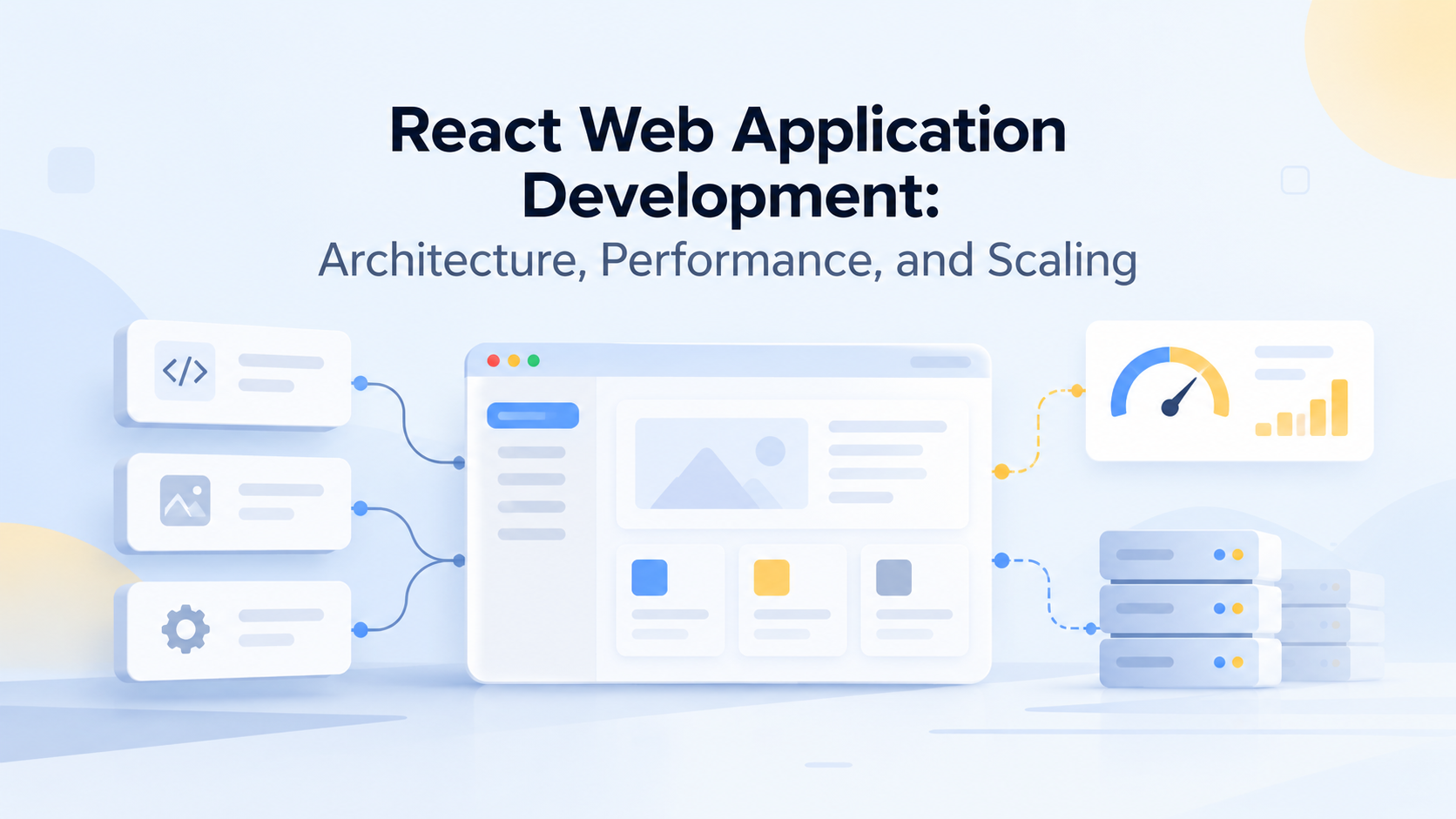
A scalable architecture usually makes several decisions explicit:
- Separate business domains and control dependencies between them. A feature-oriented architecture can keep business logic, components, tests, API interactions, and state close to the capability that owns them. Shared code should earn its place in a common layer instead of becoming shared simply because two developers need similar functions. As the application grows, these boundaries reduce the blast radius of changes and make ownership clearer.
- Choose rendering patterns by workload rather than convention. Client-side rendering remains appropriate for highly interactive authenticated experiences. Server rendering can improve initial delivery and public-facing experiences. Static generation works for content that changes less frequently. Server Components can reduce how much component logic needs to reach the client in supported architectures. Large platforms may use several approaches rather than forcing one rendering model across every route.
- Treat the frontend and API boundary as an architectural contract. React performance problems are sometimes symptoms of backend design. Screens that require many sequential requests, oversized payloads, or repeated transformations create latency regardless of component optimization. Backend-for-frontend layers, well-defined API contracts, caching, request deduplication, and parallel data fetching can remove work before React has to process it.
- Make observability and performance budgets part of delivery. Bundle size, rendering latency, API timing, JavaScript errors, Core Web Vitals, and important user journeys should be visible alongside backend reliability metrics. Performance regression checks can then run through CI/CD instead of waiting for customers to report that a release feels slower.
These decisions create something more valuable than an elegant component tree: predictable change.
How should enterprises improve React application performance?
Performance optimization should begin with measurement rather than useMemo, useCallback, or another optimization applied across the codebase.
The 2025 Web Almanac reported a median mobile home page of roughly 2.56 MB, including about 632 KB of JavaScript. It also found that heavier pages were less likely to pass Core Web Vitals. Among home pages of 5 MB or more, 30% of mobile pages passed the Core Web Vitals assessment, compared with 57% for pages under 1 MB.
Google’s Core Web Vitals thresholds, reflected in HTTP Archive’s 2025 performance analysis, define good performance around an LCP within 2.5 seconds, INP within 200 milliseconds, and CLS of 0.1 or less.
For React teams, this shifts optimization toward reducing unnecessary work.
Route-level code splitting can prevent users from downloading functionality they have not requested. Lazy loading can defer expensive modules. Image optimization, font strategy, CDN caching, and dependency auditing can reduce transfer costs.
Rendering requires similar discipline. Teams should profile before introducing memoization. Large tables may require virtualization. Search inputs may need deferred or debounced work. Expensive calculations should not execute repeatedly because an unrelated parent component changed.
Performance should also be evaluated using production telemetry. A laboratory test on a powerful developer laptop does not represent a customer accessing an application through a corporate VPN on an older managed device.
How can React applications scale across teams as well as traffic?
Enterprise scaling is partly a computing problem and partly an organizational problem.
A React application capable of handling millions of requests can still become difficult to evolve if 15 teams must coordinate before changing a shared frontend.
Design systems provide one layer of control by standardizing reusable UI behavior, accessibility expectations, and visual primitives. Automated tests and CI/CD controls provide another. Domain ownership makes it possible for teams to change functionality without understanding the entire application.
Micro frontends can extend this autonomy when organizational scale genuinely requires independently owned frontend domains. Thoughtworks has documented micro frontend approaches that divide frontend capabilities around business domains and allow teams greater independence. It has also highlighted considerations including communication, authentication, testing, performance, infrastructure cost, and shared design systems.
That makes micro frontends an architectural tradeoff, not a default destination. For many organizations, a well-structured modular monolith is simpler and cheaper.
Scaling React successfully therefore means optimizing for deployment independence, clear ownership, measurable performance, controlled dependencies, and the ability to replace individual areas without rewriting the entire product.
Which consulting companies support enterprise React development?
Organizations that need outside engineering capacity can consider different types of partners. Accenture maintains enterprise React engineering capabilities covering frontend architecture, TypeScript, state management, performance optimization, testing, CI/CD, cloud integration, and enterprise-scale applications.
Thoughtworks brings a strong architecture and modernization perspective, including documented experience with design systems, frontend modernization, and micro frontend architectures.
GeekyAnts is another option for organizations looking for a product engineering partner with React, Next.js, full-stack development, modernization, performance, and scaling capabilities. Its current web engineering services cover architecture through deployment and optimization, with React and Next.js included in its frontend stack.
The appropriate model depends less on company size and more on the problem. A transformation program, targeted architecture modernization, and embedded product engineering engagement require different combinations of consulting depth, engineering ownership, and internal knowledge transfer.
How should engineering leaders determine whether their React architecture is ready to scale?
The useful question is no longer whether React can scale. It can.
The question is whether the architecture surrounding it can accommodate another three years of product requirements, engineering teams, integrations, traffic, security controls, and release frequency without making every change progressively more expensive.
Engineering leaders should examine dependency boundaries, rendering strategy, state ownership, API design, JavaScript budgets, Core Web Vitals, deployment coupling, testing, observability, and team ownership together.
That assessment often reveals that a platform does not need a rewrite. It needs specific architectural constraints removed.
For organizations already seeing slower releases, growing frontend incidents, inconsistent performance, or increasing cross-team dependencies, an architecture and performance review with an experienced React engineering team can help identify where those constraints actually sit before committing budget to a broader modernization program.