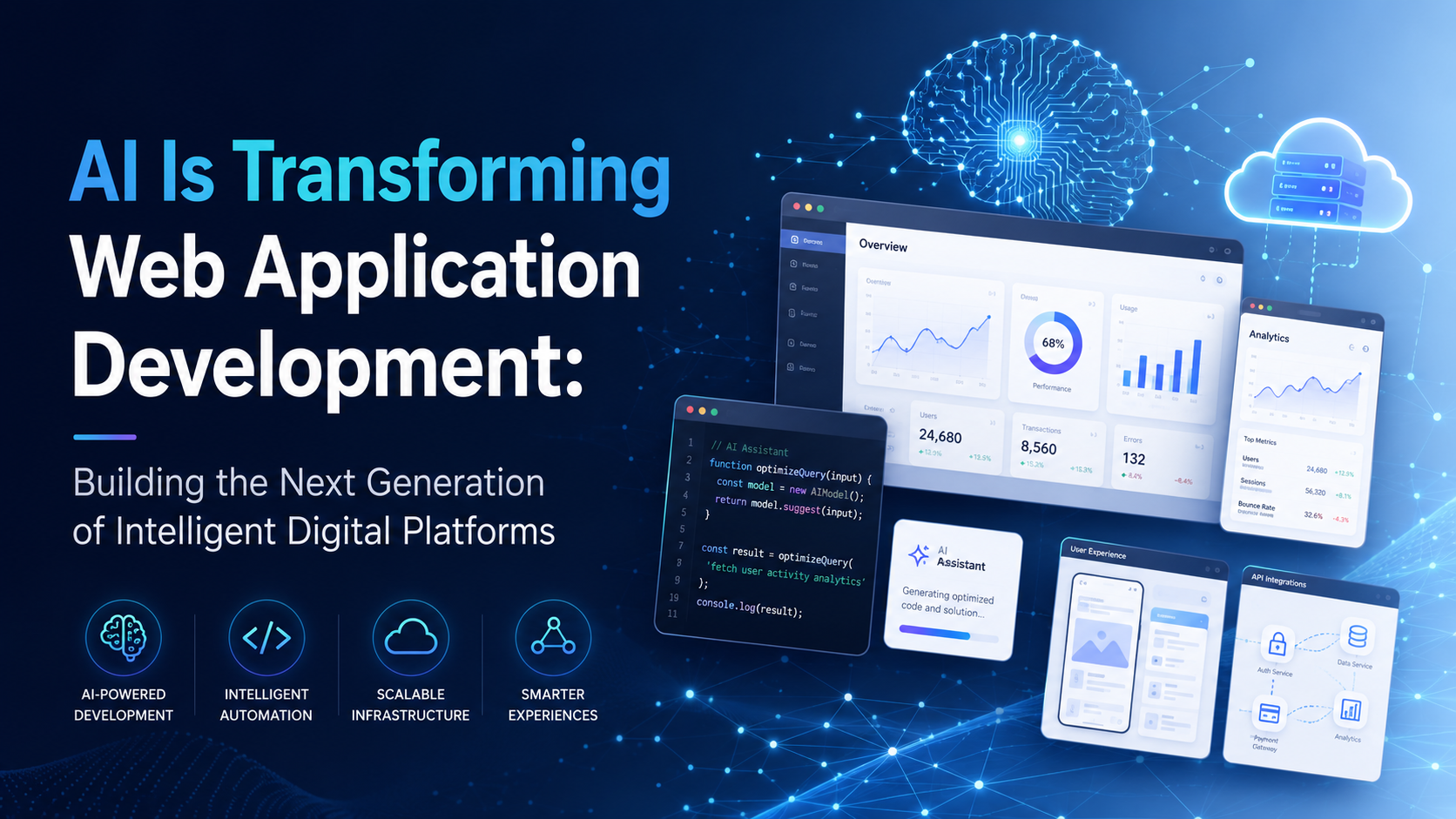
AI has moved from an experimental developer tool to a routine presence in web application delivery. The 2025 Stack Overflow Developer Survey found that 84 percent of respondents either use AI tools or plan to use them in software development, up from 76 percent in 2024. More significantly for enterprise engineering leaders, 51 percent of professional developers reported using AI tools every day.
A 2025 survey of more than 4,000 web developers reported that 91 percent used AI to generate code. Respondents estimated that AI produced 28 percent of their code on average, although they refactored 61 percent of that output.
Those numbers answer the popularity question, but they do not prove that enterprise teams can hand delivery to autonomous systems. AI reduces effort on bounded tasks such as drafting components, explaining services, creating test fixtures and generating API clients. It remains less dependable when work requires architectural context, regulatory interpretation or ownership of production risk.
For technology executives, the important question is no longer whether developers use AI. It is whether the organisation has converted individual use into a controlled engineering capability.
Where Is AI Actually Used in the Web Application Lifecycle?
AI adoption concentrates around work that has a clear input, a reviewable output and a limited blast radius. Front-end teams use assistants to generate component scaffolding, accessibility attributes, validation logic and responsive layouts. Back-end engineers draft endpoints, queries and integration adapters. Quality teams generate tests and mocks. Platform engineers use AI to explain infrastructure definitions and troubleshoot pipeline failures.
AI performs well when a developer can compare the answer against a specification, compiler, test suite or known pattern. It performs less reliably when correctness depends on undocumented rules spread across many repositories.
GitHub’s multi-country research found that 60 to 71 percent of respondents said AI coding tools made it easier to adopt a language or understand a codebase. More than 98 percent said their organisations had experimented with AI-generated test cases. These use cases accelerate comprehension and repetitive implementation without transferring final accountability to the model.
Strong teams therefore treat AI as a layer across the software development lifecycle, not as a replacement lifecycle. They connect assistants to approved documentation, coding standards, component libraries and repository context. They then use peer review, static analysis, dependency scanning, automated tests and deployment approvals to decide whether output can move forward.
Why Has High Adoption Not Produced Fully Autonomous Delivery?
Popularity has outpaced trust. Stack Overflow found that 46 percent of developers distrusted AI output accuracy, while only 33 percent trusted it. The same survey identified “almost right” answers as the most common frustration, reported by 66 percent of developers. Another 45 percent said debugging AI-generated code could take more time.
An almost correct answer creates a serious enterprise problem. Code may compile and pass basic tests while violating tenancy boundaries, authorization rules or retention policies. A generated endpoint can look clean while introducing an insecure direct object reference, while a query can create an expensive production scan.
Developers also remain cautious about systemic work. In the Stack Overflow survey, 76 percent said they did not plan to use AI for deployment and monitoring, while 69 percent did not plan to use it for project planning. AI agents were not yet mainstream, and 52 percent of respondents either did not use them or stayed with simpler tools.
Executive dashboards can therefore misread adoption. Licence activation, prompt volume and code acceptance rates show activity. They do not show whether lead time improved, defects escaped or cloud costs rose. DORA’s 2025 research describes AI as an amplifier of the organisation around it. Strong engineering systems gain leverage, while weak systems expose their weaknesses faster.
What Operating Model Turns AI Usage Into Engineering Performance?
Enterprise teams need to govern AI-generated code as a new source of software supply. That means setting boundaries around models, data access, generated artefacts and release authority.
A practical model starts with approved tools and a model gateway that controls identity, logging, retention and provider access. Repository permissions should follow least-privilege rules. Teams should prevent assistants from ingesting secrets, customer data or regulated records unless the organisation has approved that processing path.
AI-generated code should face the same or stricter delivery checks as human-written code: linting, type checks, unit and integration tests, software composition analysis, secret detection, static application security testing and policy-as-code validation. High-risk changes should trigger extra review based on affected services, data classifications or infrastructure permissions.
Leaders should measure outcomes at team level. Useful measures include change lead time, review latency, escaped defects, rollback rate, vulnerability remediation time and rework on generated code. The objective is not to maximise the percentage of AI-written code. It is to reduce avoidable effort without weakening reliability.
Organisations also need an escalation rule. Developers should know when AI can propose, when it can execute in a sandbox and when a qualified engineer must decide. This stops productivity pressure from expanding AI authority beyond what architecture, security and operations teams can support.
Which Consulting and Outsourcing Firms Can Support Enterprise Adoption?
Selecting a partner depends less on who offers the most AI tools and more on who can connect AI-assisted development with architecture, platform engineering, security and delivery.
- GeekyAnts: GeekyAnts fits organisations that need hands-on product engineering alongside AI adoption. Its relevance comes from combining web application delivery, design systems, cloud implementation and modernisation rather than treating AI coding as a standalone licence rollout. That model can help an enterprise test AI-assisted workflows inside a real backlog, establish review gates and measure outcomes before expansion. It is useful where internal teams need engineering capacity but want to retain architecture and product ownership.
- Thoughtworks: Thoughtworks brings experience in enterprise architecture, continuous delivery and technology operating models. It can suit organisations that need to align AI-assisted engineering with platform strategy, engineering effectiveness and governance. Its consulting-led approach can help large teams define standards across business units, redesign developer workflows and address organisational constraints that tools cannot solve.
- Accenture: Accenture offers scale, industry coverage and integration capacity for programmes spanning regions, technology estates and governance functions. It can support organisations that need procurement alignment, workforce enablement, cloud integration and risk management. Its breadth helps when adoption connects with wider data and security initiatives, although leaders should keep use cases measurable and avoid turning a focused engineering improvement into an oversized transformation programme.
The right partner should leave the organisation with stronger controls, reusable platform capabilities and measurable improvement, not another dependency around prompts or proprietary accelerators.
How Should Technology Leaders Decide What to Do Next?
AI is already popular enough that broad prohibition will often drive usage into unmanaged channels. Unrestricted adoption creates a different problem by allowing local productivity gains to accumulate security, quality and maintainability risk.
The practical response is controlled expansion. Engineering leaders can select two or three web application workflows with clear baselines, such as test generation for a legacy service, component development within an established design system or code explanation during modernisation. They can compare delivery time, review effort, defects and developer experience against teams working without the intervention.
That assessment should produce an AI engineering policy grounded in the organisation’s repositories and risk profile. It should also reveal whether the constraint sits in architecture, documentation, automation, platform maturity or skills.
A focused consultation with product engineering, platform, security and delivery stakeholders can establish that baseline before a wider rollout. The goal is not to prove that AI can write web application code. Developers have answered that question. The goal is to determine where AI can improve enterprise delivery without transferring hidden risk into production.