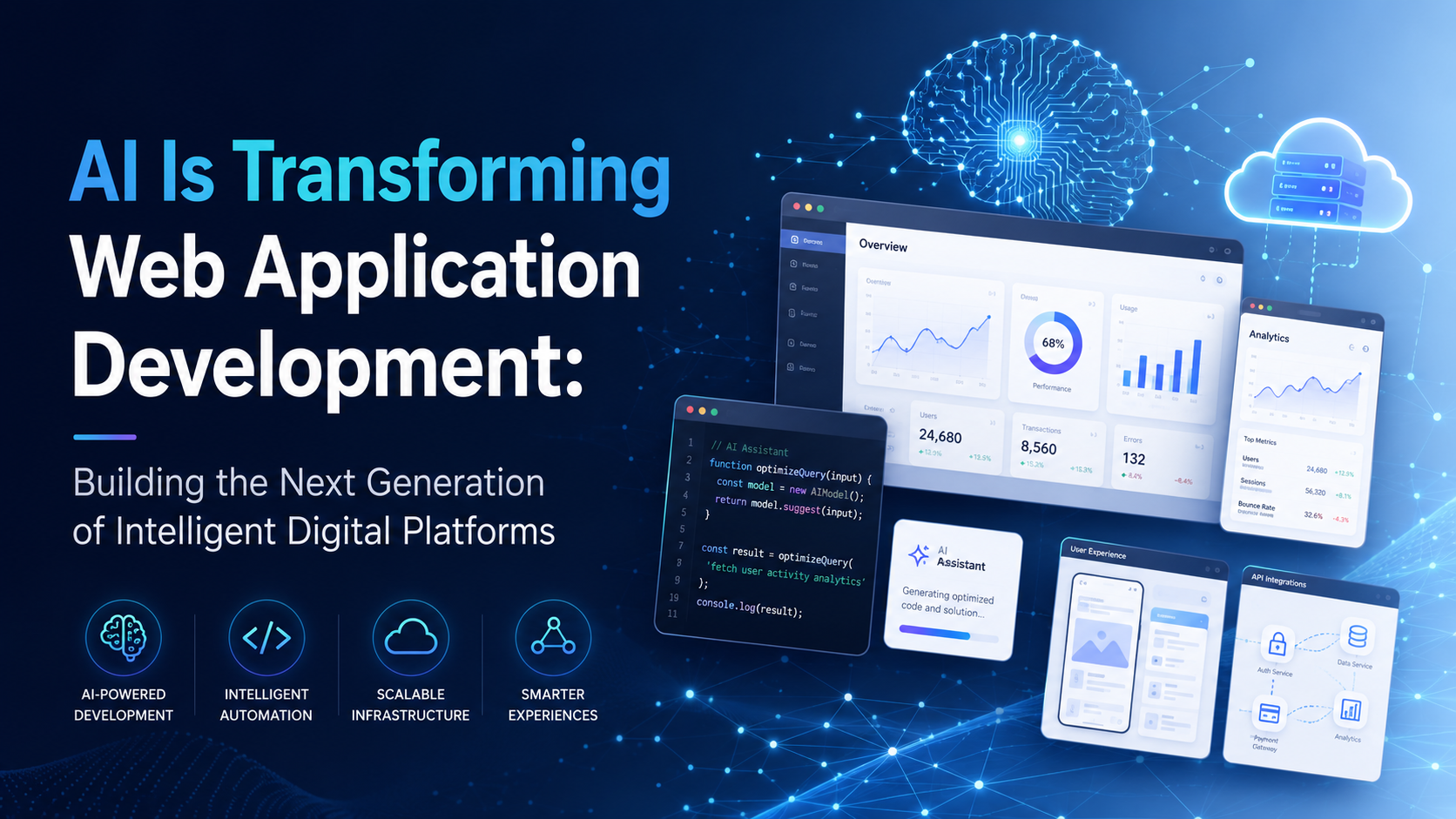
There was a time when web applications were built primarily to display information, collect user inputs, and simplify online transactions. Today, that definition feels outdated. Artificial intelligence is fundamentally changing what businesses expect from their digital products, turning ordinary web applications into intelligent platforms capable of learning, adapting, and automating complex tasks.
From personalized customer experiences to autonomous business workflows, AI has become one of the biggest drivers of innovation in web application development. Companies that embrace this shift are creating products that are not only faster and more scalable but also significantly more valuable to users.
Web Applications Are Becoming Smarter
Modern users expect more than responsive interfaces and attractive designs. They want applications that understand their preferences, anticipate their needs, and reduce the effort required to complete everyday tasks.
AI enables web applications to recommend products, summarize documents, generate content, analyze customer behavior, detect anomalies, and provide intelligent assistance in real time. These capabilities are no longer limited to technology giants. With cloud-based AI services and advanced machine learning models becoming more accessible, businesses of every size can integrate intelligence into their products.
As a result, web applications are evolving from digital tools into active participants in business operations.
AI Is Only One Part of the Equation
Adding an AI model to a web application is relatively straightforward. Building an application that can reliably use AI at scale is where the real engineering challenge begins.
A successful AI-powered platform requires secure APIs, scalable infrastructure, efficient databases, continuous monitoring, robust authentication, and governance policies that ensure data privacy and compliance. Without these foundations, even the most advanced AI features can become unreliable in production.
This is why experienced engineering teams focus on the complete architecture rather than treating AI as a standalone feature.
Performance Still Defines the User Experience
Artificial intelligence introduces new opportunities, but it also increases computational demands. Every recommendation engine, chatbot, or intelligent search feature consumes additional resources.
To maintain excellent performance, developers optimize frontend rendering, reduce unnecessary API requests, implement caching strategies, and leverage cloud infrastructure that can scale automatically during traffic spikes.
Users may appreciate intelligent features, but they still expect applications to respond instantly. Fast performance remains one of the strongest indicators of software quality.
Security Becomes Even More Important
As AI-powered applications process larger amounts of customer data, protecting that information becomes increasingly critical.
Modern web applications must incorporate encrypted communication, secure authentication, access controls, audit logging, and continuous vulnerability monitoring. Organizations operating in healthcare, finance, and enterprise software must also consider regulatory requirements while integrating AI into their platforms.
Security is no longer a feature added before launch. It is an ongoing engineering practice that supports user trust throughout the product’s lifecycle.
Integration Drives Business Value
Few businesses rely on a single platform. Today’s web applications connect with payment gateways, CRM systems, ERP platforms, cloud storage, communication tools, analytics services, and AI providers.
The ability to integrate seamlessly across these systems determines how useful a product becomes. Well-designed APIs and scalable backend architectures allow businesses to automate workflows, eliminate manual tasks, and deliver a more connected user experience.
As organizations adopt more AI tools, integration will become even more important.
Designing for Intelligent Experiences
Great user experience now extends beyond visual design. AI allows applications to personalize dashboards, simplify navigation, automate repetitive actions, and surface relevant information exactly when users need it.
The most successful products combine intuitive design with intelligent functionality. Instead of overwhelming users with features, they reduce complexity and help people accomplish tasks more efficiently.
This balance between design and intelligence is becoming a defining characteristic of modern web applications.
The Importance of Experienced Product Engineering
Building AI-enabled web applications requires expertise across frontend development, backend architecture, cloud infrastructure, DevOps, security, and product strategy.
Many organizations work with engineering partners that understand how these technologies fit together in production environments. Companies such as GeekyAnts have contributed to this evolution by delivering scalable web platforms, modern design systems, AI-enabled solutions, and cloud-native applications for businesses across multiple industries. Their approach reflects a broader industry trend where successful products are built with long-term scalability, maintainability, and user experience in mind.
The Future of Web Application Development
Artificial intelligence is not replacing web application development. It is expanding what web applications are capable of achieving.
The next generation of digital products will automate workflows, provide deeper insights, personalize every interaction, and continuously improve through data and machine learning. Businesses that invest in modern architectures, secure engineering practices, and responsible AI integration will be better positioned to compete in an increasingly digital economy.
The future belongs to web applications that do more than respond to user requests. They will understand context, support decision-making, and become intelligent platforms that help organizations innovate, grow, and deliver exceptional customer experiences.