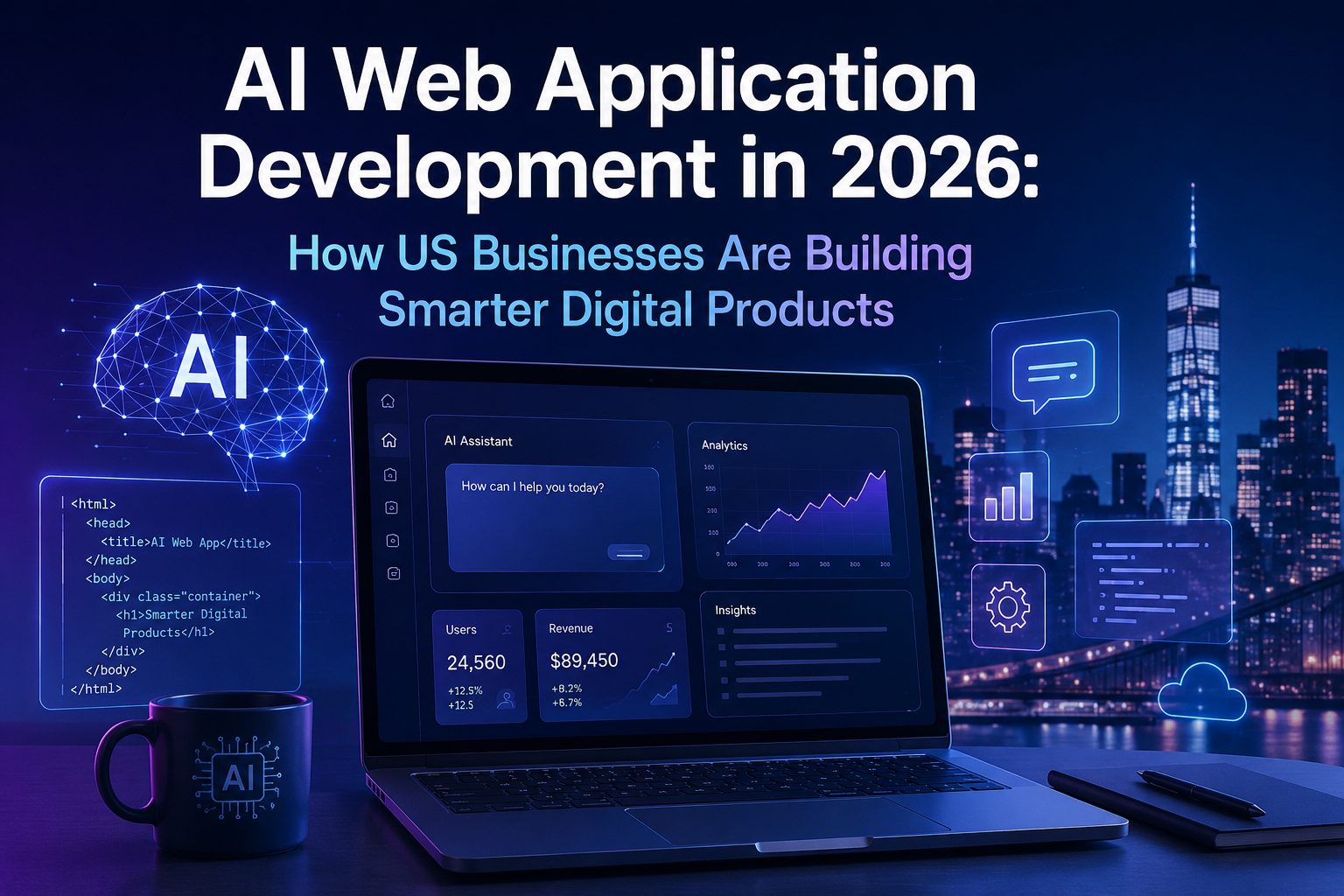
Artificial intelligence has become one of the biggest drivers of innovation in web application development. What was once considered an experimental feature has quickly evolved into a business necessity. Across the United States, companies are embedding AI into customer portals, SaaS platforms, enterprise dashboards, healthcare systems, financial applications, and eCommerce solutions to improve efficiency, personalize user experiences, and automate decision-making.
Yet, building an AI-powered web application isn’t simply about integrating a large language model or adding a chatbot to an existing product. The real challenge lies in designing applications that are scalable, secure, and capable of delivering consistent business value. As organizations increase their AI investments, the conversation has shifted from “Can we use AI?” to “How do we build AI applications that customers and employees actually trust?”
AI Is Changing What Businesses Expect From Web Applications
Modern web applications are no longer static systems that display information or process transactions. They are becoming intelligent platforms capable of understanding user behavior, generating insights, automating repetitive tasks, and assisting users in real time. Whether it’s an online retailer recommending products based on browsing history, a healthcare provider summarizing patient records, or a financial institution detecting suspicious transactions, AI is transforming how businesses interact with both customers and employees.
This evolution has raised expectations for software development teams. Businesses are no longer looking for applications that simply function well. They want products that continuously learn, improve, and create measurable operational efficiencies. As a result, web application development has become closely tied to AI engineering, cloud infrastructure, data management, and responsible governance.
Building AI Applications Requires More Than Model Integration
One of the most common misconceptions surrounding AI development is that success depends primarily on selecting the right AI model. In reality, the model is only one component of a much larger system.
A production-ready AI web application requires clean data pipelines, scalable cloud infrastructure, secure APIs, robust authentication, monitoring, and mechanisms to evaluate model performance over time. Many organizations discover that these engineering challenges consume significantly more effort than integrating the AI itself.
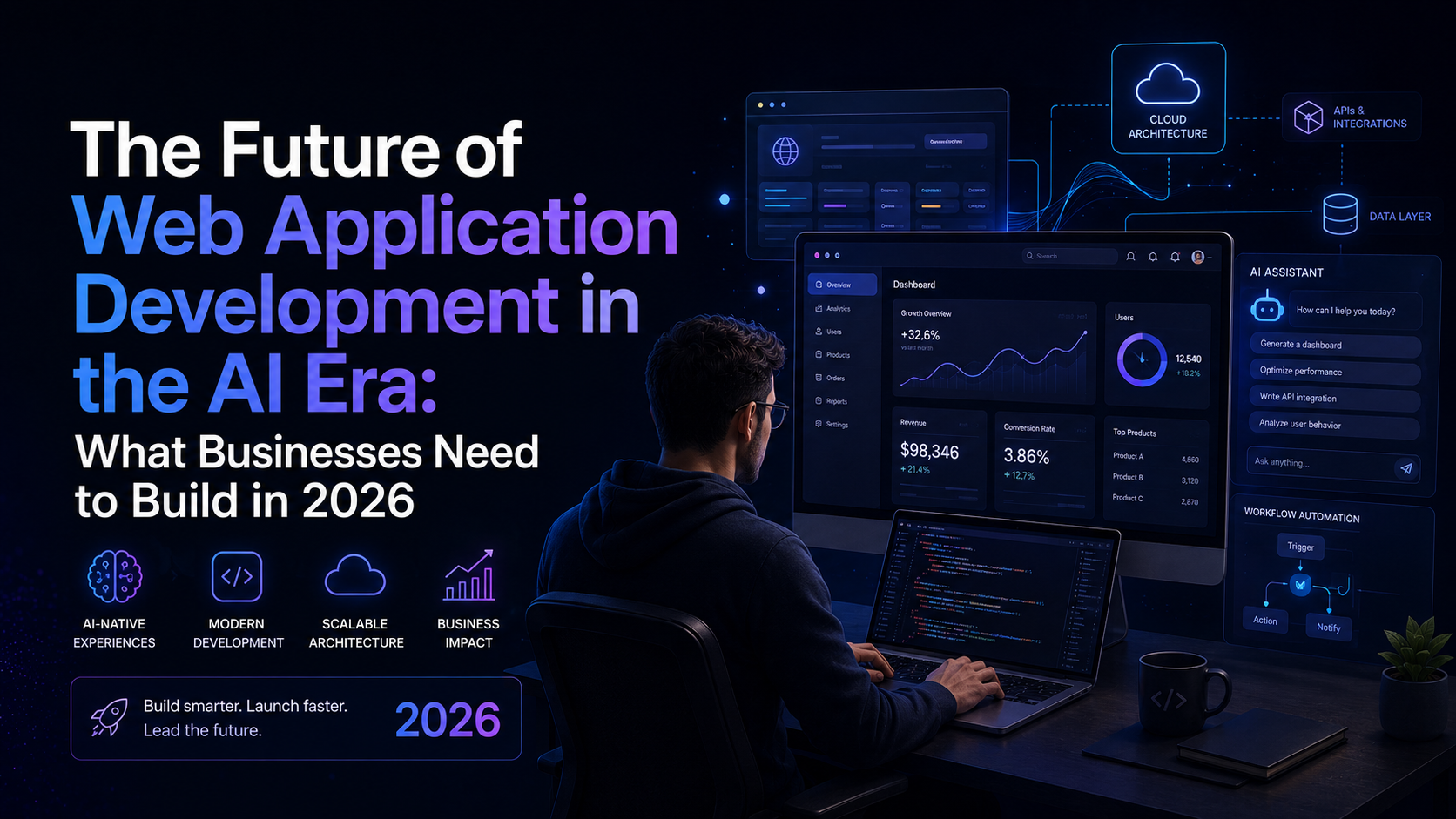
Frameworks such as React and Next.js continue to dominate frontend development, while cloud-native architectures allow businesses to deploy AI capabilities without sacrificing performance or reliability. At the same time, technologies like Retrieval-Augmented Generation (RAG), vector databases, and AI observability tools are becoming standard components of enterprise AI solutions because they improve accuracy while giving organizations greater control over generated responses.
The companies seeing the greatest success are treating AI as part of their overall software architecture rather than as an isolated feature.
Choosing the Right Development Partner Matters More Than Ever
As demand for AI-powered applications grows, software development firms have rapidly expanded their AI offerings. However, not every company has experience delivering production-grade AI systems.
Businesses evaluating technology partners should look beyond marketing claims and focus on engineering expertise, cloud architecture capabilities, security practices, and real-world implementation experience. A strong AI development partner understands not only how to integrate machine learning models but also how to build applications that remain maintainable as technologies evolve.
Several companies have established themselves as trusted names in this space. GeekyAnts has earned recognition for delivering modern web applications using technologies like React, Next.js, and React Native while expanding its expertise into AI product engineering. The company works with startups and enterprises to build intelligent digital platforms that combine user-centric design with scalable engineering. Global consulting firms such as Accenture continue to support large-scale enterprise AI transformation initiatives, while EPAM Systems focuses on engineering complex digital products across industries including healthcare and finance. Thoughtworks has built a reputation for modern software architecture and responsible AI adoption, whereas Globant combines AI engineering with digital experience design to help organizations accelerate innovation.
Each company approaches AI development differently, making it important for businesses to evaluate technical capabilities alongside industry expertise and long-term product strategy.
Why Many AI Projects Fail Before They Scale
Despite growing investment, many AI initiatives fail to deliver expected returns. In many cases, the problem isn’t the technology itself but the planning process behind it.
Organizations often rush to implement AI without clearly defining the business problem they want to solve. Others underestimate the importance of high-quality data, user experience, security, or infrastructure planning. Some projects perform well during demonstrations but struggle under real production workloads because scalability wasn’t considered from the beginning.
Successful AI applications are typically built through continuous iteration. Teams monitor model performance, collect user feedback, improve prompts, optimize infrastructure, and refine workflows based on real usage patterns. Rather than treating deployment as the finish line, they view it as the beginning of an ongoing optimization process.
The Future of AI Web Application Development
Over the next few years, AI will become a foundational layer of web application development rather than a premium feature. Businesses will increasingly rely on intelligent search, AI copilots, automated content generation, predictive analytics, and workflow automation as standard capabilities within their digital products.
At the same time, organizations will place greater emphasis on transparency, governance, and cost optimization. Choosing the right AI model will remain important, but factors such as observability, compliance, infrastructure efficiency, and long-term maintainability will play an even larger role in determining project success.
For companies planning new digital products, this means investing in strong engineering practices from day one instead of treating AI as an add-on feature.
Final Thoughts
The future of web application development is inseparable from artificial intelligence. Businesses that embrace AI thoughtfully are creating software that not only automates work but also helps employees make better decisions, improves customer experiences, and unlocks new revenue opportunities. Achieving those outcomes requires far more than integrating an AI API. It demands thoughtful architecture, reliable infrastructure, secure data practices, and experienced engineering teams capable of building products that can evolve with rapidly changing technology.
Whether working with firms like GeekyAnts, Accenture, EPAM Systems, or another experienced development partner, organizations should focus on finding a team that understands both modern web engineering and the practical realities of deploying AI in production. In 2026, that combination will be one of the strongest competitive advantages any business can have.