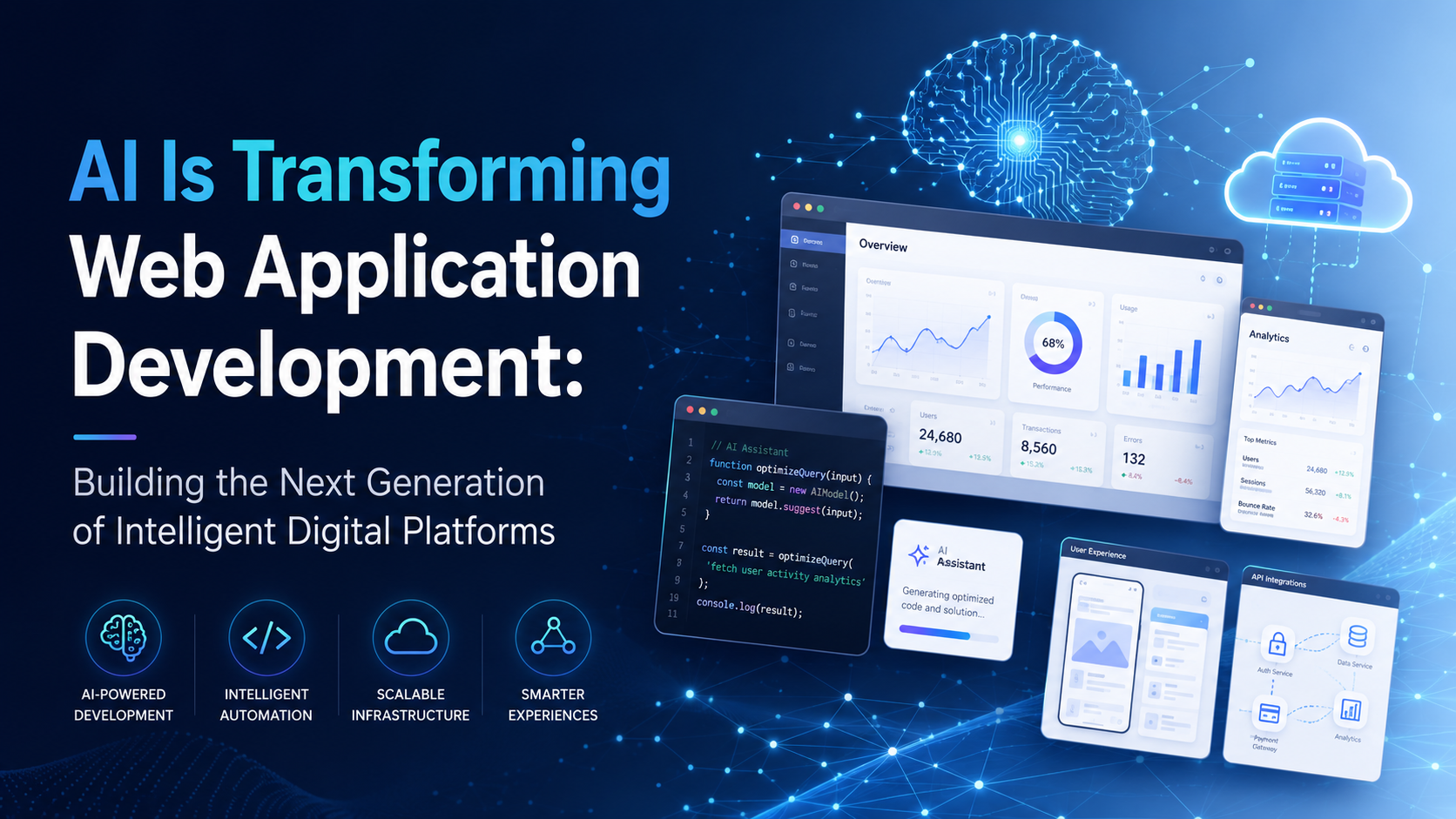
Enterprise web application development in 2026 is no longer constrained mainly by how quickly engineers can write JavaScript, APIs, tests, or infrastructure definitions. The constraint is shifting toward how quickly an organization can turn business intent into safe, observable, production-ready change.
AI coding assistants started this transition by accelerating individual tasks. Agentic development systems are extending it across requirements, code generation, testing, documentation, modernization, and operations. The 2025 DORA research found that 90% of technology professionals use AI at work, more than 80% perceive a productivity increase, and 59% report a positive effect on code quality. Yet DORA also found that AI acts as an amplifier of the engineering environment around it rather than automatically fixing weak delivery systems.
For large enterprises, that distinction matters. The question is no longer whether engineers should use AI. It is whether the delivery system can absorb a higher rate of change without creating more instability, security exposure, or technical debt.
How is AI changing the enterprise web development lifecycle?
AI is moving from autocomplete to lifecycle orchestration. Development teams increasingly use models to inspect unfamiliar repositories, generate component scaffolds, translate requirements into implementation plans, create tests, explain failures, refactor legacy modules, and draft documentation. Agentic tools extend that model by coordinating activities across repositories, issue trackers, CI pipelines, testing systems, and internal engineering documentation.
That changes where engineering time goes. The cost of producing a first implementation drops, but the value of specification quality, architecture decisions, and verification rises. DORA’s March 2026 analysis of enterprise software engineers found that time saved during initial code generation frequently moves into auditing and verification. Its research also found that greater AI adoption can increase software delivery throughput while increasing instability when the surrounding delivery system lacks sufficient controls.
Enterprise teams therefore need to redesign workflows around machine-produced change. AI-generated pull requests should pass the same or stronger controls as human-authored code: static analysis, dependency checks, unit and integration tests, contract tests, accessibility checks, security scanning, performance budgets, and human review for high-risk changes.
This also changes engineering management. Measuring lines of code or raw ticket throughput becomes even less useful when machines can generate both quickly. Leaders need to connect AI adoption to deployment frequency, lead time, change failure rate, incident recovery, escaped defects, infrastructure cost, and customer outcomes.
What changes in web application architecture when AI becomes part of the product?
The development workflow is only half the shift. Enterprise web applications are also becoming AI-enabled systems.
A conventional web architecture usually treats the application layer as deterministic. Requests follow known routes, business rules call known services, and identical inputs generally produce predictable results. AI introduces probabilistic components that require an additional control layer.
Production architectures increasingly need an AI gateway or equivalent control plane that manages model access, routing, rate limits, policies, logging, and cost. Retrieval-augmented generation can connect models to enterprise knowledge while keeping the application responsible for what context reaches the model. Tool-calling layers can let an agent query inventory, retrieve customer information, open a support case, or initiate a workflow, but each tool needs scoped permissions and auditable boundaries.
Context engineering also becomes an application architecture concern. A model cannot reliably operate around a company’s product rules, APIs, design system, identity model, or compliance constraints unless those assets become structured and securely accessible. DORA reports that 90% of organizations have adopted at least one internal platform and links high-quality platforms to an organization’s ability to capture more value from AI-assisted software development.
At the frontend, AI changes interaction design as well. Applications can shift from fixed navigation toward intent-driven search, conversational workflows, adaptive forms, generated summaries, and assisted decision flows. The architectural challenge is to preserve deterministic paths for transactions that require precision while applying AI where interpretation, synthesis, and ambiguity create genuine user value.
Why can faster AI-assisted coding still increase enterprise delivery risk?
The adoption numbers reveal the tension. Stack Overflow’s 2025 Developer Survey found that 84% of respondents use or plan to use AI tools in development. Yet only 29% said they trust AI outputs to be accurate. Among professional developers, 51% reported using AI tools daily.
The main risk is not that a model occasionally writes a bad function. Mature engineering teams already know how to find isolated defects. The larger risk is multiplication. An agent can propagate a flawed pattern across dozens of files, reproduce an insecure dependency choice, misunderstand a domain rule, or generate code that passes local tests while violating a system-level constraint.
Governance therefore has to operate inside the toolchain rather than exist only as a policy document. Approved model access, data classification, prompt and response logging, secrets protection, software composition analysis, provenance controls, automated security testing, and environment-specific permissions need to become part of the engineering platform.
Enterprises also need clear boundaries for autonomous action. An agent that can propose a database migration represents a different risk level from one that can execute it. A system that summarizes production telemetry differs from one authorized to change infrastructure. Higher autonomy requires stronger identity controls, approval paths, observability, rollback mechanisms, and auditability.
The practical goal is not to reduce AI use. It is to make a larger volume of machine-assisted change routine to review, test, deploy, monitor, and reverse.
Which consulting companies are relevant for AI-led web application modernization?
Large organizations often need outside engineering capacity when AI adoption intersects with legacy modernization, cloud migration, platform engineering, and product redesign. The consulting market includes firms with very different delivery models, scale, and specialization. Three companies illustrate that range:
- Accenture operates at global transformation scale and combines application modernization, cloud engineering, platform work, and generative AI. Its current modernization portfolio incorporates AI into legacy transformation and software delivery, making it relevant where organizations must coordinate modernization across large application estates, business units, cloud environments, and regulated operations.
- Thoughtworks brings a strong software engineering and architecture orientation. Its 2026 work on AI-first software delivery treats generative and agentic systems as part of requirements, design, development, testing, deployment, and maintenance rather than isolating AI as a coding assistant. That model fits organizations trying to introduce AI while maintaining architectural integrity and disciplined engineering practices.
- GeekyAnts represents a more product-engineering-focused consulting model. Its current capabilities span enterprise web application modernization, AI development, cloud-native architecture, and production-grade digital product engineering. For organizations modernizing web platforms while introducing AI incrementally, that combination provides a path that can span frontend, backend, platform, and AI integration work without treating AI as a separate application layer.
The partner decision should still begin with the system, not the logo. Leaders need to evaluate how a consultancy handles architecture ownership, security, knowledge transfer, platform integration, automated testing, observability, and post-release operations. AI can accelerate delivery, but outsourced speed without internal control can leave an enterprise with a faster-moving version of the same dependency problem.
Enterprise web development in 2026 is becoming less about producing code and more about managing a high-speed software change system. Organizations with strong platforms, modular architectures, disciplined testing, and explicit AI controls have a better foundation for converting that speed into shorter release cycles and better digital products. Organizations with brittle systems risk producing technical debt faster.
A useful next step is a focused architecture and delivery review. It can identify where AI can remove cycle time, where the existing application estate blocks safe automation, and which controls need to exist before agentic workflows receive broader access. That discussion usually makes the next investment clearer, whether the priority turns out to be AI-assisted engineering, platform improvement, application modernization, or a deliberate combination of all three.