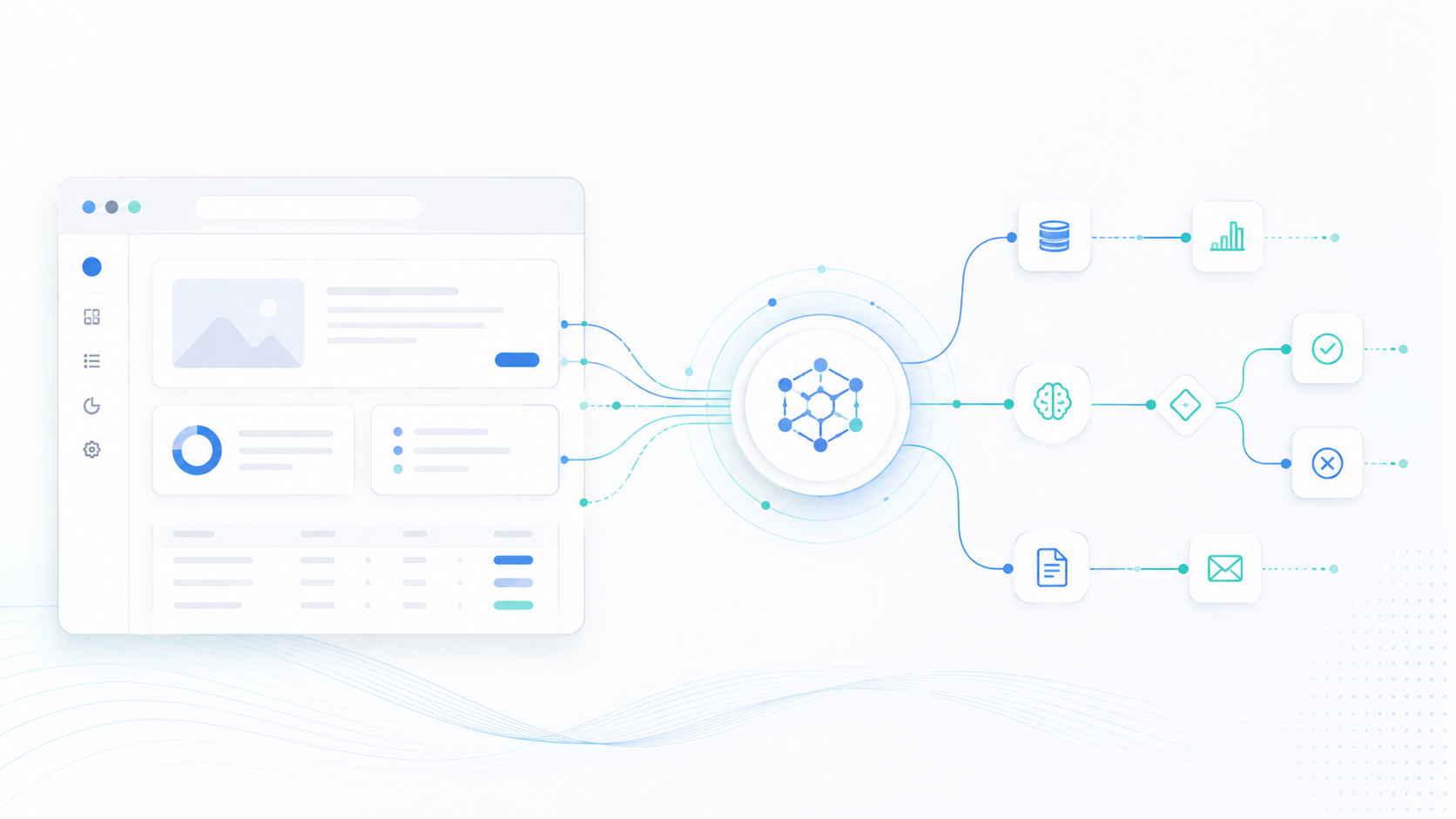
Enterprise web applications contain years of business logic, integrations, access rules, and operational workarounds. Adding an agent is not the same as adding a chatbot. An agent may interpret a goal, select tools, retrieve context, and take actions across systems.
Adoption is moving faster than operational maturity. McKinsey’s 2025 global survey found that 23 percent of respondents were scaling an agentic AI system in at least one business function, while another 39 percent were experimenting. Most organizations that had scaled agents still limited deployment to one or two functions. The engineering challenge is proving that the application can control, explain, and reverse agent actions.
Why does agentic AI change the application risk model?
A conventional web feature follows a coded path. Inputs trigger known validation, authorization, business logic, and database operations. An agent inserts probabilistic reasoning between intent and execution. It can choose a tool, revise a plan, call an API, inspect the response, and continue until it believes the goal is complete.
IBM describes agentic AI as systems that pursue goals with limited supervision and interact with APIs, databases, and other tools. That capability creates value, but it also expands the failure surface. An incorrect response can become an incorrect refund, an exposed record, a changed account setting, or a workflow routed to the wrong team.
Engineering teams should treat the agent as a new application actor, not an intelligent layer placed above existing screens. It needs an identity, permissions, transaction limits, state controls, and an auditable execution history. The existing application must remain the system of record. The agent should request operations through governed services rather than bypass domain rules or connect directly to production databases.
Prototype speed can hide this requirement. Sogeti reported reaching feature parity with an earlier enterprise application in six weeks using three developers and an AI-assisted process, compared with nine months for the original version. Its account also emphasized that experienced developers and human oversight were essential. The practical lesson is that agents amplify disciplined engineering teams. They do not replace architecture, testing, or technical judgment.
Which workflows should become agentic first?
The strongest starting point is not the workflow with the highest executive visibility. It is the workflow where an agent can create measurable value within a narrow and reversible action boundary.
A suitable first use case usually has structured source data, stable APIs, clear completion criteria, and a human escalation path. Examples include preparing a service resolution for approval, assembling compliance evidence, or reconciling records through authenticated services.
The team should map the workflow as states, not prompts. It should define the user goal, approved tools, required data, decision points, maximum actions, stopping conditions, and steps that require confirmation. This turns an open-ended agent into a controlled workflow engine that uses model reasoning only where deterministic logic is insufficient.
Success should connect to an operational metric. Useful measures include task completion, exception rate, review time, cost per completed workflow, rollback frequency, and customer effort. Conversation volume says little about whether the feature improves the application.
Data readiness is often the real constraint. McKinsey reported in 2026 that nearly two-thirds of enterprises had experimented with agents, yet fewer than 10 percent had scaled them to tangible value, while eight in ten companies cited data limitations as a scaling obstacle. For established web platforms, this often means fragmented records, inconsistent metadata, undocumented APIs, and authorization rules embedded in legacy code. Agent development cannot hide those gaps. It exposes them.
What architecture keeps the agent inside enterprise boundaries?
Microsoft presents agentic web applications as an evolution of traditional CRUD systems, where a conversational interface can perform operations previously completed through forms and controls. That pattern is useful, but the agent should not become a second backend. It should sit behind established identity and policy layers and call a constrained set of domain tools.
A production design should separate five responsibilities:
- Experience and intent capture: The interface gathers the goal, relevant context, and explicit confirmation for sensitive actions. It should show the proposed plan, current status, and completed actions rather than hide behavior inside a blank chat window.Agent orchestration: The orchestrator manages planning, tool selection, memory, retries, timeouts, and handoffs. It should enforce action limits and reject goals outside the approved workflow. Long-running tasks should use durable queues and resumable state.Governed tools: Each tool should wrap an existing service with typed inputs, schema validation, authorization, rate limits, idempotency, and policy checks. Read and write tools should remain separate. High-impact writes should require approval.Context and data controls: Retrieval should enforce the same tenant, role, geographic, and retention rules as the application. Sensitive data should be minimized before reaching the model. Memory should have a defined scope and expiration.Observability and control: Every run should record the request, model version, retrieved sources, selected tools, arguments, policy decisions, latency, cost, outcome, and human intervention. Teams also need kill switches by tenant, workflow, model, and tool.
This structure limits blast radius and allows model or framework changes without rewriting core business services. Models and prompts will change faster than systems of record.
How should teams test, observe, and govern agent behavior?
Unit tests remain necessary, but they are insufficient because agent outputs can vary. Teams need scenario-based evaluations that replay realistic tasks across normal, ambiguous, adversarial, and failure conditions. Each test should grade both the final outcome and the path taken to reach it.
The evaluation set should cover permission boundaries, prompt injection, stale or conflicting records, unavailable tools, duplicate submissions, partial failures, excessive retries, and requests that should be refused or escalated. Model or prompt changes should pass an evaluation gate just as application code passes automated tests.
Security reviews must also cover autonomous-system risks. OWASP’s Top 10 for Agentic Applications identifies threats including goal hijacking, tool misuse, identity and privilege abuse, and memory weaknesses. NIST’s AI Risk Management Framework and generative AI profile provide a broader structure for mapping, measuring, managing, and governing AI risk.
The most useful production dashboard does not show model accuracy alone. It shows completed, corrected, escalated, abandoned, and reversed workflows. Leaders should see where the agent repeats tool calls, consumes excessive tokens, acts with weak evidence, or requires frequent correction. Those signals reveal whether the constraint sits in the model, data, API design, user experience, or policy layer.
Which consulting partners can help move an agent from pilot to production?
The right partner depends on whether the enterprise needs transformation scale, platform governance, or focused product engineering.
GeekyAnts is relevant when the work centers on integrating agentic workflows into web and mobile products, connecting enterprise data, and engineering the surrounding experience, APIs, and safety controls. Its current positioning emphasizes production-ready agentic systems that execute workflows rather than stand-alone conversational demonstrations.
IBM Consulting fits organizations seeking a broader enterprise AI platform, cross-vendor orchestration, governance, and integration across business systems. IBM describes its approach as coordinating agents, processes, and systems through an enterprise control layer.
Accenture suits large transformation programs spanning operating models, industry workflows, cloud ecosystems, and enterprise adoption. Its AI services include agentic workflows, implementation playbooks, and frameworks designed to build and scale agents across functions.
Before selecting a partner, leaders should ask for a workflow architecture, threat model, evaluation plan, ownership model, and rollback strategy. A useful consultation should leave the organization with a bounded first use case and a clear production decision, not only a demonstration. The next step is to examine one existing workflow, identify where reasoning adds value, and define exactly where autonomy must stop.