For enterprise engineering leaders, the architecture debate is no longer about whether microservices are modern and monoliths are old. The practical question is whether independent deployment and scaling justify the operational complexity of a distributed system.
That choice affects release frequency, cloud spend, incident recovery, developer coordination and modernization for years. CNCF reported in January 2026 that 98% of surveyed organizations had adopted cloud-native techniques, while 82% of container users ran Kubernetes in production. Yet CNCF and SlashData reported microservices adoption at 46% among backend developers in 2025. Cloud-native maturity does not automatically require microservices.
The better enterprise question is whether the architecture removes the constraints that block delivery.
Why is modular monolith vs microservices still a difficult enterprise decision?
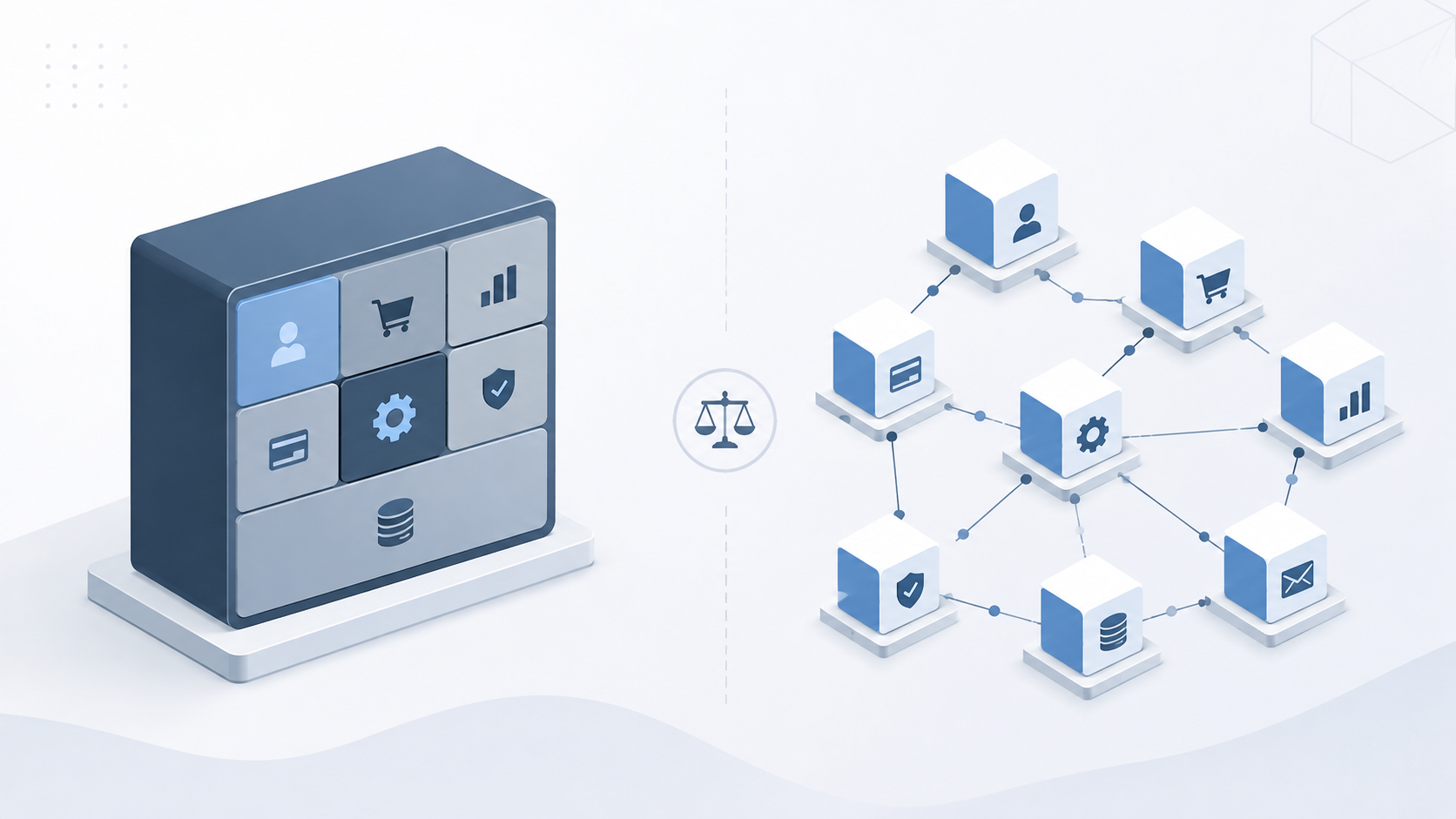
A modular monolith and a microservices system can both follow domain-driven design, enforce bounded contexts and separate business capabilities. The critical difference is the runtime and deployment boundary.
A modular monolith packages well-defined modules into one deployable application. Modules should expose explicit interfaces, own their domain logic and avoid direct access to another module’s internals. Teams can enforce boundaries with architecture tests, separate schemas and dependency rules. Calls remain in-process, avoiding network latency, service discovery and many distributed failure modes. The trade-off is shared deployment risk: a defective release can affect the whole runtime, so feature flags, backward-compatible database changes, automated regression testing and progressive deployment still matter at enterprise scale.
Microservices move those boundaries into independently deployable services. Each service can scale, release and fail separately, but every network boundary becomes an operational concern. Teams need timeouts, retries, idempotency, distributed tracing and contract testing. Cross-service transactions often require sagas or transactional outboxes instead of one ACID transaction.
AWS notes that microservices add debugging, tracing and operational complexity because the system becomes distributed. DORA makes the more important point: delivery performance depends on loosely coupled teams that can change, test and release independently, and organizations can fail to achieve that even with modern technology.
When does a modular monolith make more sense for enterprise web applications?
A modular monolith is often stronger when the business domain changes faster than the organization can define stable service boundaries. Splitting an uncertain domain into dozens of services can turn assumptions into network contracts, data duplication and deployment dependencies that are expensive to reverse.
It also works when most features share a release cadence, transactions cross several capabilities, and workload profiles do not differ enough to justify independent scaling. If the platform can scale the complete application horizontally without waste, separating every module into a service creates cost without meaningful autonomy.
The technical requirement is discipline. A modular monolith should not become a traditional monolith with folders renamed as modules. Each module needs a clear API, controlled dependencies and defined data ownership. Teams should prevent direct table access across module boundaries and track coupling in build pipelines. This preserves an extraction path if a module later needs separate deployment.
The approach also fits continuous modernization. An IDC survey published in a February 2026 Thoughtworks-sponsored report found that 35% of organizations planned to prioritize continuous, incremental modernization over the next two years. Desired outcomes included greater development velocity and agility, lower technical debt, and better maintainability and scalability.
When do microservices justify their additional operational cost?
Microservices make sense when the enterprise can name the constraint that service independence will remove.
One signal is asymmetric scale. If search, checkout, recommendations or document processing consume radically different compute profiles, independent scaling can reduce contention. Another is organizational scale. When many autonomous teams own separate business capabilities, a shared deployment unit can become a release bottleneck even when the code is modular.
Different reliability requirements can also justify service boundaries. A payments capability may need stricter isolation, auditing and recovery objectives than a marketing-content service. Regulatory or data-residency requirements can make separate runtime and persistence boundaries useful.
But service independence has to be real. If ten services share one database, require synchronized releases and trigger coordinated incidents whenever an API changes, the enterprise has created a distributed monolith. It pays the network and platform costs without gaining delivery autonomy.
Kubernetes does not solve that design problem. CNCF’s 2026 survey shows how mature the infrastructure layer has become, but it also found cultural change was the leading container challenge, cited by 47% of respondents, ahead of complexity at 34%. Platform capability is an enabler, not proof that every domain boundary belongs on the network.
How should enterprises decide whether to migrate from a modular monolith to microservices?
The decision should start with evidence from production and delivery systems rather than an architecture target.
Engineering leaders can examine change coupling, deployment lead time, incident blast radius, module-level resource consumption and cross-team dependencies. If one bounded context causes repeated scaling problems or slows unrelated teams, it becomes a candidate for extraction. If the pain comes from poor boundaries, slow testing or governance queues, microservices may simply relocate the bottleneck.
A safer migration path hardens modular boundaries before extracting services. Teams can isolate domain logic and data access, introduce stable contracts, add observability and remove cross-module shortcuts. They can then extract one capability using a strangler-style approach while monitoring latency, failure modes, cost and deployment independence. Migration should stop when additional service boundaries no longer improve measurable outcomes.
This gives leadership a reversible path. Architecture becomes an evolutionary system rather than a one-way transformation program.
Which consulting companies can support enterprise architecture modernization?
For organizations considering an external architecture review or delivery partner, the shortlist should favor firms that assess the existing estate, operating model and platform maturity before recommending a target state.
- Thoughtworks is a strong option for large modernization programs where architecture change must align with product operating models and continuous delivery. Its modernization practice emphasizes incremental change, and its published work includes enterprise programs that moved monolithic platforms toward microservices while stabilizing existing operations. It is relevant when architecture sits inside a broader transformation rather than a single rewrite.
- EPAM is worth evaluating when the program spans application modernization, cloud infrastructure and platform engineering. Its current modernization offerings cover legacy application transformation and cloud-native services using Kubernetes and containers. This breadth can suit enterprises coordinating application, data, infrastructure and operational change across a large estate.
- GeekyAnts can fit organizations looking for architecture assessment combined with hands-on product engineering. Its enterprise modernization practice covers application re-architecture, API-first design, Kubernetes, Infrastructure as Code, platform engineering and SRE. Operating since 2006, it positions modernization alongside engineering execution, which can suit teams that want a partner to validate boundaries and implement the resulting changes.
What should engineering leaders validate before committing to either architecture?
The useful next step is not a vote for monoliths or microservices. It is an architecture working session built around the application’s actual constraints.
That session should establish which domains require independent deployment, where transaction boundaries sit, which workloads need separate scaling, what platform capabilities microservices would require, and how change would affect delivery metrics and run cost. A decision record can then define which modules stay together, which become services, the migration sequence and the conditions that stop further decomposition.
For enterprise web applications, the best architecture is not the one with the most services. It is the one that lets teams change critical systems faster without making production harder to operate.