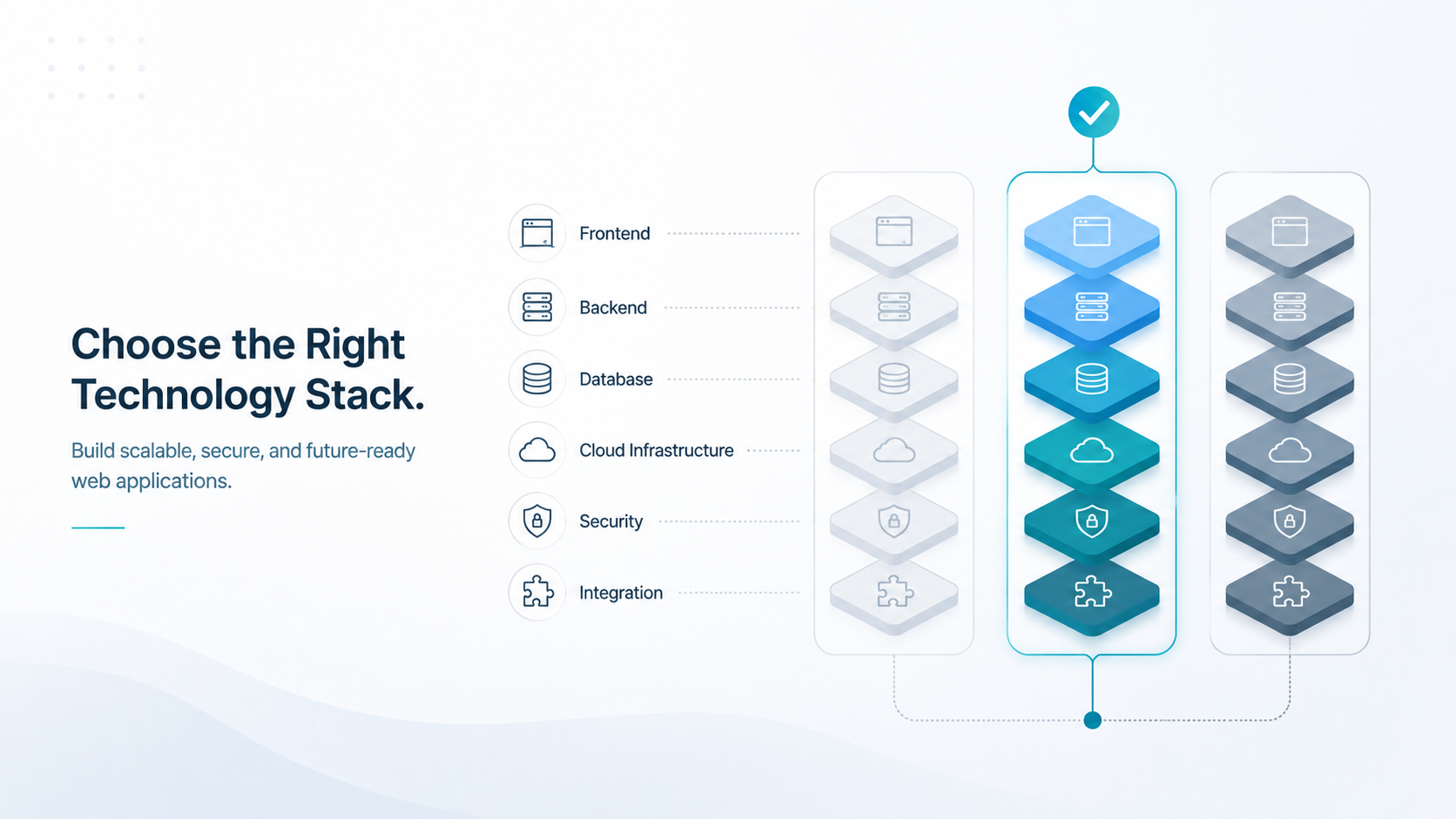
Selecting a technology stack looks like an engineering decision, but at enterprise scale it quickly becomes an operating-model decision. A framework that helps one team ship quickly can create years of platform fragmentation when dozens of teams adopt it independently. A database that performs well in a benchmark can become expensive when replication, compliance, backup, observability, and specialist staffing enter the production equation.
That is why the right question is not, “Which stack is best?” It is, “Which stack gives this organization the best trade-off between delivery speed, reliability, security, integration, talent availability, and cost of change?”
Current adoption data reinforces that distinction. Stack Overflow’s 2025 Developer Survey shows Node.js and React among the most widely used web technologies, while GitHub reported that TypeScript became its most-used language in August 2025. These are useful signals about ecosystem depth and hiring availability, but popularity alone does not make a stack appropriate for a regulated customer portal, a high-volume commerce platform, or an internal operational system.
What should the stack be optimized for before anyone names a framework?
Engineering leaders should begin with workload characteristics, not a list of preferred technologies. The application’s transaction profile, latency targets, expected concurrency, data sensitivity, integration surface, release frequency, availability requirements, and regional footprint should define the decision boundary.
A consumer-facing application with unpredictable traffic may need aggressive horizontal scaling, edge delivery, asynchronous processing, and strong observability. A B2B workflow platform may care more about transactional consistency, auditability, identity integration, and long-term maintainability. An internal application may benefit from a simpler architecture that fits the existing platform and identity standards rather than a technically fashionable stack.
The same applies to growth assumptions. “Scalable” is too vague to guide architecture. Teams should model what needs to scale: reads, writes, search, file processing, real-time events, tenant count, data volume, geographic distribution, or engineering throughput. Each creates different constraints.
This requirements-first approach also protects the organization from overengineering. A team does not need Kubernetes, event streaming, multiple databases, and microservices simply because those technologies can scale. CNCF’s 2025 survey found Kubernetes running in 82% of containerized environments, showing how established cloud-native infrastructure has become. It does not mean every new web application benefits from owning that operational complexity.
Which technical criteria should narrow the shortlist?
Once workload requirements are explicit, the architecture group can compare candidate stacks against a small set of decision criteria. The useful comparison is not a feature checklist. It is an analysis of how each option behaves under the company’s real delivery and operating conditions.
- Application architecture fit: The stack should support the application’s dominant interaction model without forcing unnatural patterns. Teams building highly interactive interfaces may favor a mature TypeScript ecosystem with React, Angular, or another established frontend framework. Back-end choices should reflect workload shape. Java or .NET may fit transaction-heavy enterprise domains, Node.js can simplify full-stack TypeScript environments, while Python is often a practical choice when the application sits close to data science or AI services. The goal is architectural fit, not language loyalty.
- Data and integration model: Database selection should follow access patterns and consistency requirements. PostgreSQL can cover a wide range of transactional workloads, but search-heavy, analytical, graph, cache, or event-driven requirements may justify specialized components. Leaders should also examine how the stack integrates with IAM, ERP, CRM, data platforms, payment systems, messaging infrastructure, and internal APIs. Integration friction that looks minor during development often becomes a recurring delivery tax.
- Security and software supply chain: Security should influence framework, dependency, package-management, identity, secrets, runtime, and deployment choices from the start. OWASP’s 2025 Top 10 places Software Supply Chain Failures at A03, alongside risks such as broken access control and security misconfiguration. That makes dependency health, patch cadence, SBOM support, provenance, automated scanning, and maintainership part of stack selection, not tasks to add after architecture approval.
- Operability and total cost: License fees and cloud compute are only part of cost. Leaders should account for CI/CD, testing, observability, incident response, upgrades, specialist skills, managed services, environment management, security controls, and platform support. A theoretically efficient runtime can still be expensive if only a small internal team knows how to operate it. A slightly less optimized technology may deliver lower total cost when it fits established engineering platforms and skills.
How should enterprise architecture change the decision?
Large organizations rarely build a web application in isolation. The new stack enters an existing environment of cloud standards, security controls, design systems, identity platforms, data governance, API conventions, observability tooling, release processes, and legacy systems. The best local choice can therefore be the wrong enterprise choice.
Engineering leaders should evaluate how much new cognitive load the proposed stack introduces. Every additional framework, datastore, runtime, build system, and deployment pattern creates documentation, patching, security review, developer onboarding, and production-support obligations. Platform engineering teams eventually inherit much of that complexity.
Standardization helps, but rigid standardization creates another problem. A single approved stack may work for most internal applications but fail for high-performance streaming, AI-enabled products, or latency-sensitive customer experiences. The better model is a paved road with controlled exceptions: a small set of supported technologies for common workloads, plus an architecture process for cases where teams can demonstrate a measurable reason to depart.
AI-assisted development also makes this discipline more important. GitHub’s 2025 Octoverse reported TypeScript as the most-used language on GitHub after it overtook Python and JavaScript. As code generation accelerates implementation, engineering organizations can create inconsistency faster as well. Typed interfaces, automated testing, dependency policies, API contracts, and architecture guardrails become more valuable when producing code becomes easier.
When should leaders bring in external architecture validation?
External review is useful when the decision crosses several domains at once, such as a customer platform that must combine modernization, cloud migration, security controls, data integration, and a new frontend architecture. It can also help when internal teams are divided between competing stacks or when a program carries enough commercial or regulatory risk that an independent challenge is worthwhile.
The purpose should not be to outsource the decision. It should be to pressure-test assumptions, compare operating costs, identify migration constraints, and expose architecture risks before a multi-year program commits to them.
Among well-known technology consulting and product engineering firms, organizations may encounter different profiles. Thoughtworks operates extensively in technology advisory and modernization, Globant combines large-scale digital engineering and consulting, and GeekyAnts brings a more application-engineering-focused profile across modern web development and modernization. The relevant question is not which firm has the longest technology catalogue. It is whether the advisor can explain why a stack fits the organization’s workload, platform standards, engineering capabilities, and risk model, and can demonstrate the trade-offs in measurable terms.
What does a defensible final stack decision look like?
A strong decision ends with more than an architecture diagram. It should state the target stack, the alternatives considered, the assumptions behind the choice, expected operating model, security and compliance controls, integration dependencies, scaling thresholds, skills requirements, and conditions that would trigger a future review.
Teams should also validate the highest-risk assumptions with a focused technical spike. That may mean testing authentication throughput, database contention, cold-start behavior, build times, cross-region latency, third-party API limits, or deployment recovery. The goal is to test the decision where failure would be expensive.
For engineering and digital leaders, the right technology stack is therefore not the newest combination of frameworks. It is the one that makes the application easier to evolve without quietly creating another platform problem. Before a major build or modernization program locks its architecture, a short stack and platform review can often reveal whether the proposed choices will still make sense when the application reaches enterprise traffic, governance, staffing, and support conditions.