A web application project rarely becomes difficult because an engineering team cannot write the code. It becomes difficult when business expectations, architecture, integrations, security requirements, and operating responsibilities are decided at different times by different groups.
For enterprise organizations, that planning gap can quickly translate into delayed releases, expanding budgets, integration failures, and applications that reach production but remain difficult to operate.
Thoughtworks’ research across senior technology and business decision-makers has highlighted issues such as unclear ownership, disconnected digital experiences, technical complexity, and difficulty maintaining delivery velocity across digital products. These problems often appear during development, but many begin much earlier, when teams define scope and architecture.
For a VP of Engineering, Head of Technology, or Digital Platform leader, planning a web application should therefore produce more than a backlog, wireframes, and launch date. It should establish how the application will work inside the existing enterprise technology environment and how teams will operate it once customers start using it.
What should be defined before a web application development project starts?
The first decision should not be whether the application will use React, Angular, Java, Node.js, .NET, or another technology.
The first decision should be what business or operational result the application must change.
That result may involve reducing manual processing, improving customer self-service, consolidating fragmented digital journeys, replacing an expensive legacy workflow, accelerating partner onboarding, or enabling a new digital service.
Once that outcome is clear, teams can translate it into user journeys and technical requirements.
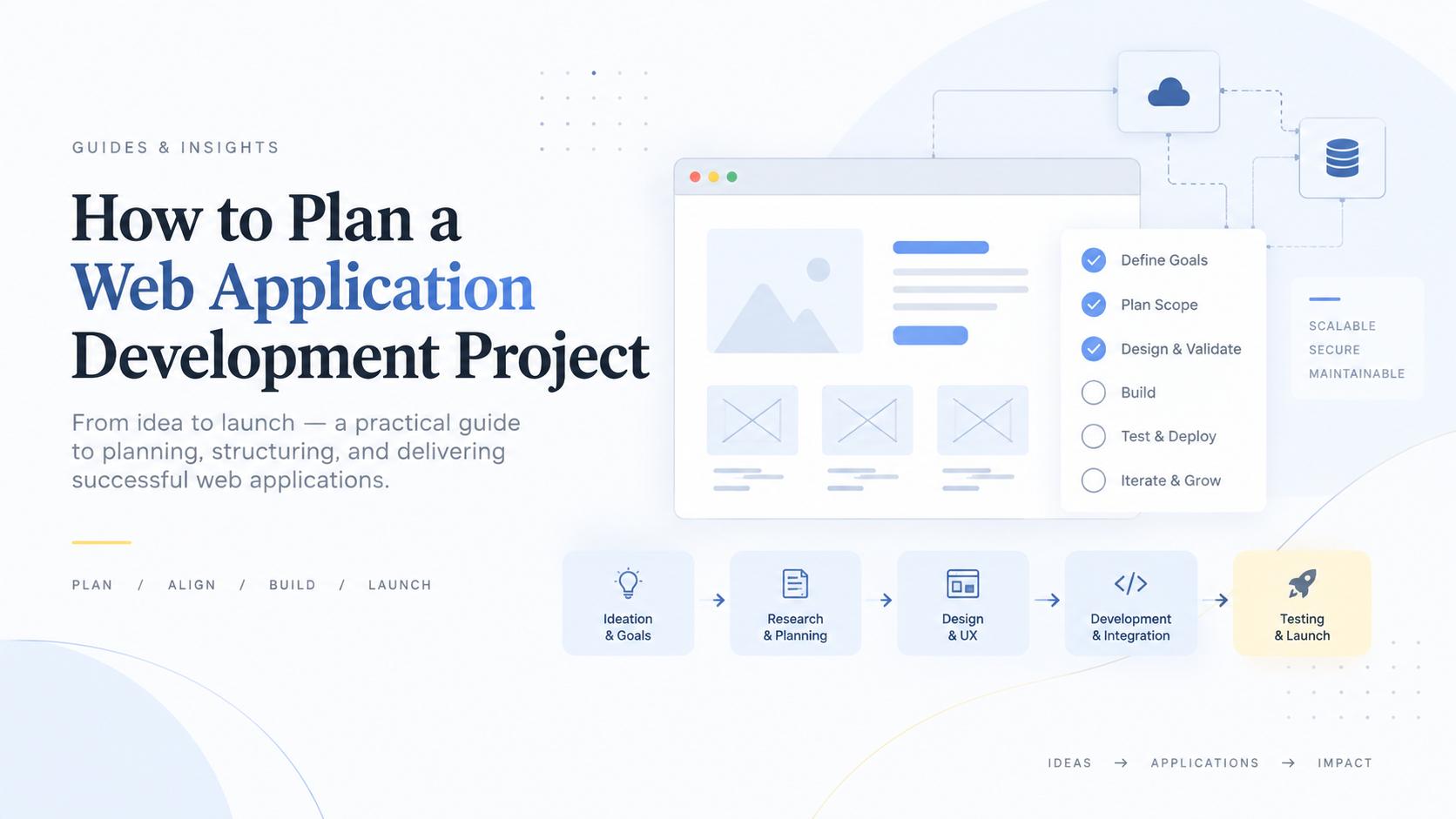
Before engineering begins, enterprise teams should establish the following planning baseline:
- Business scope and user journeys: Teams should document primary users, important workflows, edge cases, accessibility expectations, administrative journeys, and capabilities that will intentionally remain outside the first release. A simple customer portal may eventually require enterprise SSO, delegated administration, audit trails, entitlements, localization, approval workflows, and integrations with several internal systems. These requirements need visibility before architecture decisions become expensive to change.
- Non-functional requirements: Performance, expected traffic, concurrency, availability targets, recovery expectations, geographic restrictions, browser support, accessibility standards, data retention, and regulatory requirements should be documented early. These decisions influence infrastructure, database architecture, caching, monitoring, testing, and deployment patterns.
- System dependencies: Teams should map APIs, CRM platforms, ERP systems, identity providers, payment processors, data services, document platforms, legacy applications, and third-party services. They should identify which integrations already exist, which need development, and which depend on another team’s roadmap.
- Delivery boundaries: Planning should clarify what engineering will build, reuse, buy, or integrate. Enterprises often already have authentication, notification, analytics, workflow, API gateway, and logging capabilities. Rebuilding them inside another application increases maintenance without necessarily improving the customer experience.
- Production ownership: The project should identify who will monitor the application, handle incidents, approve releases, manage infrastructure, patch vulnerabilities, rotate secrets, review logs, and fund third-party services. Production ownership should exist before development begins.
This level of definition prevents the project from treating architectural questions as sprint-level decisions.
How should architecture be planned before choosing the technology stack?
Technology selection should follow architectural constraints.
Architecture planning starts with understanding domain boundaries and data movement. Teams need to identify which information belongs inside the application, which remains inside systems of record, and which services must communicate in real time.
That normally leads to decisions around API architecture, authentication, authorization, asynchronous processing, caching, databases, file handling, observability, integration patterns, and deployment topology.
An architecture does not need to predict every feature the organization might build over the next five years. It does need to expose expensive assumptions.
For example, an internal application serving a few thousand employees has different availability and scaling requirements from a customer-facing platform supporting millions of sessions. An application connected to ten enterprise systems may also carry more delivery risk in integration work than in its user interface.
Security requirements should be part of architecture planning rather than a final review activity.
The NIST Secure Software Development Framework recommends integrating secure software practices throughout the development lifecycle. OWASP’s Application Security Verification Standard provides additional guidance around authentication, access control, session management, input validation, cryptography, APIs, and other application controls.
Enterprise teams can translate these frameworks into technical acceptance criteria.
That means a security requirement becomes something engineers design and test rather than something discovered during a penetration test shortly before launch.
How can enterprises create a realistic web application timeline and budget?
Enterprise application estimates often become unreliable because teams estimate visible features without estimating uncertainty.
Twenty screens may be straightforward to implement. One unstable legacy integration can delay the entire release.
A realistic project plan should therefore include architecture discovery, integration validation, UX testing, environment provisioning, access approvals, security reviews, performance testing, data preparation, deployment automation, production readiness, and release governance.
Teams should also identify dependencies outside the engineering team’s control.
If a critical API depends on another business unit, its availability should be treated as a delivery risk rather than assumed as part of the schedule.
One useful delivery approach is to build thin vertical slices.
Instead of completing the entire interface before connecting backend systems, teams can complete an important user journey across the interface, API layer, database, integrations, automated tests, monitoring, and deployment pipeline.
This exposes architectural problems earlier.
It also gives technology leaders evidence of progress beyond completed tickets or percentage estimates.
Software delivery metrics can provide another layer of visibility. DORA research commonly evaluates delivery performance using measures including deployment frequency, change lead time, failed deployment recovery time, change fail percentage, and reliability.
These measures help leaders understand whether the application’s delivery system is becoming more predictable rather than simply measuring how much development activity occurred.
Budget planning should follow the same principle.
The cost model should account for infrastructure, observability platforms, third-party APIs, testing environments, security tooling, accessibility testing, data services, support capacity, maintenance, and future enhancements.
The initial development budget is only one part of the cost of running a web application.
What should be tested before a web application is considered production ready?
“QA complete” is not a sufficient enterprise release criterion.
Production readiness should be defined through measurable technical and operational conditions.
Functional tests should validate core customer journeys and important failure scenarios. Integration and contract tests should validate communication between services. Performance testing should represent expected traffic patterns and realistic datasets.
Security testing should examine authentication, authorization, secrets, dependencies, API behavior, input handling, logging, and access boundaries.
Accessibility testing should also happen throughout development rather than after the user interface has been finalized.
Operational readiness requires a different set of tests.
Teams should confirm that logs, traces, dashboards, alerts, backups, rollback processes, feature flags, incident runbooks, and deployment procedures operate correctly in production-like environments.
A platform should not be considered ready simply because engineering can deploy it.
Operations teams must also be able to identify whether something has failed, locate the affected service, understand customer impact, and restore service quickly.
This becomes increasingly important as organizations introduce AI-assisted development tools. Faster code generation can increase engineering throughput, but it does not automatically improve architecture, testing quality, observability, security, or production ownership.
Faster development only helps when the surrounding delivery system can safely absorb that speed.
When should a company involve a web application consulting partner?
External engineering support can make sense when the primary constraint is not simply development capacity.
Large web application programs often involve legacy modernization, architecture redesign, cloud migration, integration complexity, platform engineering, design systems, security requirements, or delivery transformation.
Different consulting companies approach those problems differently.
Thoughtworks works across digital product strategy, software engineering, platform modernization, and continuous delivery. Accenture operates at a larger transformation scale across application modernization, cloud, architecture, engineering, and managed operations. GeekyAnts works across web application consulting, product engineering, UX, modernization, and application performance, particularly where companies need a hands-on engineering partner alongside internal technology teams.
The useful comparison is therefore not which company appears first on a generic vendor list.
Engineering leaders should evaluate whether a partner can understand the existing architecture, identify hidden dependencies, work within enterprise security requirements, integrate with internal engineering teams, transfer knowledge, and leave behind an application that the organization can operate independently.
A successful planning phase should ultimately reduce uncertainty.
Before development accelerates, technology leaders should be able to see the application’s scope, architecture, integration dependencies, security expectations, release strategy, ownership model, delivery risks, and operating costs clearly enough to challenge them.
For organizations preparing a new web platform or modernizing an existing application, an architecture and delivery planning discussion can therefore be more useful than immediately requesting a development estimate.
It allows teams to test assumptions while those assumptions are still inexpensive to change, before they become code, infrastructure, vendor contracts, and production dependencies.