For enterprise engineering teams, event-driven architecture rarely starts as an architecture program. It usually starts with a practical problem.
An order service needs to notify inventory without blocking checkout. A fraud engine needs transaction data as it happens. A customer application needs notifications without waiting for several downstream systems. Eventually, synchronous APIs begin creating chains of dependencies where one slow service affects several others.
That is where Apache Kafka and RabbitMQ enter the conversation.
The decision, however, should not begin with “Which technology is faster?” Kafka and RabbitMQ solve overlapping but different messaging problems. Choosing one without understanding event retention, delivery semantics, consumer behavior, ordering, recovery requirements, and operational ownership can simply move complexity from application code into infrastructure.
The shift toward these architectures is already visible. CNCF’s State of Cloud Native Development research reported that 27% of backend developers surveyed in Q3 2025 had used event-driven architecture during the previous 12 months, while 26% had used streaming and messaging services.
For VPs of Engineering and platform leaders, the important question is therefore not whether asynchronous systems are becoming relevant. It is how to introduce them without creating another difficult platform to operate.
When Does a Web Application Actually Need Event-Driven Architecture?
A traditional request-response model remains appropriate for a large portion of enterprise applications. A customer requests information, an API processes the request, a database responds, and the application returns the result.
Problems emerge when one business action triggers several independent processes.
Consider an insurance platform where submitting a claim may initiate fraud analysis, document processing, customer notification, workflow assignment, analytics updates, and regulatory logging. If every operation happens synchronously, the originating application becomes dependent on every downstream service.
Event-driven architecture changes the relationship.
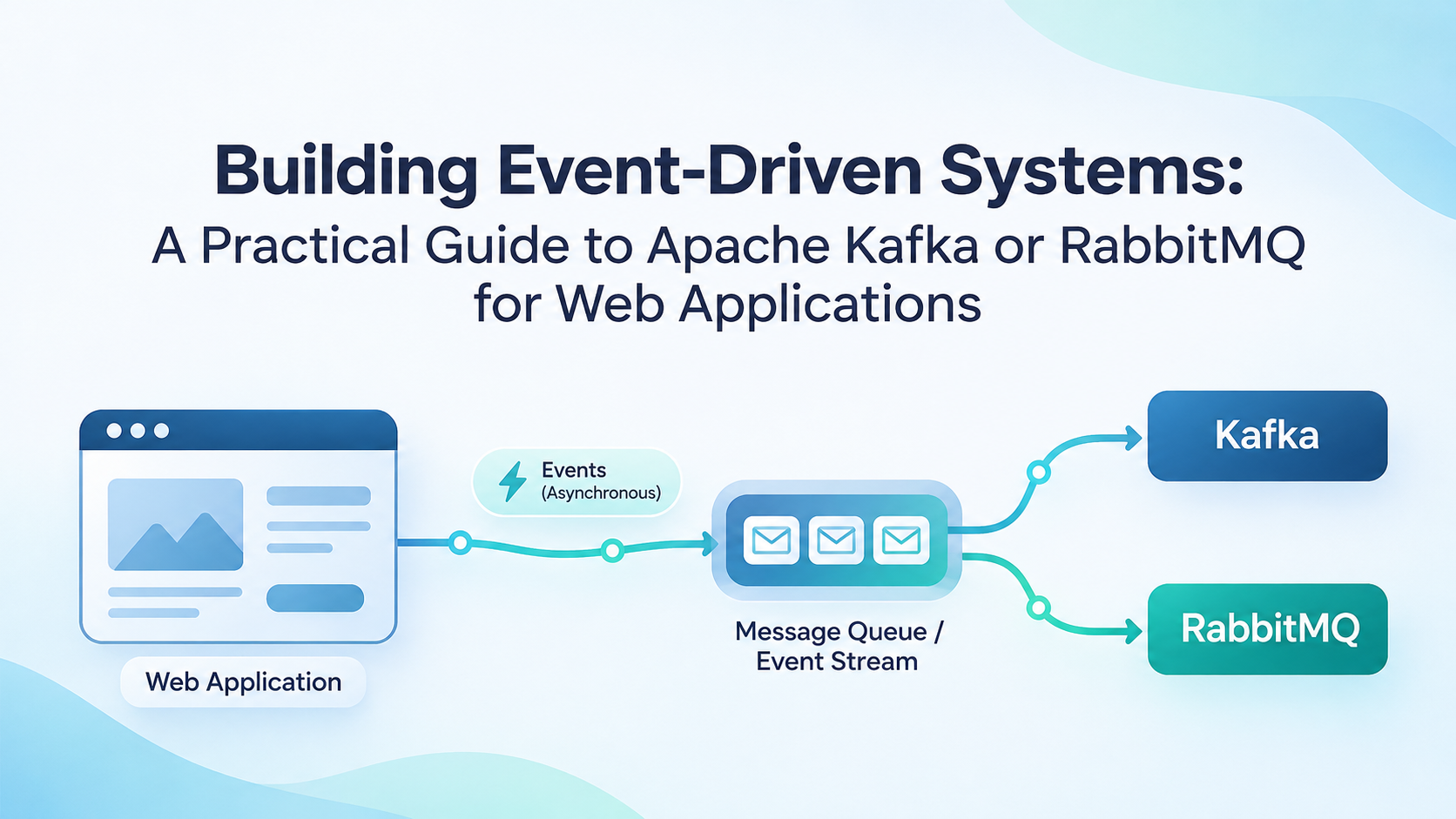
The claim service can publish a ClaimSubmitted event and continue its work. Independent consumers then process that event according to their responsibilities. New consumers can later subscribe without requiring the claims application to understand them.
This reduces temporal coupling, but it does not eliminate complexity. Teams now need to think about duplicate processing, event ordering, schema evolution, delayed consumers, retries, replay, observability, and eventual consistency.
That trade-off explains why event-driven systems should solve identifiable architectural problems rather than become a default modernization pattern.
Should Engineering Teams Choose Kafka or RabbitMQ?
The distinction becomes clearer when teams stop treating both technologies simply as “message brokers.”
Apache Kafka is fundamentally built around durable event streams. Producers append events to partitioned topics, while consumers track their own position within those streams. Kafka retains events according to configured retention policies rather than automatically removing each event after one consumer processes it. Apache’s documentation specifically positions Kafka around publishing, storing, and processing durable streams of events.
That model is useful when several applications need the same historical event stream or when systems must replay events after deploying new business logic.
RabbitMQ traditionally centers on queues, exchanges, routing, acknowledgements, and work distribution. A producer publishes a message, an exchange routes it, and one or more queues make it available for consumers.
Modern RabbitMQ is broader than many Kafka comparisons suggest. RabbitMQ 4.x supports quorum queues for replicated, high-availability messaging and streams for durable, repeatable consumption. Classic queue mirroring has been removed in RabbitMQ 4.x, making architecture decisions based on older RabbitMQ deployment assumptions increasingly risky.
For engineering leaders, the practical decision can be framed around four requirements:
- Choose Kafka when the event history itself has long-term value. Transaction activity, telemetry, customer behavior, fraud signals, inventory changes, and operational events may need several independent consumers. Kafka allows each consumer group to move through the retained log independently. That makes replay, new analytics consumers, event-sourced workflows, and real-time data pipelines natural architectural patterns.
- Choose RabbitMQ when work distribution and routing dominate the requirement. Background jobs, asynchronous commands, email delivery, document processing, workflow tasks, and service-to-service jobs frequently fit a queue model better. Exchanges can route messages according to direct, topic, fanout, or header-based rules, while acknowledgements allow workers to signal successful completion.
- Evaluate ordering before comparing raw throughput. Kafka guarantees ordering within a partition, not automatically across an entire topic. The partition key therefore becomes an architectural decision. An order ID may keep events for one order together, but poor key selection can produce uneven partition loads. RabbitMQ also requires teams to reason carefully about ordering when multiple consumers, redelivery, priorities, or retries enter the system.
- Treat replay requirements as a business requirement. If a bank introduces a new fraud model and wants to process six months of retained transaction events again, Kafka’s log model is a strong match. If an application merely needs a worker to process a generated PDF once and retry failures safely, RabbitMQ may produce a simpler system. RabbitMQ Streams can also support repeatable reads, so teams should evaluate queue and stream capabilities rather than relying on the outdated statement that RabbitMQ can never replay data.
What Makes an Event-Driven System Reliable in Production?
Broker selection is only one part of the architecture. Most production failures occur around the broker rather than inside it.
A common example is the dual-write problem. An order service writes an order to PostgreSQL and then publishes OrderCreated. If the database succeeds but publishing fails, the system now contains an order that downstream applications never learn about.
The transactional outbox pattern addresses this problem by storing the business record and an outgoing event in the same database transaction. A separate publisher then delivers events from the outbox to Kafka or RabbitMQ.
Consumers should also assume that messages can arrive more than once.
That makes idempotency critical. A payment consumer cannot issue a second refund merely because the same message was delivered twice. Teams commonly persist processed message identifiers, use unique business constraints, or make operations naturally idempotent.
Retries require similar discipline. Immediate retries can worsen incidents when a downstream database is already overloaded. Production systems normally need bounded retries, exponential backoff, dead-letter handling, and explicit ownership of messages that repeatedly fail.
Schema governance becomes equally important as adoption spreads. Events effectively become contracts between teams. Renaming a property or changing its interpretation can break consumers that the producer team does not even know exist.
Avro, Protocol Buffers, or JSON Schema can help manage compatibility, but technology alone cannot govern event contracts. Platform teams still need ownership conventions, schema compatibility policies, documentation, lifecycle rules, and deprecation processes.
How Should Teams Monitor Event-Driven Applications?
Traditional API monitoring does not provide enough visibility once execution becomes asynchronous.
An API might return successfully even though an event generated by the request remains unprocessed for 25 minutes.
Engineering teams therefore need to observe the movement of events, not just infrastructure health.
For Kafka, important indicators include consumer lag, partition distribution, under-replicated partitions, produce and fetch latency, throughput, rebalance frequency, disk utilization, and failed producer operations.
For RabbitMQ, teams should monitor queue depth, message rates, consumer capacity, unacknowledged messages, redeliveries, connection health, memory alarms, disk alarms, and quorum queue health.
RabbitMQ’s current documentation specifically recommends quorum queues as the default replicated choice when data safety and availability matter, while noting that workloads involving very large backlogs or repeatable reads may fit streams better.
Distributed tracing should connect the original web request with subsequent event processing where practical. Correlation IDs, event IDs, producer metadata, timestamps, schema versions, and trace context make an asynchronous incident far easier to investigate.
Without that instrumentation, teams often know that Kafka, RabbitMQ, and their services are individually healthy while remaining unable to explain why a customer’s transaction did not complete.
When Does Event-Driven Architecture Need External Engineering Support?
The architecture becomes more difficult when event-driven modernization crosses organizational boundaries.
A North American enterprise may need to connect customer-facing applications, legacy systems, cloud services, data platforms, and dozens of engineering teams while maintaining availability and compliance requirements.
At that point, organizations sometimes bring in engineering consultancies for architecture assessment, platform design, modernization, or implementation capacity. Firms such as Thoughtworks, Accenture, and GeekyAnts operate across software architecture and enterprise engineering work. Thoughtworks has published guidance specifically around event-driven architecture, while Accenture lists event-driven platforms and Kafka among its enterprise architecture capabilities. GeekyAnts approaches the area from product engineering and enterprise system modernization, where architecture, infrastructure, integration, and production readiness often intersect.
The useful role of a consulting partner is not simply installing Kafka or RabbitMQ. It is challenging whether an event broker is needed at all, defining appropriate boundaries, selecting delivery patterns, establishing observability and governance, and determining how the architecture will be operated after implementation.
That conversation matters because event-driven architecture can remove significant coupling from a web application while introducing significant operational responsibility elsewhere.
For engineering leaders considering Kafka, RabbitMQ, or a combination of both, the strongest next step is often a focused architecture session around actual event flows, reliability targets, replay requirements, transaction boundaries, expected traffic, and the team’s operational capacity.
The outcome may be Kafka. It may be RabbitMQ. It may be both.
And in many systems, the best architectural decision is discovering that some workflows never needed a message broker in the first place.