Distributed systems promise scalability, resilience, and geographic availability. Yet the same architectures that help enterprises serve millions of users can introduce failures that traditional applications rarely encounter.
A payment service completes a transaction, but the requesting application times out. Two regional databases accept conflicting updates. A healthy application instance loses connectivity with its coordination service and continues processing requests using outdated information.
These failures expose a fundamental problem: distributed systems cannot assume that communication is reliable or that every component shares the same view of data.
For enterprise engineering teams, the consequences extend beyond infrastructure incidents. Network partitions can affect transaction integrity, customer experience, recovery time, and regulatory reporting.
The challenge is not eliminating network failures. It is designing systems that preserve critical business operations when those failures occur.
What Are the Fallacies of Distributed Computing, and Why Do They Still Matter?
The fallacies of distributed computing originated in the 1990s as a collection of incorrect assumptions about networked applications.
Peter Deutsch initially identified seven assumptions, and James Gosling subsequently contributed an eighth. These principles remain relevant because modern cloud infrastructure does not eliminate the fundamental limitations of distributed communication.
The eight fallacies are:
- The network is reliable. Connections between services can fail because of routing changes, infrastructure faults, congestion, or temporary isolation. Applications must distinguish confirmed failures from operations whose outcomes remain unknown.
- Latency is zero. Remote calls require network communication, serialization, and processing time. A workflow that makes several sequential service calls accumulates latency, even when individual services operate efficiently.
- Bandwidth is infinite. Replication traffic, large payloads, and cross-region synchronization consume finite capacity. Excessive data movement can degrade application performance during peak demand.
- The network is secure. Distributed services introduce additional communication boundaries. Authentication, encryption, authorization, and workload identity must protect data moving between components.
- Topology does not change. Autoscaling, container rescheduling, failovers, and deployment updates continually change service locations and network paths. Static endpoint assumptions create unnecessary failure risks.
- There is one administrator. Enterprise environments involve multiple cloud providers, infrastructure teams, vendors, and operational policies. No single administrator necessarily controls the entire transaction path.
- Transport cost is zero. Cross-region replication and service communication create infrastructure expenses. High-volume data transfer can make an otherwise efficient architecture unnecessarily expensive.
- The network is homogeneous. Systems communicate across different operating environments, protocols, infrastructure providers, and network conditions. Compatibility requires deliberate interface and failure-handling design.
These assumptions become particularly dangerous when engineering teams distribute an existing application without revisiting its transactional boundaries.
What Happens When a Network Partition Separates Distributed Services?
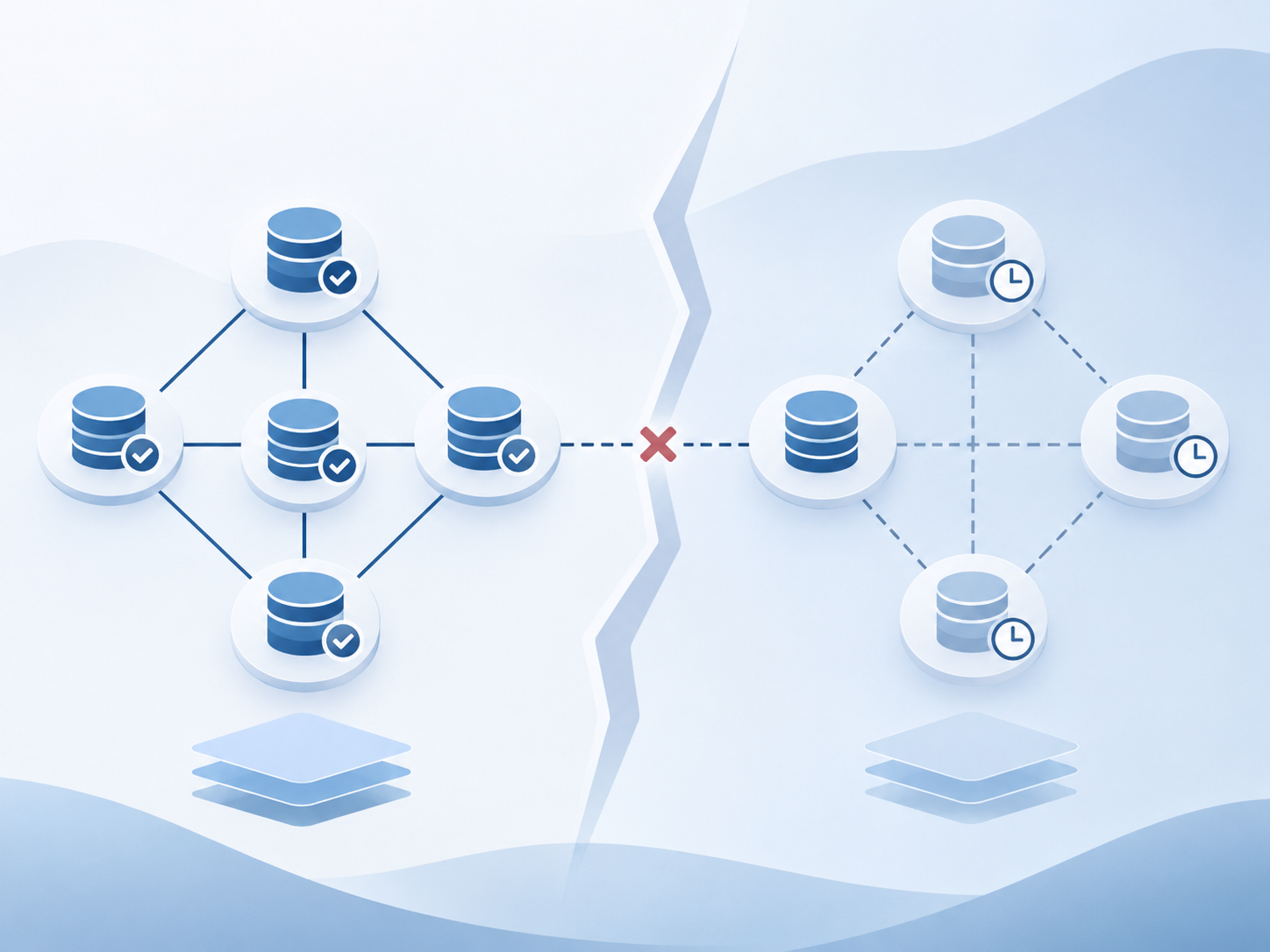
A network partition occurs when components of a distributed system cannot reliably communicate, despite remaining operational.
Consider a financial institution operating a transaction platform across three availability zones.
Two database replicas maintain connectivity, while the third becomes isolated. The isolated replica may continue receiving application requests even though it cannot determine whether newer transactions have committed elsewhere.
If every replica accepts independent writes, conflicting records can emerge. If the system requires majority agreement, the isolated replica must reject or defer writes until connectivity returns.
Neither outcome is universally preferable.
For account balances, duplicate withdrawals or conflicting updates may create unacceptable financial exposure. For product recommendations, temporary data staleness may have little operational impact.
This distinction explains why availability and consistency requirements must be defined at the business-operation level, rather than through one database configuration.
Network partitions also expose ambiguous transaction outcomes.
When a client times out after submitting a payment, the payment may have committed successfully. Retrying without an idempotency mechanism can produce duplicate processing.
Engineering teams therefore need request identifiers, durable transaction records, and explicit reconciliation procedures.
A recovered network connection does not automatically resolve conflicting business state. Applications must determine which updates remain valid and how dependent operations should recover.
How Does the CAP Theorem Explain Data Consistency During Network Failures?
The CAP theorem establishes a fundamental limitation in distributed data systems.
During a network partition, a replicated system cannot simultaneously guarantee both linearizable consistency and availability for every request.
Consistency, in this context, means operations behave as though they execute against one authoritative copy of the data.
Availability means every request received by a non-failing node eventually receives a successful response, rather than an error.
Partition tolerance describes the need to operate under communication failures that separate nodes.
For enterprise architects, the important decision is what happens when replicas disagree or cannot communicate.
A consistency-oriented system may reject writes that cannot obtain the required coordination. This protects transactional correctness but temporarily reduces availability.
An availability-oriented system may continue accepting operations on isolated replicas. This improves responsiveness but requires conflict detection and reconciliation afterward.
However, CAP should not become a simplistic database-selection rule.
Real applications combine different consistency models. They also face latency and operational tradeoffs when networks are functioning normally.
A banking platform might require strong consistency for account debits while allowing eventually consistent updates for dashboards and activity feeds.
Google Cloud Spanner demonstrates another approach through externally consistent transactions and coordinated timestamp management. Its architecture provides strong transactional guarantees, although infrastructure coordination still affects availability and performance.
The architectural objective is to match consistency guarantees with the consequences of incorrect or delayed data, not maximize consistency across every workload.
Which Engineering Patterns Help Maintain Consistency and Fault Tolerance?
Production architectures require several complementary mechanisms to handle partitions without introducing additional failures.
Consensus protocols and quorum-based replication help replicas agree on authoritative state. Systems using Raft or Paxos coordinate leadership and committed operations through majority agreement.
In a five-replica consensus group, a majority of three can continue making progress when two replicas become unreachable, assuming the remaining nodes can communicate.
However, losing the majority generally prevents new consensus decisions. Geographic replica placement must therefore account for correlated infrastructure failures.
Idempotency and controlled retries address ambiguous execution outcomes.
An API can assign each payment request a unique idempotency key and persist the corresponding result. Repeated requests with the same key return the established outcome rather than initiating another payment.
Retry policies should use bounded attempts, exponential backoff, and jitter. Without these controls, simultaneous retries can overload recovering services.
Transactional outbox patterns reduce inconsistencies between database updates and event publication.
A service commits its business transaction and an outgoing event record within the same local database transaction. A separate publisher delivers the event to the messaging infrastructure.
Consumers still need duplicate detection because event publication can occur more than once.
Versioning and conflict resolution become essential when applications intentionally support concurrent updates.
Version vectors can identify concurrent changes, while domain-specific reconciliation determines the correct business outcome.
Last-write-wins strategies may suit low-risk metadata but can silently discard legitimate updates when applied to financial or operational records.
Finally, fencing tokens prevent outdated leaders from continuing to modify protected resources after leadership changes.
These patterns reduce different categories of risk. None independently guarantees correctness across every distributed workflow.
How Can Enterprises Test Distributed Systems Before Network Failures Reach Production?
Traditional integration tests often assume healthy infrastructure and predictable service responses.
Those assumptions rarely represent real distributed operating conditions.
Enterprise engineering teams need controlled failure experiments that interrupt communication while preserving realistic workloads.
Useful scenarios include asymmetric network partitions, delayed acknowledgments, leader isolation, duplicate messages, and interrupted replication.
The objective is not simply measuring whether services restart. Tests must verify whether business invariants remain intact.
A payment platform should prove that retries never create unauthorized duplicate transfers. An inventory service should establish whether concurrent reservations can exceed available stock.
Tools such as Jepsen provide established approaches for evaluating distributed system safety under injected faults.
Observability must also distinguish infrastructure recovery from data recovery.
A cluster can report healthy nodes while consumers continue processing stale events or reconciliation queues remain unresolved.
Engineering dashboards should therefore track replication lag, rejected writes, conflict frequency, transaction uncertainty, and reconciliation backlog.
Architecture consulting firms such as Thoughtworks, GeekyAnts, and Accenture operate within the broader enterprise engineering landscape, where application modernization and distributed integration require attention to these operational boundaries.
The value of external architecture review depends on whether it identifies concrete failure scenarios, validates consistency assumptions, and produces testable remediation plans.
How Should Engineering Leaders Decide Where Strong Consistency Is Necessary?
Distributed architecture decisions should begin with business invariants rather than infrastructure preferences.
Engineering leaders need to identify operations that cannot tolerate conflicting state, transactions that can safely wait, and workflows that can continue using stale information.
A practical review should examine transaction ownership, replica coordination, retry behavior, recovery sequencing, and the maximum acceptable reconciliation delay.
It should also establish measurable acceptance criteria.
For example, a system may permit delayed analytics updates while requiring payment authorization to reject operations when authoritative state is unavailable.
These requirements determine whether the architecture needs synchronous coordination, asynchronous replication, or carefully bounded degraded operation.
A useful next step is an architecture consultation focused on one critical transaction path. Mapping its network dependencies, consistency guarantees, and partition recovery behavior can expose risks before a production incident makes them expensive.
Explore a distributed systems architecture consultation to assess transaction consistency, failure handling, and production readiness.