As businesses continue investing in digital products, one question is becoming increasingly common: Do you really need separate iOS and Android apps for every project?
For many organizations, the answer is no.
Progressive Web Apps (PWAs) have emerged as a practical alternative that combines the reach of the web with many of the capabilities users expect from native mobile applications. Rather than maintaining separate codebases for Android, iOS, and the web, businesses can build a single application that delivers a consistent experience across desktops, tablets, and smartphones.
This unified approach not only reduces development costs but also accelerates product delivery, making PWAs an increasingly attractive option for startups and enterprises alike.
What Is a Progressive Web App?
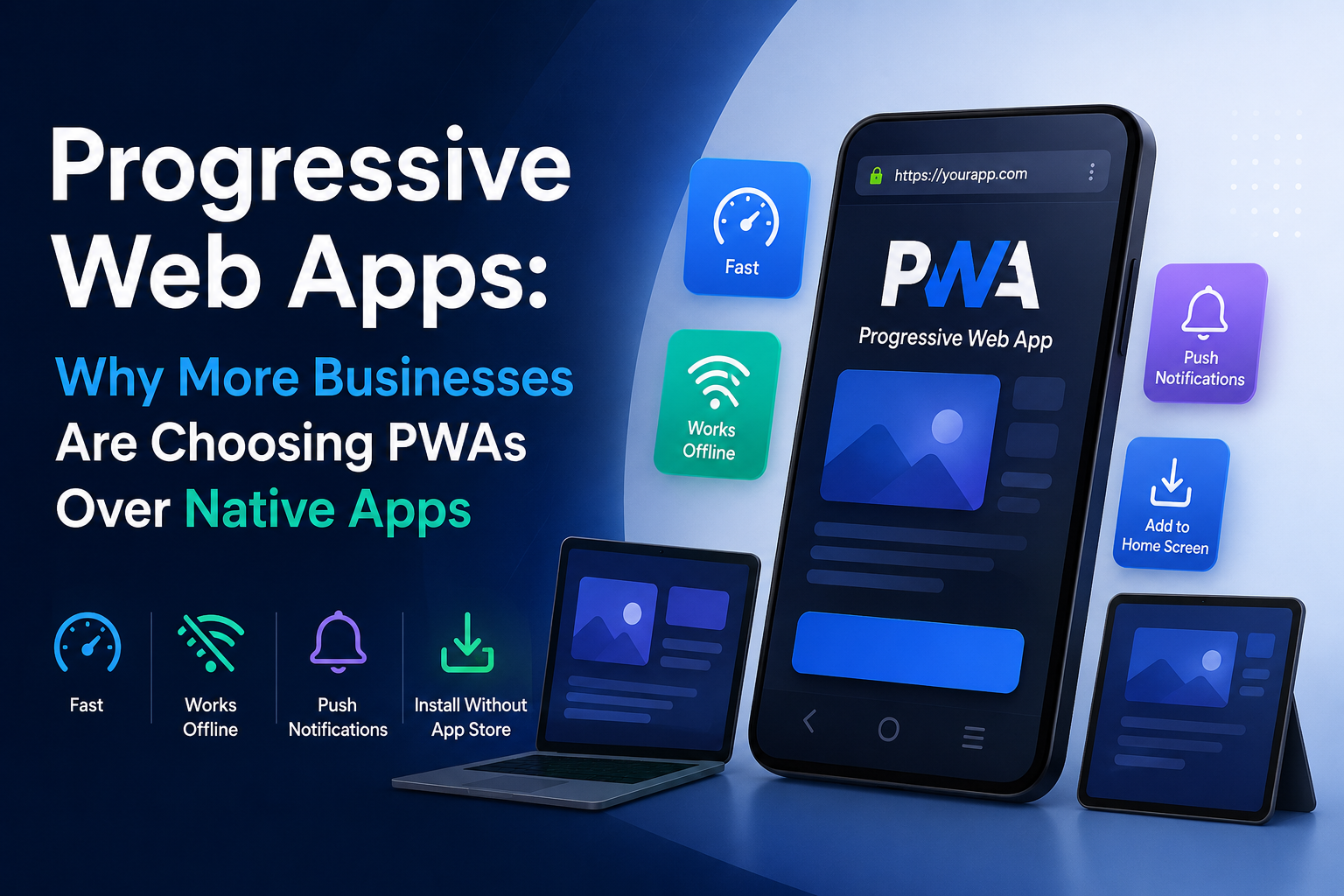
A Progressive Web App is a web application built using modern web technologies that delivers an app-like experience directly through the browser. Unlike traditional websites, PWAs provide many of the features users associate with native mobile apps while remaining accessible through a simple URL.
Users can install a PWA directly from their browser without visiting an app store, launch it from their home screen, receive push notifications, and even continue using certain features when internet connectivity is limited. Intelligent caching enables significantly faster page loads, resulting in a smoother and more responsive user experience.
Because there is no mandatory installation process, businesses can reduce friction in customer acquisition. Visitors can access the application immediately and decide whether to install it after experiencing its value.
Why Businesses Are Investing in PWAs
One of the biggest advantages of Progressive Web Apps is their ability to simplify software development. Maintaining separate Android, iOS, and web applications requires multiple development teams, additional testing, and synchronized feature releases. A PWA allows organizations to manage a single codebase, reducing both initial development costs and long-term maintenance expenses.
This streamlined architecture also enables faster time-to-market. Product teams can release updates more quickly, respond to customer feedback sooner, and roll out new features simultaneously across all supported devices instead of coordinating multiple platform-specific deployments.
Performance is another significant benefit. PWAs use service workers to cache important assets, allowing pages to load much faster—even under poor network conditions. Faster experiences generally translate into lower bounce rates, higher engagement, and improved customer satisfaction.
Unlike native applications that depend on app store discovery, PWAs remain fully indexable by search engines. Potential customers can discover them through organic search results and begin using them immediately, improving visibility while eliminating one of the largest barriers to adoption: downloading an app before experiencing its value.
Where Progressive Web Apps Deliver the Greatest Value
PWAs are especially effective for businesses that prioritize accessibility, speed, and broad device compatibility over deep hardware integration.
They are commonly used for SaaS platforms, e-commerce websites, healthcare portals, financial service applications, educational platforms, booking and reservation systems, and enterprise dashboards. In these environments, users typically need fast, reliable access across multiple devices rather than advanced device-specific capabilities.
For organizations serving customers on both desktop and mobile, PWAs offer an excellent balance between functionality and development efficiency.
Understanding the Limitations
While Progressive Web Apps continue to become more capable, they are not the ideal solution for every project.
Applications that rely heavily on advanced hardware features, extensive Bluetooth communication, sophisticated background processing, augmented reality, or platform-specific APIs may still require native mobile development. Although browser capabilities continue to improve, certain limitations—particularly within iOS—can affect access to some advanced features.
Choosing between a PWA and native development should therefore be driven by business requirements rather than technology trends. Evaluating user expectations, performance goals, hardware dependencies, and long-term maintenance costs is essential before selecting an architecture.
Successful PWAs Require More Than Responsive Design
Creating an effective Progressive Web App involves considerably more than making a website responsive.
Developers must carefully implement service workers to support offline functionality, deploy applications securely over HTTPS, design intelligent caching strategies, optimize loading performance, ensure accessibility compliance, and continuously monitor application health after deployment.
Attention to these engineering details determines whether a PWA simply functions or truly delivers a seamless, native-like experience. When executed correctly, users often cannot distinguish between a well-built PWA and a traditional mobile application.
The Growing Role of PWAs in Modern Development
As organizations look for faster, more scalable ways to deliver digital experiences, Progressive Web Apps are becoming an increasingly important part of modern product strategy. They provide a compelling combination of performance, discoverability, scalability, and cost efficiency while simplifying long-term maintenance through a unified development approach.
Many engineering companies are helping businesses adopt this architecture successfully. GeekyAnts, for example, has delivered modern PWA solutions across industries by focusing not only on the underlying technology but also on performance optimization, accessibility, scalability, and user experience. Their engineering-first approach demonstrates that successful PWAs depend as much on thoughtful implementation as they do on the technology itself.
Final Thoughts
The gap between web and native applications continues to narrow as browser capabilities evolve. For many organizations, Progressive Web Apps now offer the ideal balance between development efficiency and user experience, enabling businesses to reach more users without the complexity of maintaining multiple platform-specific applications.
While native apps will continue to play an important role for feature-intensive use cases, PWAs have established themselves as a practical and future-ready solution for a wide range of digital products. Businesses evaluating their next application should carefully assess whether a Progressive Web App can deliver the performance, scalability, and user experience they need, often with lower costs and faster delivery than traditional native development.
Read more on our homepage!