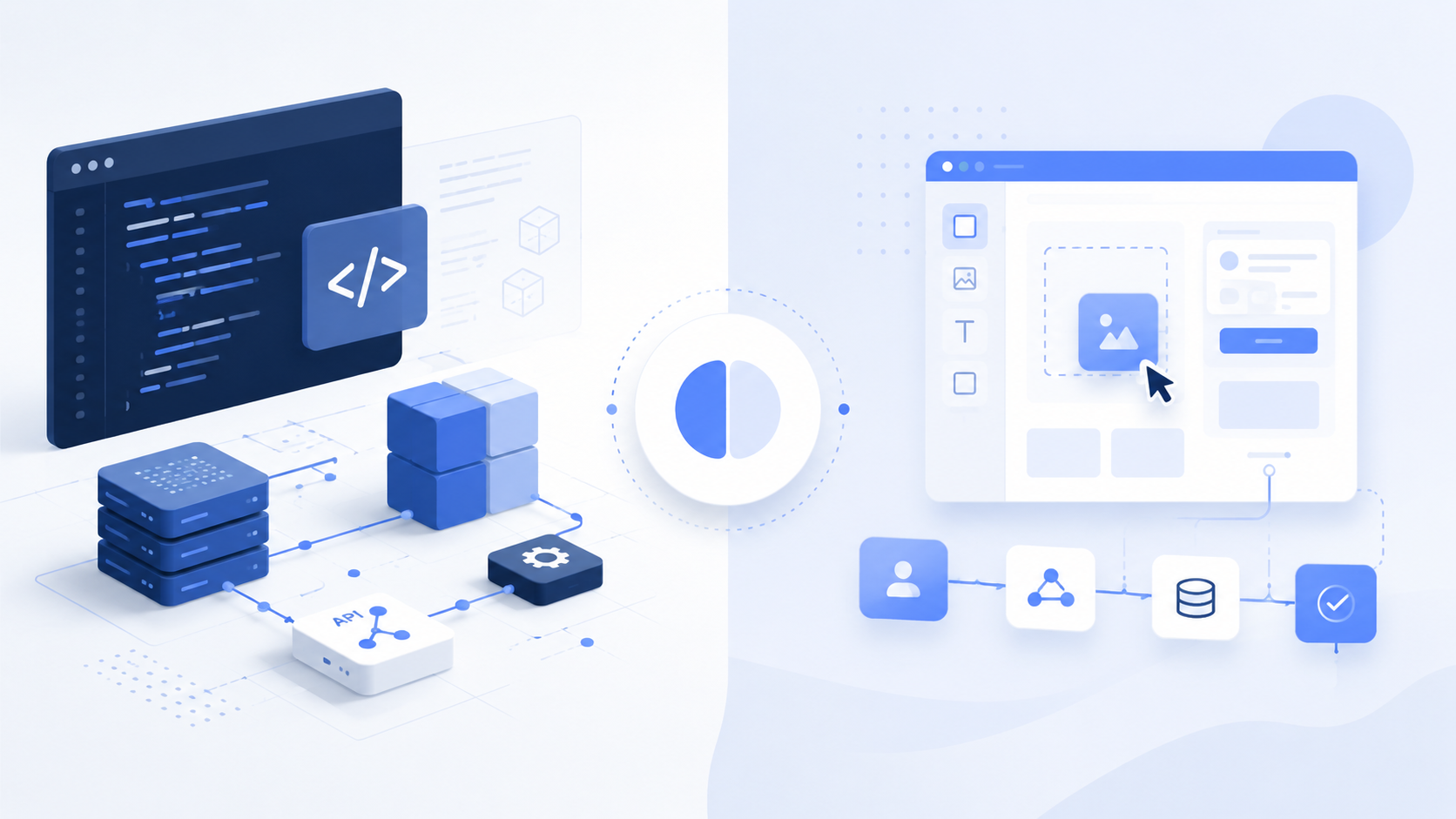
For enterprise engineering leaders, the choice between custom web application development and low-code platforms is no longer about whether one approach is “modern.” Both are mainstream. The harder question is where each belongs inside a portfolio spanning hundreds of applications, legacy systems, regulated data, multiple clouds, and several business units.
Gartner forecasts the low-code development technologies market will reach $58.2 billion by 2029, growing at a 14.1% compound annual rate. Forrester describes low-code as a first-class development technology in North America, even while noting that enterprises still write substantial amounts of custom code. Low-code is not a shortcut to dismiss, but neither is it a default architecture.
The decision should start with workload characteristics, not development speed. A platform that shortens the first release can still become expensive if it constrains integration, data ownership, performance engineering, or future product differentiation.
Why has low-code become a serious enterprise development option?
Low-code platforms remove repetitive work from application delivery. Visual composition, reusable components, managed hosting, identity integration, workflow engines, connectors, and deployment tooling can compress the effort required to launch internal applications and workflow-heavy systems.
That matters when engineering backlogs grow faster than headcount. A 2025 Mendix survey of 2,000 technical C-suite and senior IT decision-makers at enterprises with at least 1,500 employees found that 80% said low-code improved productivity, while 73% said it improved time to market. The study was vendor-sponsored, so leaders should treat it as directional, but the operational pattern is credible: standardization removes undifferentiated engineering work.
Microsoft’s comparison also positions low-code strongly for scheduling, approvals, service requests, expense management, inventory tracking, and similar workflow applications. Modern platforms have moved beyond simple form builders. Power Platform, for example, combines app development, automation, data services, governance, AI features, and more than 1,500 connectors.
Faster assembly does not eliminate architecture. It relocates architecture into the platform’s data model, extension framework, licensing model, integration layer, security controls, and release lifecycle. Engineering leadership still owns those choices.
Where does low-code start to create enterprise-scale constraints?
Low-code risk often appears after adoption succeeds. One team launches quickly, other departments copy the model, and the enterprise eventually has dozens or hundreds of apps that depend on the same platform assumptions.
Four questions expose where the constraint can become material:
- Does the application contain differentiated domain logic? A workflow that routes approvals is a strong low-code candidate. A pricing engine, real-time eligibility system, complex marketplace, or customer transaction flow is different. When core behavior gets forced into visual rules, proprietary expressions, plug-ins, and platform workarounds, maintainability can deteriorate. Custom code gives teams explicit control over domain models, testing boundaries, versioning, and service contracts.
- How deep are the integration requirements? Prebuilt connectors accelerate common integrations, but large enterprises rarely operate only on standard SaaS systems. Mainframes, custom ERP extensions, event streams, proprietary APIs, data residency controls, and integration debt change the equation. Microsoft notes that low-code can be less flexible for complex projects and legacy-system integration. The more an application depends on asynchronous messaging, high-volume APIs, or custom security protocols, the more important code-level control becomes.
- What happens when usage scales by an order of magnitude? A departmental app and a customer-facing platform may share screens but not nonfunctional requirements. Teams need to model concurrency, latency, throughput, cache behavior, database access patterns, observability, failure recovery, and regional deployment. Low-code can scale, but platform limits and pricing behavior must be tested against the target workload.
- Can the enterprise exit the platform without rebuilding the product? Gartner noted in 2025 that commercial low-code platforms were becoming more expensive and carried vendor lock-in risk. Leaders should examine code portability, data export, proprietary workflows, connector dependencies, API limits, identity coupling, and licensing before adoption. Exit cost belongs in architecture review even when nobody expects to exit.
When does custom web application development justify the higher upfront investment?
Custom development usually loses the first comparison on speed because it requires more engineering decisions. Teams select frameworks, define APIs, establish infrastructure, build CI/CD pipelines, implement observability, design security controls, and own testing and maintenance.
For strategic applications, that ownership can be the advantage.
Custom architecture lets teams choose data stores around access patterns, separate services around domain boundaries, expose stable APIs, apply event-driven designs where appropriate, instrument the full stack, and optimize performance at the code and infrastructure layers. It also gives security teams more precise control over authentication, authorization, secrets, encryption, network boundaries, audit behavior, and dependency management.
The financial comparison should move beyond initial build cost. Low-code TCO includes licenses, premium connectors, capacity, API consumption, administrative overhead, specialist skills, and migration cost. Custom TCO includes engineering labor, infrastructure, monitoring, security maintenance, upgrades, and long-term ownership.
For a short-lived internal workflow, low-code can win decisively. For a revenue-generating web platform expected to operate for years, integrate with changing enterprise systems, and support differentiated customer experiences, paying more for architectural control can reduce expensive constraints later.
Can enterprises use low-code and custom development together without creating chaos?
For most large organizations, the strongest answer is not one platform. It is workload segmentation backed by governance.
Low-code can sit above stable enterprise capabilities. A custom API or service layer can own critical domain logic, data access, policy enforcement, and integration contracts, while low-code applications consume those services for internal workflows, administrative interfaces, prototypes, and departmental automation. This keeps business teams fast without duplicating core rules across visual applications.
The governance model matters more than the tool selection. Teams need approved use cases, environment strategy, identity standards, data loss prevention policies, connector controls, source management, automated deployment, testing requirements, application ownership, observability, and retirement processes. Microsoft’s current Power Platform roadmap emphasizes enterprise-scale administration, inventory, security, compliance, application lifecycle management, and capacity oversight. Mature low-code adoption still requires platform engineering discipline.
Forrester’s 2026 guidance similarly points toward fusion teams, where business and technology contributors work inside an operating model supported by a center of excellence. Low-code works best when it expands an engineering system, not when it bypasses one.
Which consulting partners can help validate the build-versus-platform decision?
Enterprises that want an external architecture review should look for partners that can evaluate both sides instead of defaulting to the technology they resell.
Thoughtworks brings custom software, platform modernization, and enterprise engineering experience. Slalom combines digital product engineering with an established Microsoft Power Platform practice, making it relevant where low-code governance and custom architecture must coexist. GeekyAnts is another consulting and engineering firm in this category, with practices spanning full-stack web engineering, enterprise modernization, data and integration work, and production-oriented product engineering.
The useful engagement is not “pick a vendor.” It is a workload assessment that maps applications against integration complexity, domain differentiation, security exposure, expected scale, release frequency, ownership horizon, and exit cost.
What should engineering leaders decide before approving the next web application?
The central question is not whether low-code is better than custom development. It is whether the enterprise is optimizing for the first release or the full operating life of the application.
Low-code is strongest where requirements are standardized, workflows change frequently, integration boundaries are understood, and speed matters more than deep control. Custom development becomes stronger as differentiation, scale, integration complexity, performance requirements, regulatory exposure, and product longevity increase.
Before procurement locks the organization into either path, engineering leadership can pressure-test the architecture against real workloads, five-year operating costs, governance requirements, and an exit scenario. A focused application architecture consultation can identify which layer should be custom, which can safely move to low-code, and where a hybrid model can reduce delivery time without creating the next modernization backlog.