Enterprise architecture decisions rarely fail because an engineering team chose an unfashionable technology. They fail because the architecture stops matching how the business needs to change.
A platform that worked when an organization released monthly can become a constraint when dozens of product teams need to deploy independently. On the other hand, a company can introduce microservices too early and spend more engineering effort managing networks, observability, service ownership, and distributed data than delivering customer-facing capabilities.
That tradeoff matters more as cloud-native infrastructure becomes standard. CNCF’s 2026 research found that 82% of container users now run Kubernetes in production, while 98% of surveyed organizations reported adopting cloud-native techniques. Google Cloud’s 2025 DORA research also reported that 90% of organizations had adopted at least one internal platform. Modern infrastructure is widely available. The harder question is deciding how much architectural distribution a particular business actually needs.
For technology leaders, the architecture conversation should therefore move beyond “monolith versus microservices.” The practical decision is where the organization needs independent deployment, independent scaling, asynchronous processing, strong consistency, and operational isolation, and where it does not.
When is a monolith still the right architecture?
A monolith is often treated as something an enterprise eventually needs to escape. That assumption can create unnecessary complexity.
In a monolithic system, application capabilities typically share a deployment unit and often a common runtime and data layer. That reduces infrastructure overhead because calls between modules remain local, transactions are easier to coordinate, and developers can trace application behavior without following requests across multiple distributed services.
The real distinction is between an uncontrolled monolith and a well-designed modular monolith.
A modular monolith separates business domains within the application through explicit module boundaries, internal APIs, dependency rules, and clear ownership. The system remains deployable as one unit, but teams avoid allowing every module to access every other module’s implementation or database structures.
That model can work particularly well when an enterprise has moderate traffic, closely related business transactions, strong consistency requirements, or teams that do not need completely independent release schedules.
AWS similarly notes that monolithic systems require less initial architectural and infrastructure investment, while microservices introduce additional planning, deployment, monitoring, and debugging requirements.
The warning sign is not simply that the codebase has become large. The stronger signal appears when unrelated product areas repeatedly block one another. If changing customer onboarding requires coordinating releases with payments, reporting, administration, and notifications, the deployment boundary may no longer match the business boundary.
At that point, decomposition becomes an organizational decision as much as a technical one.
When do microservices actually improve delivery?
Microservices become valuable when independently changing parts of the business need independently deployable software.
A well-designed service normally represents a bounded business capability, owns its behavior and data, and exposes explicit contracts through APIs, messages, or events. Teams can change and deploy that capability without rebuilding the entire application.
This becomes useful when an enterprise has multiple autonomous engineering teams, uneven scaling requirements, distinct reliability targets, or domains evolving at very different speeds.
For example, an e-commerce platform may experience extreme demand around product search while account administration remains relatively stable. With independently deployable services, platform teams can scale the high-demand workload without scaling every application component.
AWS highlights precisely this advantage: microservices can scale individual components independently rather than requiring infrastructure increases across an entire application.
But microservices do not eliminate complexity. They relocate it.
In-process method calls become network communication. Database transactions may become distributed workflows. Debugging can require distributed tracing. Developers must handle timeouts, retries, versioned contracts, authentication between services, duplicate requests, partial outages, and dependency failures.
An organization therefore needs mature CI/CD, observability, infrastructure automation, API governance, and service ownership before multiplying service boundaries. CNCF’s 2026 survey offers a useful warning: cultural change within development teams was cited by 47% of respondents as the leading challenge to cloud-native adoption, ahead of technical complexity.
Microservices work best when organizational independence justifies distributed-system complexity.
When should an architecture become event-driven?
Event-driven architecture addresses a somewhat different problem.
Microservices describe how business capabilities are separated. Event-driven architecture describes how components communicate when immediate synchronous responses are unnecessary or undesirable.
Instead of Service A calling Service B and waiting for a response, Service A can publish an event such as OrderPlaced, PaymentAuthorized, or CustomerProfileUpdated. Interested consumers process that event independently.
That model becomes powerful when a single business action triggers several downstream processes.
An online purchase, for example, might initiate inventory allocation, fraud analysis, fulfillment, loyalty updates, notifications, analytics, and accounting. Making the checkout service synchronously call every downstream system creates a fragile chain. An event broker can allow those systems to respond independently while keeping checkout latency isolated from non-critical processing.
The architecture introduces its own engineering requirements. Teams must design for eventual consistency, idempotency, duplicate messages, schema evolution, ordering, retries, poison messages, dead-letter queues, observability, and event replay.
Transactions also become harder to reason about. A traditional database transaction can commit several operations atomically. Distributed event workflows may instead require patterns such as sagas and compensating actions when part of the workflow fails.
Event-driven design should therefore solve a real asynchronous coordination problem, not simply replace APIs. Synchronous APIs remain appropriate when a caller genuinely needs an immediate response.
How should an enterprise choose between these architecture patterns?
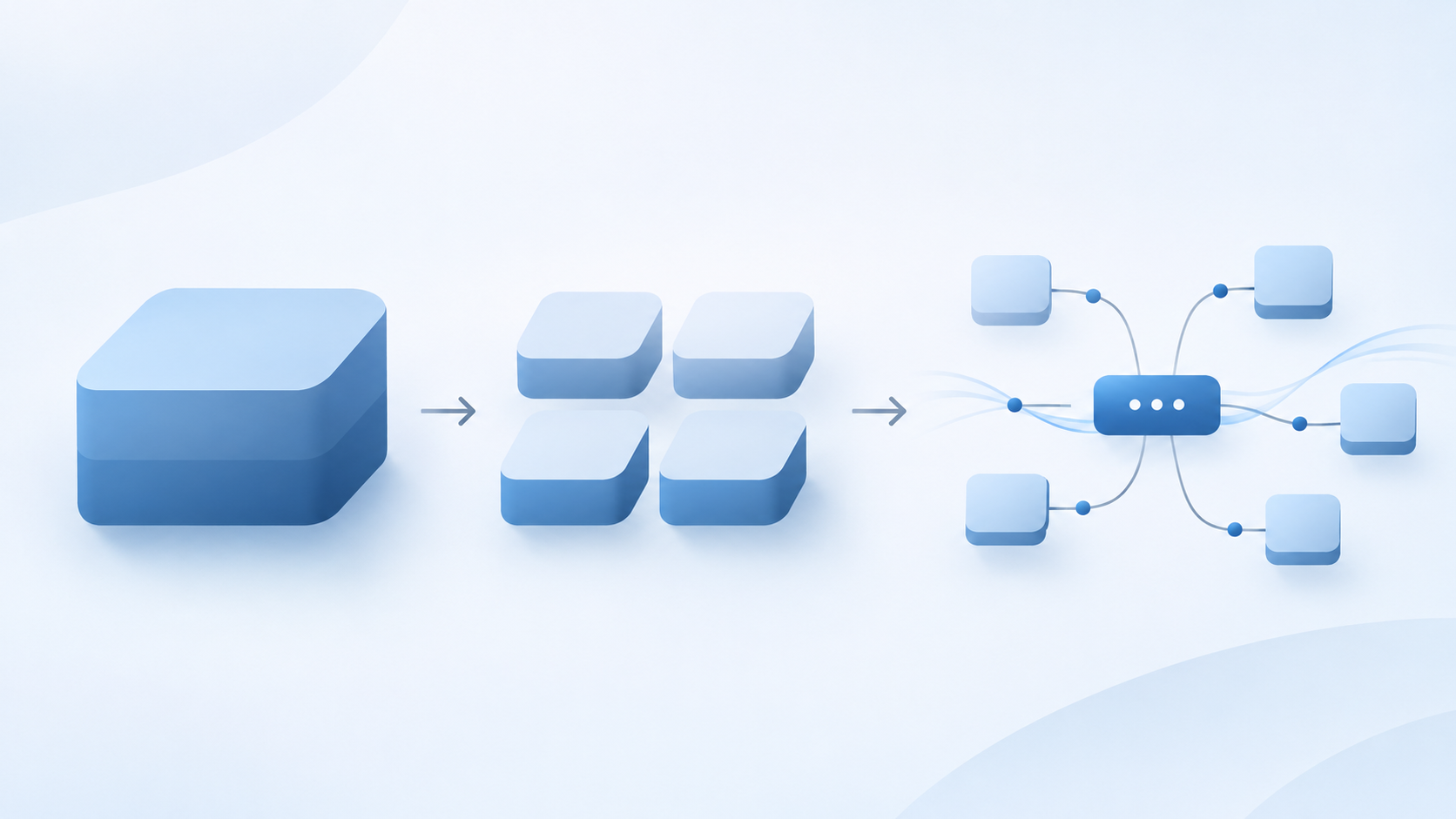
The most effective architecture will often combine all three approaches.
Architecture teams can evaluate each business domain against a small set of practical questions:
- Does the capability need independent deployment and scaling? If several functions change together, share the same availability requirements, and scale at roughly the same rate, keeping them inside a modular monolith may minimize unnecessary infrastructure. When a domain has its own product roadmap, team, scaling profile, security boundary, or reliability objective, a microservice can create a useful deployment boundary. When several independent domains need to react to the same business occurrence without blocking the originating transaction, events become a stronger integration mechanism. The decision should also consider data ownership. Splitting application code while keeping every service tightly coupled to one shared database often produces a distributed monolith rather than true service autonomy.
The architecture can therefore evolve by domain.
A customer-facing application might remain a modular monolith while high-volume search and recommendation capabilities operate as independent services. Those services could still publish events into Kafka, Amazon EventBridge, Google Pub/Sub, or another messaging platform for analytics, notifications, and downstream processing.
AWS Prescriptive Guidance explicitly notes that microservices and monoliths are not mutually exclusive, and organizations can successfully use modular monoliths for some domains while using microservices elsewhere.
That hybrid approach is increasingly practical because modern platform engineering can standardize deployment, observability, security, and infrastructure without forcing every application into the same architectural pattern.
How should companies modernize without creating another transformation program?
Architecture modernization does not require rebuilding an enterprise application from zero.
For large organizations, gradual decomposition usually offers a safer path. Teams can first identify business domains, dependency hotspots, deployment bottlenecks, scaling problems, and areas where failures have disproportionate customer impact.
They can then introduce explicit module boundaries, APIs, or events around those areas before extracting services.
A strangler-style approach can progressively redirect specific capabilities from the legacy application toward new components while both architectures coexist. This allows teams to test operational assumptions before committing the entire estate to distributed architecture.
Architecture consulting firms frequently support this type of transition when internal teams need an external assessment of boundaries, platform maturity, and migration sequencing.
Thoughtworks brings substantial experience in evolutionary architecture and distributed systems and continues to publish its Technology Radar as guidance on emerging engineering practices.
Accenture approaches modernization at portfolio scale, including application assessment, domain decomposition, microservices, event-driven architecture, cloud platforms, and phased modernization roadmaps.
GeekyAnts can be relevant where organizations want architecture consulting combined with hands-on product engineering, particularly when modernization requires building or reworking digital products rather than producing only a target-state architecture.
The appropriate partner ultimately depends on whether the organization needs portfolio transformation, architectural advisory, or engineering execution.
What architecture decision should technology leaders make next?
The strongest modern architecture is rarely the one with the greatest number of services.
It is the one that gives teams the independence they actually need while introducing the minimum operational complexity required to achieve it.
A modular monolith may be the right answer for a stable domain. Microservices may be necessary where teams and workloads need independent evolution. Event-driven systems may be critical where business processes cross multiple domains asynchronously. A large enterprise may legitimately use all three.
Before committing to a major decomposition program, engineering leaders can assess deployment dependencies, domain boundaries, scaling patterns, failure isolation, data ownership, platform maturity, and the operating cost of the proposed architecture.
A short architecture consultation built around those factors can often reveal whether the organization truly needs a transformation or whether a smaller set of structural changes can remove the bottlenecks first.