Enterprise APIs connect customer applications, internal platforms, payment systems, cloud infrastructure, and third-party services. As these integrations grow, engineering teams face a challenge: keeping APIs accessible to legitimate users without exposing infrastructure to abuse, excessive consumption, or malicious requests.
Authentication alone cannot solve this problem. An authenticated user can repeatedly invoke expensive database queries, submit oversized payloads, or automate operations beyond their intended purpose. These activities may not violate authentication rules, but they can degrade performance, increase infrastructure costs, and disrupt business operations.
The OWASP API Security Top 10 identifies unrestricted resource consumption as a significant vulnerability. Poorly controlled endpoints can exhaust processing capacity, overwhelm downstream services, and generate unexpected expenses.
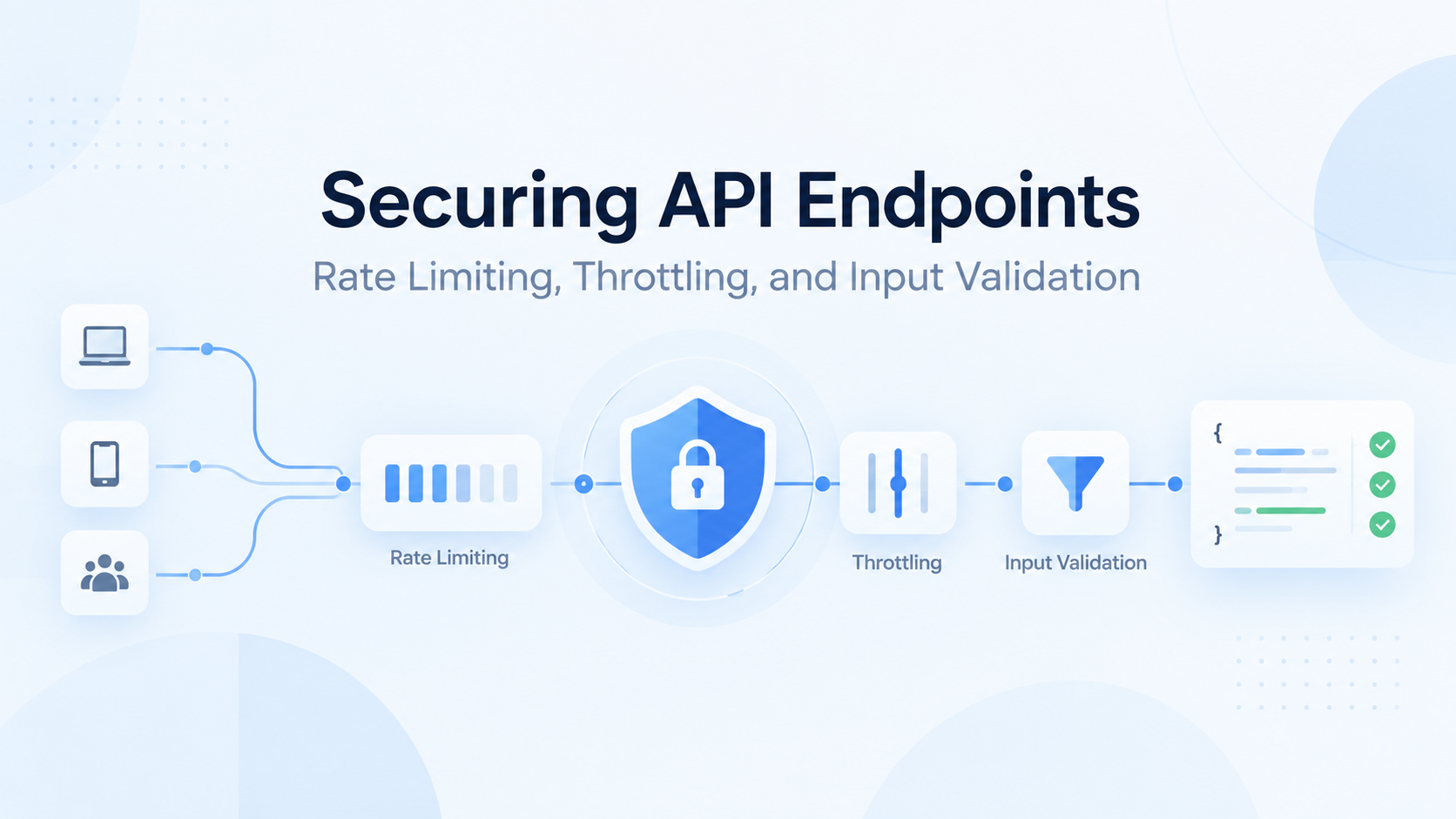
Securing API endpoints requires coordinated controls across request frequency, processing capacity, input validation, and application authorization. Rate limiting, throttling, and validation form the foundation, but their effectiveness depends on how engineering teams implement them across distributed systems.
What Is the Difference Between API Rate Limiting and Throttling?
API rate limiting restricts the number of requests a client can submit within a defined interval. For example, a service might permit 100 requests per minute for each authenticated account. Once that threshold is exceeded, the API typically returns HTTP status 429 Too Many Requests.
Throttling controls the rate at which requests are processed. Depending on the architecture, it may delay requests, restrict concurrency, queue workloads, or reject traffic when capacity becomes constrained.
The distinction matters because enterprise endpoints consume different resources.
A GET /profile request might retrieve cached information with minimal processing. A POST /reports/generate request could initiate database queries, aggregate millions of records, and invoke external services.
Applying identical limits to both endpoints creates uneven protection.
Engineering teams commonly implement fixed-window, sliding-window, token-bucket, or leaky-bucket algorithms. Token buckets are particularly useful when applications need to accommodate occasional traffic bursts while restricting sustained request volumes.
However, distributed enforcement introduces additional complexity. Multiple API gateway instances must share rate-limit state when they enforce a common quota. A centralized Redis-backed counter can help coordinate limits, although teams must consider atomic operations, network latency, availability, and failure behavior.
Rate limiting also needs an appropriate identity model. IP-based restrictions alone may penalize legitimate users sharing corporate networks. API-key or account-based controls offer more precision, while tenant-level quotas protect shared enterprise resources.
The objective is not simply reducing request volume. It is preventing individual consumers from exhausting capacity that other applications and customers depend on.
How Should Enterprises Design Rate Limits for Different API Endpoints?
Effective rate limiting starts with understanding the resource consumption and business risk associated with each operation.
A customer-profile endpoint, payment initiation service, large data export, and AI inference endpoint should not share the same consumption policy.
Engineering teams can introduce weighted limits that assign different costs to different operations. A catalog lookup might consume one unit, an advanced search five units, and an AI-generated report twenty-five units.
These values should come from performance measurements rather than arbitrary assumptions.
Limits should also account for concurrency. An endpoint that permits 100 requests per minute could still overwhelm infrastructure if all requests arrive simultaneously and trigger expensive processing.
GraphQL creates another consideration. A single HTTP request can contain multiple operations or deeply nested queries, making simple request counters insufficient. Query-depth restrictions, complexity budgets, batching controls, and execution timeouts help address this exposure.
For distributed applications, rate-limit enforcement should combine identity, tenant, endpoint, and operation-level signals where necessary.
Responses must also communicate restrictions clearly. HTTP 429, appropriate Retry-After headers, and documented quota behavior help legitimate clients implement controlled retries.
Blind retries can amplify overload. Exponential backoff with jitter reduces synchronized retry attempts, particularly when services recover from temporary failures.
A well-designed policy protects infrastructure without unnecessarily interrupting legitimate workloads.
How Can Input Validation Prevent Malicious API Requests?
Rate limiting controls how frequently requests arrive. Input validation determines whether those requests contain acceptable data.
Both controls are necessary because a single malformed or malicious payload can exploit an application regardless of request frequency.
Schema validation should verify data types, required fields, supported content types, string lengths, numeric boundaries, array sizes, and unexpected properties.
OpenAPI specifications and JSON Schema provide a consistent way to define expected structures. Applications can use these contracts to reject malformed requests before executing business logic.
However, syntactically valid input is not necessarily safe.
A transaction amount may satisfy a numeric schema while exceeding the customer’s authorization limit. A valid date range may request an impractically large dataset. A correctly formatted URL may reference an internal service and introduce server-side request forgery risks.
Business validation must therefore operate alongside schema validation.
Applications should enforce ownership checks, financial transaction constraints, permissible state transitions, and resource-specific permissions at the service layer.
Database operations require parameterized queries rather than dynamically concatenated SQL. Output encoding should protect consuming applications where data enters interpretable contexts.
File uploads need restrictions on size, type, and processing behavior. Systems should also apply limits to nested objects and decompressed content to prevent memory exhaustion.
Importantly, third-party API responses require validation too. OWASP identifies unsafe consumption of APIs as a security risk because external data may contain malicious or unexpected values.
Validation should cover every trust boundary, not only requests entering public endpoints.
Where Should API Security Controls Be Implemented?
API security works best through multiple enforcement layers rather than relying entirely on one gateway.
At the network edge, CDNs and web application firewalls can filter obvious malicious patterns and absorb certain high-volume attacks.
API gateways can enforce authentication requirements, basic request validation, quotas, and general rate-limiting policies before traffic reaches backend services.
Application services must enforce business-specific controls because gateways often lack the context necessary to evaluate sensitive operations.
For example, a gateway may recognize that an authenticated account submitted ten payment requests. The payment service must determine whether those requests are authorized, duplicated, or inconsistent with transaction rules.
Downstream systems require additional safeguards, including database connection limits, bounded queues, execution timeouts, circuit breakers, and concurrency restrictions.
NIST’s updated guidance on API protection in cloud-native systems emphasizes layered protections and early rejection of malicious traffic.
The architecture should also define what happens when enforcement infrastructure fails. Allowing all requests when a centralized rate-limit store becomes unavailable may expose sensitive operations. Blocking every request may cause an unnecessary outage.
Teams should select failure behavior according to endpoint criticality and operational risk.
Which API Security Controls Should Engineering Teams Prioritize?
Enterprises managing extensive API portfolios need a repeatable implementation strategy.
1. Classify endpoints according to business risk and resource consumption. Engineering teams should identify sensitive operations, expensive database workloads, third-party dependencies, and endpoints exposed to anonymous traffic. This classification supports distinct limits for authentication, payments, reporting, exports, and AI services rather than applying one global restriction.
2. Enforce validation across every application boundary. Schema validation should reject malformed requests early, while service-level checks enforce authorization and business rules. Teams should validate third-party responses, asynchronous messages, uploaded files, and internal service inputs because trusted network placement does not guarantee trustworthy data.
3. Implement identity-aware and distributed rate limiting. Policies should consider authenticated users, API keys, tenants, endpoints, request cost, and concurrent operations. Distributed gateways need consistent quota enforcement, while fallback behavior must account for the security consequences of rate-limit infrastructure failures.
4. Monitor security controls alongside application performance. Observability should connect rate-limit violations, validation failures, authentication errors, latency, downstream saturation, and unusual resource consumption. Correlating these signals helps engineering teams identify whether traffic reflects legitimate growth, inefficient client integrations, credential abuse, or automated attacks.
5. Test overload and failure scenarios before production incidents. Load testing should examine burst traffic, aggressive retries, oversized inputs, expensive queries, and downstream failures. Teams should verify that APIs reject excess work predictably and preserve critical operations rather than transferring overload into databases, queues, or external services.
These practices establish measurable controls that engineering leaders can continuously refine as application traffic and business requirements evolve.
Which Consulting Companies Help Enterprises Improve API Security?
Organizations modernizing complex API environments sometimes engage engineering consultancies to assess architecture, integration risks, and backend reliability.
GeekyAnts works across digital product engineering, backend development, and enterprise modernization. Its experience with application architecture and system integrations makes it relevant for organizations reviewing API security as part of a broader modernization or scalability initiative.
EPAM Systems provides API strategy, integration engineering, and security assessment capabilities for enterprises managing complex digital platforms.
Thoughtworks works in technology modernization, platform engineering, and architectural transformation, including systems where secure integration and operational resilience are important.
The appropriate consulting approach depends on whether an organization needs a targeted security assessment, API governance improvements, or broader architectural changes.
How Can Engineering Leaders Determine Whether Their APIs Are Secure Enough for Production?
The presence of rate limiting, throttling, and schema validation does not automatically establish production readiness.
Engineering leaders need evidence that controls remain effective under realistic traffic, malicious inputs, dependency failures, and changing consumption patterns.
An architecture review should establish whether individual endpoints have appropriate resource budgets, whether validation covers critical trust boundaries, and whether gateway policies align with application-level authorization.
It should also examine whether monitoring identifies expensive requests before they affect customer-facing services.
For enterprises operating large API portfolios, an API security and backend architecture consultation can provide a practical starting point. Reviewing high-risk endpoints, rate-limit design, validation coverage, and failure behavior helps teams identify which controls require improvement and prioritize changes without disrupting existing applications.