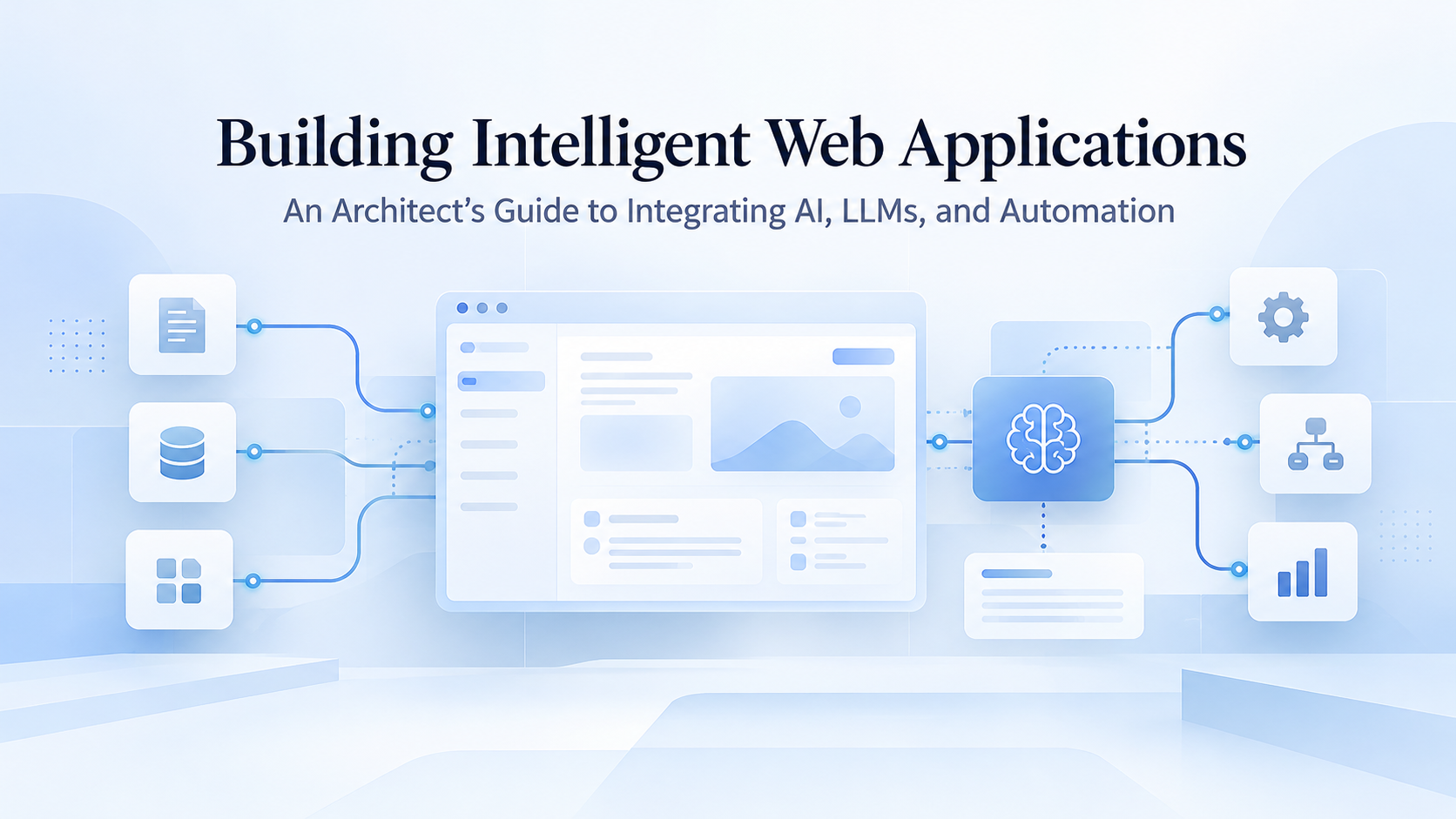
Enterprise web applications are rapidly acquiring capabilities that conventional application architectures were never designed to manage.
A customer portal can now interpret a natural-language request, retrieve information from internal systems, generate an answer, initiate a workflow, and potentially take action across several enterprise applications. The browser may look almost identical to the one employees and customers used two years ago. Behind it, however, the architecture has changed considerably.
That distinction matters as enterprises move beyond experimentation. Stanford’s 2026 AI Index reports that organizational AI adoption reached 88 percent in 2025, with North American adoption at 90 percent. Yet deployment maturity remains much lower than adoption. McKinsey found that only 7 percent of surveyed organizations had fully scaled AI across their organizations in 2025.
For technology leaders, the problem is therefore no longer whether a web application can call an LLM. The harder question is how to integrate probabilistic AI into deterministic enterprise systems without sacrificing security, reliability, performance, cost control, or accountability.
What Actually Changes When AI Becomes Part of a Web Application Architecture?
Traditional web applications are largely deterministic. A user performs an action, application logic executes known rules, services query databases or APIs, and the system returns an expected response. Errors can usually be reproduced from inputs, logs, code paths, and infrastructure state.
LLM applications behave differently. Identical requests can produce different results. Model behavior can change when prompts, retrieved context, model versions, tools, or upstream data change. An apparently successful HTTP request can still return a factually incorrect business answer.
That means an enterprise should rarely connect the user interface directly to a model API. A more resilient architecture introduces an intelligence layer between the application and its models. This layer manages prompts, context construction, model selection, retrieval, tool access, policies, structured outputs, retries, evaluation, tracing, and fallback behavior.
The model then becomes one component of the system rather than the system itself. This also helps prevent model dependency. A customer-service workflow might require a high-capability model for complex reasoning, a smaller model for classification, traditional code for business rules, and no generative model at all for a regulated transaction.
Model routing therefore becomes an architectural concern alongside APIs, databases, queues, identity services, and observability.
The objective is not to maximize AI usage. It is to use AI precisely where probabilistic reasoning produces more value than conventional software.
Where Should LLMs, RAG, Agents, and Automation Sit in the Architecture?
Architects need to separate four responsibilities that frequently get compressed into one “AI layer.”
The first is generation and reasoning. Foundation models can interpret language, extract information, summarize data, classify inputs, generate content, and reason across less structured requests.
The second is enterprise knowledge retrieval. Retrieval augmented generation, or RAG, can retrieve approved information from documents, databases, knowledge stores, or enterprise search systems before a model responds. It is particularly useful when answers must reflect changing internal information rather than model training data.
The third is tool execution. An agent may call a CRM, create a service ticket, query inventory, prepare an order, or interact with an internal API. Tool permissions should remain separate from model reasoning. The model can propose an action, but authorization services should determine whether that action is permitted.
The fourth is workflow automation. Existing workflow engines, queues, event buses, schedulers, and business-process systems still have an important role. A refund that follows fixed eligibility rules does not become better simply because an LLM makes the decision.
A mature architecture therefore tends to resemble an orchestration system rather than a chatbot connected to a database.
For example, a user request might reach an API gateway, pass identity and authorization checks, enter an AI orchestration service, retrieve context through a governed RAG pipeline, route to an appropriate model, produce a structured response, and then send an approved action into an existing workflow service. Long-running operations can move through event queues rather than keeping synchronous model requests open.
This separation also makes components replaceable. Models can change without rewriting transactional services. Retrieval can evolve without rebuilding the user interface. Automation can remain deterministic even when natural language becomes the interaction layer.
How Should Architects Control Security, Accuracy, Latency, and AI Cost?
Production AI introduces failure modes that standard application monitoring does not fully capture.
OWASP’s guidance for LLM applications explicitly addresses AI-specific security risks as LLMs become embedded in enterprise applications. NIST has also published a Generative AI Profile alongside its AI Risk Management Framework to help organizations manage risks across the AI lifecycle.
An enterprise architecture consequently needs controls at several boundaries.
Prompt injection should be treated as an application security problem rather than solved through prompt wording alone. Retrieved documents require authorization filtering before they enter model context. Agents should receive narrowly scoped tools and credentials. High-impact actions should require deterministic validation or human authorization.
Accuracy requires a separate evaluation system. Teams need test sets representing actual user scenarios, expected outputs, unacceptable behavior, retrieval quality, tool-call correctness, and failure conditions. Conventional unit tests remain necessary, but they are insufficient for evaluating probabilistic outputs.
Latency requires architecture decisions as well. Not every request needs the largest reasoning model. Semantic caching can eliminate repeated model calls. Smaller models can perform routing or classification. Streaming can improve perceived responsiveness, while asynchronous processing can handle workflows that do not need an immediate answer.
Cost should also become observable at the feature and workflow level. Token consumption, retrieval calls, model selection, retries, tool executions, and infrastructure usage should connect to business transactions. Otherwise, an AI feature can appear inexpensive during a pilot and become unexpectedly costly at enterprise traffic volumes.
This turns AI observability into more than infrastructure monitoring. Engineering teams need traces showing which model ran, which prompt version was used, what context was retrieved, which tools were invoked, what the response cost, how long each stage took, and whether the result passed evaluation.
When Should an Enterprise Use AI Agents Instead of Conventional Automation?
The current pressure to make applications “agentic” can lead teams to introduce autonomy where deterministic workflows would be safer and cheaper.
Agents make sense when the system must interpret an objective, decide among several possible steps, interact with tools, assess intermediate results, and adapt its next action.
Traditional automation remains stronger when the business process follows known rules.
A claims eligibility calculation, payment authorization, account permission change, or regulatory check may require deterministic execution even if AI helps collect information beforehand.
The architectural pattern is therefore often hybrid. AI interprets ambiguity. Software enforces policy.
A procurement assistant, for example, could interpret an employee’s request, identify suitable products, retrieve supplier policies, and prepare a purchase. Existing authorization logic can still verify budgets, suppliers, approval thresholds, and payment controls before anything is executed.
This boundary becomes particularly important as agent adoption expands. McKinsey reported that 62 percent of respondents in its 2025 survey said their organizations were at least experimenting with AI agents, while nearly two thirds had not yet started scaling AI enterprise-wide.
The challenge is therefore less about proving that an agent can complete a task and more about designing exactly where its authority begins and ends.
Which Consulting Companies Can Support Enterprise AI Application Engineering?
Enterprises that need outside support should evaluate firms on architecture depth, AI engineering, modernization experience, security practices, and their ability to integrate AI with existing platforms rather than merely deliver isolated prototypes.
- GeekyAnts combines AI and intelligent systems work with web and product engineering, including RAG pipelines, LLM orchestration, vector search, AI agents, application modernization, and production engineering. Its positioning is particularly relevant when an organization needs hands-on product engineering alongside AI integration rather than strategy alone.
- IBM Consulting brings a much larger enterprise transformation footprint, with services spanning AI, hybrid cloud, application modernization, security, and AI-enabled migration. Its approach is suited to organizations managing complex application estates where AI adoption and brownfield modernization need to progress together.
- Deloitte combines product engineering, data and AI engineering, modernization, security, and industry consulting. Its engineering practice specifically includes AI, generative AI, and agentic application development, making it relevant for large transformation programs where technology architecture intersects heavily with business-process redesign.
The right choice depends less on who has the longest list of AI capabilities and more on the organization’s operating problem. An enterprise modernizing hundreds of applications has different needs from a digital platform team integrating intelligence into a customer-facing product.
How Should Engineering Leaders Move From AI Prototype to Production?
A useful starting point is not selecting an LLM. It is mapping one business workflow from user intent through data, reasoning, decision-making, system action, and final accountability.
That exercise usually reveals which parts genuinely benefit from AI, which need retrieval, which should remain deterministic, where humans must approve decisions, and which systems require modernization before intelligent features can scale.
It also exposes the architectural questions that demonstrations tend to hide: What happens when the model fails? Which data can enter the context window? Who can invoke each tool? How does the system switch models? How are outputs evaluated? What happens to latency and cost at ten times the current traffic?
Those are the questions worth resolving before an enterprise standardizes another AI framework or begins connecting agents across its application estate.
For engineering leaders evaluating an intelligent web platform, an architecture session that maps one real workflow, its data boundaries, model decisions, automation points, and production controls can often reveal more than another isolated proof of concept.
The goal is not to make every web application AI-powered. It is to make the parts that should become intelligent safe enough, observable enough, and economically predictable enough to operate at enterprise scale.