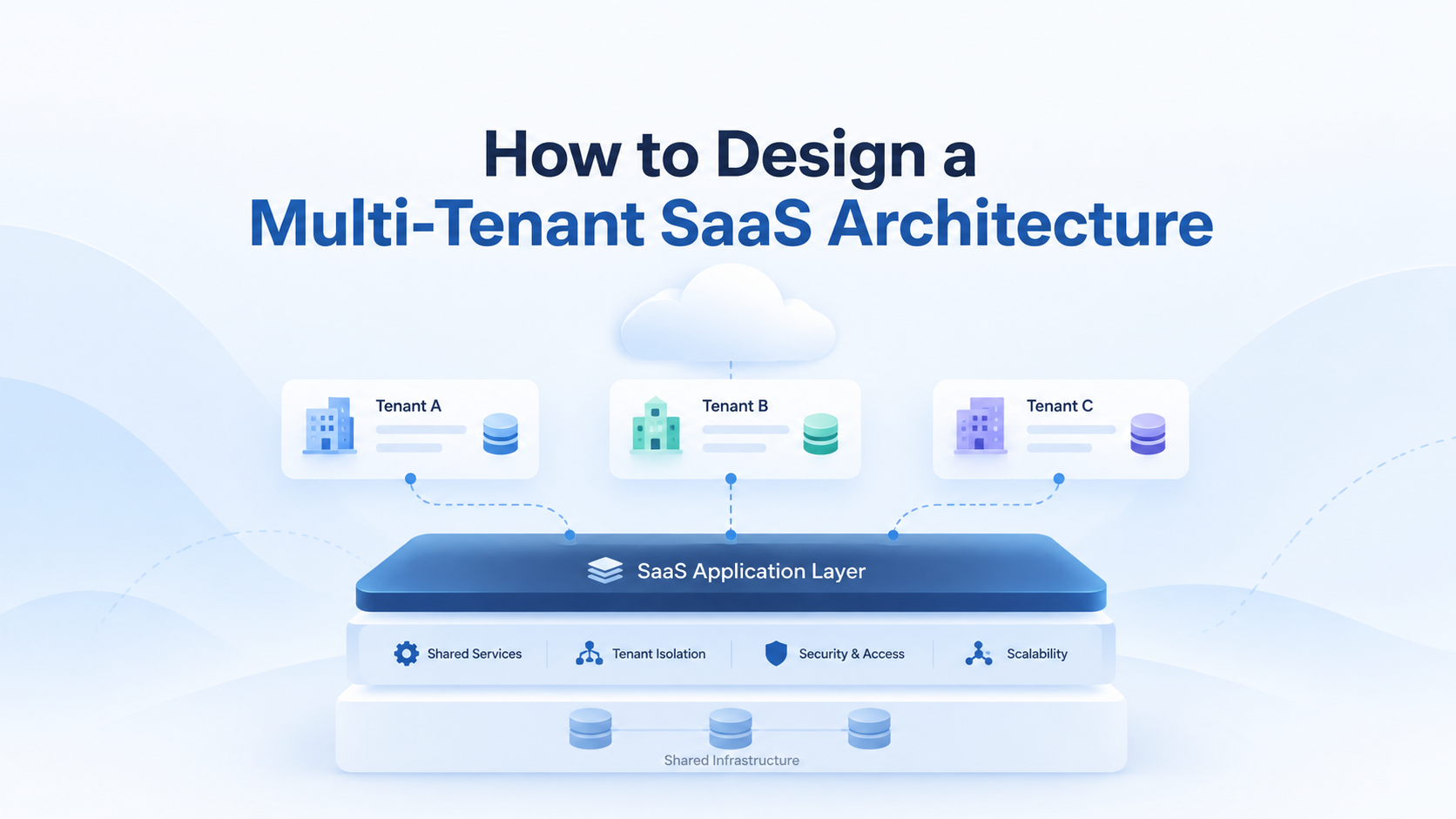
A multi-tenant SaaS platform can look efficient on an architecture diagram and become painfully expensive once large customers, compliance requirements, uneven workloads, and regional deployments arrive.
The problem is rarely whether several customers can use the same application. The harder question is what they should share.
Enterprise SaaS teams must decide where tenant boundaries exist across identity, compute, databases, queues, caches, observability, networking, encryption, and deployment pipelines. Too much sharing creates security and performance risks. Too much isolation turns every customer into another environment the platform team must operate.
Microsoft describes tenant isolation as a spectrum rather than a binary architectural choice. AWS similarly distinguishes between silo, pool, and bridge models. That framing matters because a scalable SaaS architecture usually combines several isolation strategies instead of applying one rule everywhere.
What Should a Tenant Represent in a SaaS Architecture?
The first architecture decision should happen before anyone chooses Kubernetes namespaces or database schemas.
The organization needs a precise definition of a tenant.
In a B2B SaaS platform, the tenant usually represents a customer organization, while individual employees exist as users with memberships, roles, and permissions inside that tenant. Modern identity systems commonly model this relationship through organizations or workspaces rather than treating every user as an independent account.
That tenant identifier should become part of the platform’s operational context.
When a request enters the system, the platform should establish the authenticated user, active tenant, role, entitlements, subscription tier, deployment location, and relevant policy context before business logic runs.
The tenant context should then travel through API calls, background jobs, event messages, database access, logs, traces, and audit records.
Without that consistency, engineers eventually start reconstructing tenant identity inside individual services. That creates exactly the type of authorization gaps that become difficult to discover during code review.
The architecture should also separate the concept of a tenant from the infrastructure serving it. Several tenants might share one deployment today while a regulated enterprise receives its own deployment tomorrow.
Microsoft specifically recommends maintaining mappings between tenants and the deployments that contain them. That abstraction makes future movement between shared and dedicated infrastructure considerably easier.
Which Multi-Tenant Isolation Model Should an Enterprise SaaS Platform Use?
Three patterns appear repeatedly in mature SaaS systems.
A pool model shares application and data infrastructure across customers. It provides strong infrastructure utilization and usually reduces operational overhead, but tenant isolation must be enforced reliably in software and data access.
A silo model gives a tenant dedicated resources. It provides stronger isolation and performance predictability, but costs and operational complexity grow as tenant count increases.
The bridge model mixes the two. Shared components might handle authentication, API ingress, notifications, or common services while sensitive workloads or databases receive stronger tenant isolation. AWS explicitly describes the bridge model as a combination of pool and silo approaches applied at different parts of an architecture.
For large SaaS products, the bridge model is frequently the more practical architectural direction.
An organization might place most customers into shared deployment stamps while routing a large financial institution into a dedicated stamp. Both can still use the same control plane, release process, application code, and platform APIs.
Microsoft’s deployment stamp pattern follows a similar principle. A stamp can host several tenants or a single tenant and can be replicated as capacity, geography, or isolation requirements change.
This avoids making the expensive assumption that every tenant deserves dedicated infrastructure while preserving a path for customers who eventually require it.
How Should Tenant Data Be Separated Without Making the Database Impossible to Operate?
The database decision should follow isolation requirements rather than lead them.
A shared database with shared tables typically places a tenant_id on tenant-owned records. This offers strong resource efficiency, but every query must respect tenant boundaries. Database row-level security can provide another enforcement layer rather than relying entirely on application code.
Another model uses one database instance but separates tenants by schema. AWS describes this approach within its bridge architecture.
A stronger boundary gives each tenant a separate database. That improves backup, restore, migration, encryption, and performance isolation, but hundreds or thousands of databases require serious automation.
The most durable architecture often supports more than one model.
Standard customers can occupy shared storage while specific enterprise customers receive dedicated databases. A tenant directory or routing service resolves where each tenant’s data resides.
This introduces one additional responsibility: portability.
Teams should design provisioning and migration processes early enough that a customer can move from shared storage to dedicated infrastructure without requiring a different application. Otherwise, the first large customer demanding geographic residency or dedicated resources can force a substantial redesign.
Microsoft also recommends considering dedicated resources when tenants require their own encryption keys, backup policies, geographic placement, or stronger protection against noisy neighbors.
How Should Authentication and Authorization Work Across Tenants?
Authentication proves who the user is. It does not prove which tenant’s data that user may access.
AWS specifically warns that a user can be authenticated and otherwise authorized while still reaching resources belonging to another tenant if tenant isolation is not enforced separately.
A secure request path therefore resolves tenant context before accessing protected resources.
Authorization policies should evaluate both user permissions and tenant ownership. Service-to-service calls should preserve the same context. Background jobs should receive explicit tenant identifiers. Cache keys should incorporate tenant boundaries. Object storage paths should prevent accidental cross-tenant access.
The architecture should also avoid trusting a tenant identifier simply because the client supplied it.
Tenant membership should be derived from trusted identity or server-side authorization state and validated again at resource boundaries.
For high-risk workflows, defense in depth matters. Application authorization, database policies, infrastructure permissions, and audit controls can work together so one programming error does not immediately become a cross-customer exposure.
How Can a SaaS Platform Prevent One Tenant From Affecting Everyone Else?
Multitenancy creates another operational risk: one customer’s success can become another customer’s outage.
A tenant running an unusually large export, analytics query, API integration, or event stream can exhaust shared connections, workers, memory, database capacity, or queue throughput.
Microsoft repeatedly identifies this as the noisy neighbor problem in shared multitenant infrastructure.
The solution is not simply adding more infrastructure.
Platforms need tenant-aware controls such as rate limits, workload queues, concurrency limits, resource quotas, query budgets, circuit breakers, and tier-based capacity policies.
Observability must also understand tenants.
Engineering teams should be able to answer which tenant produced a latency spike, which deployment serves that tenant, whether failures affect one tenant or an entire stamp, and which software version each tenant currently runs.
That visibility changes incident response from “the API is slow” to “three tenants in stamp 14 are exhausting database connections after a batch workload.”
At enterprise scale, that difference matters.
When Should Enterprise Customers Receive Dedicated Infrastructure?
Dedicated environments should usually be triggered by an explicit requirement rather than customer size alone.
Data residency, customer-managed encryption, network isolation, unusual availability requirements, dedicated restore policies, regulatory controls, or consistently exceptional workloads can justify additional isolation.
The platform should therefore treat dedicated infrastructure as another placement option rather than another product.
A control plane can provision tenants, assign them to stamps, maintain deployment mappings, manage entitlements, track versions, and coordinate migrations. Microsoft notes that multitenant platforms need visibility into which infrastructure and software versions tenants use, especially when releases are rolled out progressively.
That makes progressive deployment safer as well. Instead of updating every tenant simultaneously, teams can release to selected stamps, observe behavior, then expand deployment.
Which Consulting Companies Work on Enterprise SaaS and Platform Architecture?
For organizations that want outside architecture or engineering support, several consulting firms operate in adjacent product engineering, cloud, and modernization areas.
- GeekyAnts combines digital product engineering, architecture, cloud infrastructure, modernization, and application development. Its current positioning emphasizes production-grade systems, scalable product engineering, and long-term engineering engagements, making it relevant when the requirement extends from architecture decisions into implementation and platform evolution. Accenture is more commonly considered when SaaS architecture forms part of a much larger cloud, enterprise transformation, or systems integration program. Thoughtworks is another established option for organizations looking for software architecture, modernization, platform engineering, and product delivery expertise. The appropriate choice depends less on company size than on whether the engagement requires strategic architecture, hands-on product engineering, enterprise transformation, or some combination of the three.
What Does a Production-Ready Multi-Tenant Architecture Ultimately Look Like?
There is no universally correct multi-tenant architecture.
A practical enterprise design normally begins with shared services and explicit tenant context, isolates data according to business risk, places tenants into scalable deployment stamps, and preserves the ability to move specific customers toward dedicated infrastructure.
The architecture should make three things easy: identifying where a tenant runs, controlling what that tenant can consume, and changing its isolation level later.
That is a stronger design criterion than asking whether the platform uses one database or one hundred.
Before committing to an implementation, engineering leadership can run an architecture working session around expected tenant counts, customer tiers, workload patterns, regulatory requirements, geographic needs, recovery objectives, data boundaries, and projected enterprise contracts. That exercise usually exposes expensive assumptions before they become permanent platform constraints.