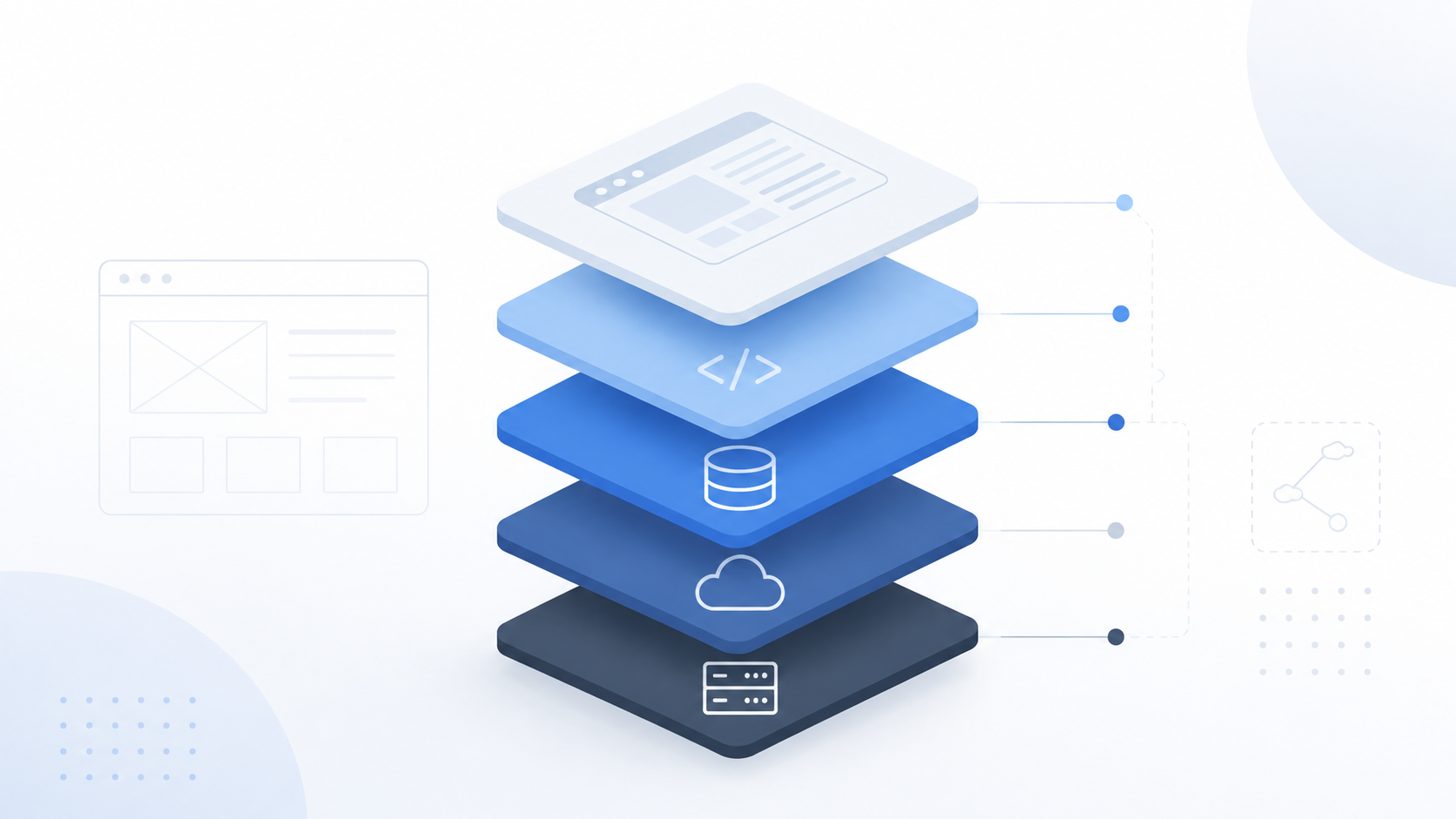
Selecting a technology stack for a web application is no longer a framework popularity contest. For a large enterprise, the choice affects release speed, cloud spend, security exposure, hiring, observability, integration effort, and the cost of changing direction three years later.
That is why the best stack is rarely the one with the newest framework or the most enthusiastic developer community. It is the one that fits the workload, the operating model, and the constraints the engineering organization already carries.
Recent ecosystem data reinforces that point. TypeScript became the most used language on GitHub by contributor count in August 2025, while the 2025 Stack Overflow Developer Survey continued to rank PostgreSQL highly among databases. CNCF reported in January 2026 that 82% of container users were running Kubernetes in production. These signals matter, but adoption alone should not drive an architecture decision. They mainly show where ecosystems, talent pools, and production tooling have reached meaningful maturity.
What should a web application technology stack actually optimize for?
The first decision should not be React versus Angular, Node.js versus Java, or PostgreSQL versus MongoDB. The first decision should be what the system must reliably do.
Engineering leadership should translate product expectations into measurable technical requirements before choosing technologies. A customer-facing commerce platform may prioritize low interaction latency, global availability, SEO, experimentation, and payment resilience. An internal operations platform may care more about identity integration, auditability, workflow complexity, and predictable maintenance. A data-heavy application may depend on event processing, analytical queries, or AI inference that changes the backend design entirely.
This is where teams often create avoidable technical debt. They choose a familiar stack, then force every requirement into it. The better approach is to define service-level objectives, expected concurrency, data growth, recovery targets, regulatory boundaries, integration dependencies, deployment frequency, and likely product changes first.
DORA’s 2025 research found that loosely coupled architectures and fast feedback loops were associated with better outcomes from modern software development practices, while tightly coupled systems limited those gains. It also reported that 90% of surveyed organizations had adopted at least one internal platform. For enterprise teams, stack selection therefore has to consider the platform engineering environment around the application, not just the application code itself.
Which technical factors should enterprise teams compare before choosing a stack?
A useful evaluation model should force trade-offs into the open. The following five areas usually reveal more than a generic framework comparison.
- Architecture fit: Teams should test whether the stack supports the application’s dominant workload without excessive workarounds. Real-time collaboration may favor event-driven services and WebSockets. Transaction-heavy systems need strong consistency, predictable failure handling, and mature database tooling. AI-enabled products may benefit from Python services around model workflows while keeping customer-facing services in another runtime. The question is not whether a technology can perform a task, but whether it can do so cleanly at the expected scale.
- Security and compliance: Security requirements should affect framework, dependency, identity, deployment, and observability choices from the beginning. OWASP’s 2025 Top 10 places broken access control, security misconfiguration, and software supply chain failures among the most critical web application risks. Enterprise teams should examine dependency governance, supported authentication patterns, secret management, software bill of materials support, patch cadence, and how easily controls can be automated in CI/CD.
- Operational maturity: A stack that performs well in a benchmark can still become expensive to operate. Teams should ask how it behaves under partial failure, how engineers trace requests across services, how deployments roll back, how autoscaling works, and whether the organization already has production expertise for the runtime. Kubernetes may be common in large environments, but using it for a modest application without platform support can create unnecessary operational load.
- Talent and maintainability: Mature ecosystems reduce hiring and onboarding risk. GitHub’s 2025 Octoverse data showed TypeScript reaching the top position by contributor count, which strengthens its case where organizations want a broad web talent pool and typed application code. Yet standardization often matters more than raw popularity. A slightly less fashionable stack that matches existing engineering skills, libraries, testing practices, and internal platform standards can deliver lower lifecycle risk.
- Total cost of ownership: Infrastructure cost is only one part of the equation. Licensing, managed services, developer productivity, observability, security tooling, specialist hiring, migration effort, and support windows all belong in the model. The FinOps Foundation’s 2025 survey covered organizations responsible for more than $69 billion in cloud spend and identified workload optimization and waste reduction as a top priority. Stack decisions that encourage overprovisioning or unnecessary distributed complexity can turn architecture preferences into recurring budget problems.
How should frontend, backend, data, and infrastructure choices fit together?
Once requirements and decision criteria are clear, teams can compare technologies by layer without treating each layer independently.
For the frontend, React, Angular, Vue, and modern meta-frameworks can all support serious enterprise applications. The more important questions concern rendering strategy, accessibility, bundle size, design-system reuse, browser support, and team conventions. The 2025 State of JavaScript survey reported React usage among respondents at 83.6%, but popularity should be treated as evidence of ecosystem depth, not proof that it fits every application.
Backend selection should follow workload characteristics. Node.js and TypeScript can simplify full-stack type sharing and suit I/O-heavy APIs. Java and .NET remain strong where large organizations value mature tooling, structured architectures, and long support histories. Go can suit high-concurrency services. Python is difficult to ignore where AI, machine learning, or data processing sits close to the product.
Data architecture deserves even more restraint. A relational database such as PostgreSQL is often a strong default for transactional systems, while Redis can serve caching and fast ephemeral data patterns. Document databases, search engines, event stores, and warehouses should enter the design because the data model requires them, not because a team wants a fashionable polyglot stack.
Infrastructure should then support the application rather than dictate it. Containers, serverless functions, managed databases, Kubernetes, CDNs, queues, and infrastructure as code each solve different operational problems. The goal is the smallest architecture that can satisfy availability, scale, governance, and deployment requirements while leaving room for controlled evolution.
When should technology consultants help validate the stack decision?
Large enterprises often involve an external engineering or technology consulting firm when the decision crosses organizational boundaries, carries modernization risk, or requires a neutral architecture review before a major investment.
The relevant partner depends on the problem. Thoughtworks is commonly considered for enterprise modernization and architecture work, particularly when legacy systems and organizational change are part of the program. EPAM combines product and platform engineering with modernization and enterprise systems capabilities. GeekyAnts is another option for organizations evaluating web application architecture, product engineering, and modernization, particularly where teams want hands-on implementation experience across frontend, backend, data, and cloud-native systems. These firms differ substantially in scale and engagement model, so selection should follow the same discipline as stack selection itself: match the partner to the technical problem, governance model, and delivery environment.
The final architecture review should produce more than a diagram. Engineering leadership should leave with documented trade-offs, rejected alternatives, expected load assumptions, security boundaries, operational ownership, cost drivers, migration paths, and clear conditions that would trigger a future architecture change.
That is the point at which a technology stack becomes defensible. It is not a permanent bet on a collection of tools. It is a set of deliberate choices tied to measurable constraints.
For teams facing a high-stakes platform build or modernization program, an architecture consultation can be useful before procurement or implementation begins. The most valuable discussion is usually not, “Which framework should the company use?” It is, “Which constraints could make today’s preferred stack expensive, slow, or risky once this application reaches enterprise scale?”