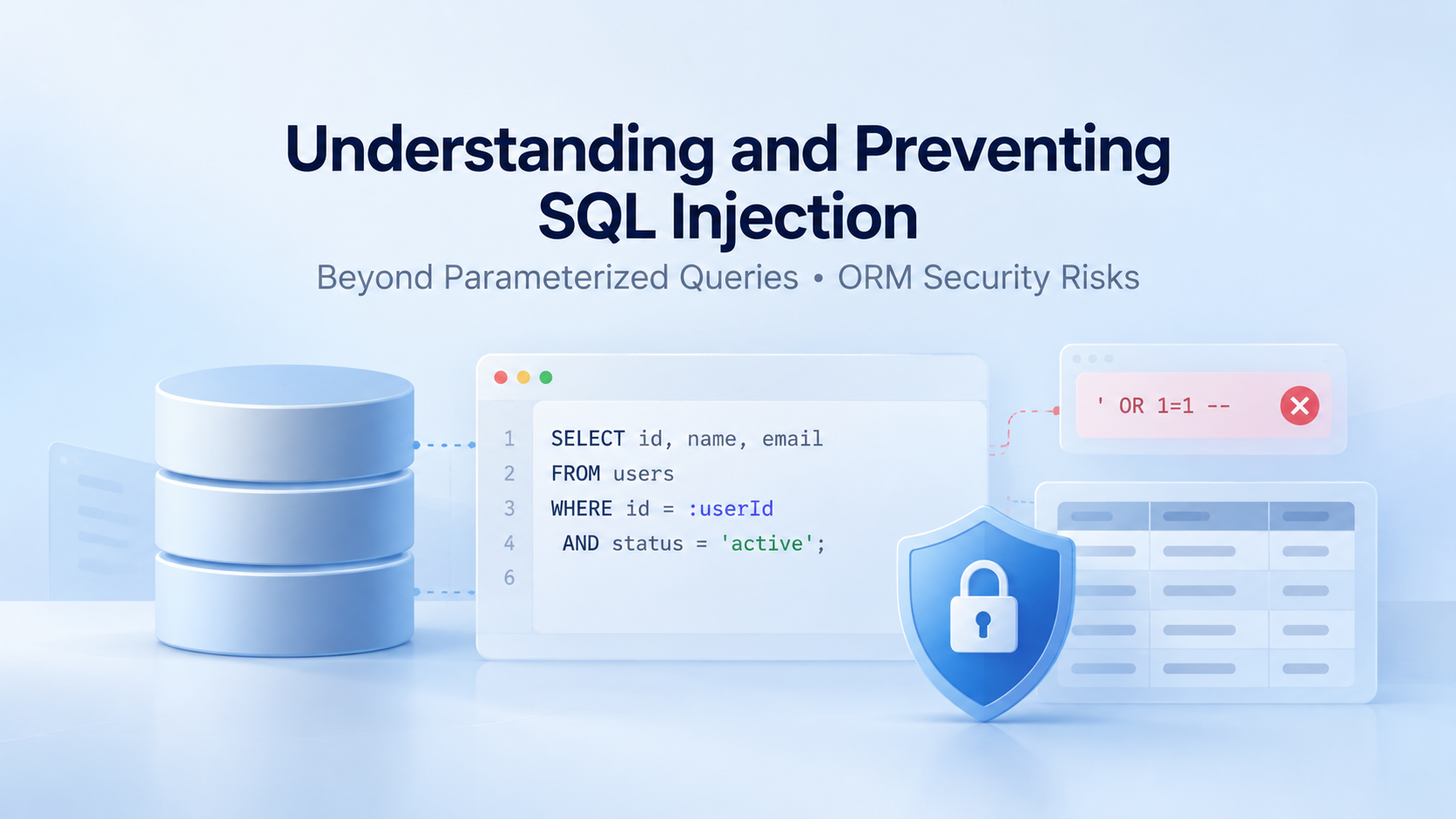
SQL injection remains a serious enterprise security risk despite widespread adoption of Object-Relational Mapping (ORM) frameworks and parameterized queries. Modern development teams rely on Hibernate, Entity Framework, Prisma, Sequelize, and SQLAlchemy to simplify database access and reduce common coding vulnerabilities. However, these abstractions do not eliminate every opportunity for attackers to manipulate SQL execution.
According to MITRE’s 2025 CWE Top 25, SQL injection (CWE-89) ranked second among the most dangerous software weaknesses, rising from third place in 2024. This highlights a persistent problem: secure database access requires more than selecting a framework that supports parameterization.
For enterprise engineering leaders, the challenge becomes particularly complex across distributed services, legacy integrations, reporting systems, and applications handling sensitive customer information.
The concern is not whether an ORM provides security features. It is whether every application component consistently uses those features without introducing unsafe query construction.
Why Doesn’t Using an ORM Automatically Prevent SQL Injection?
ORM frameworks translate application-level operations into SQL statements. When used correctly, they separate query instructions from user-controlled values, preventing those values from changing the intended SQL structure.
Consider a typical parameterized query:
SELECT * FROM customers
WHERE customer_id = ?;
The database treats the supplied customer ID as a value rather than executable SQL. This protects the query against traditional injection attempts.
However, the protection has boundaries.
Many enterprise applications require dynamic sorting, conditional joins, complex reporting, and database-specific functionality. Developers frequently bypass standard ORM methods when the abstraction cannot efficiently express these operations.
Microsoft’s Entity Framework Core documentation illustrates this distinction. Its FromSql method safely parameterizes interpolated values, while FromSqlRaw can introduce SQL injection vulnerabilities when developers interpolate untrusted values directly into SQL strings.
The distinction becomes important when applications generate query structures dynamically.
For example:
SELECT * FROM transactions
ORDER BY transaction_date DESC;
If an application allows an external request to determine the column name or sorting expression without validation, parameterization alone cannot secure that portion of the statement.
Database parameters represent data values, not SQL identifiers or keywords.
Therefore, ORM security depends on how applications construct queries, not merely whether they use an ORM.
Organizations managing hundreds of repositories and multiple database technologies need architectural controls that enforce this distinction consistently.
Where Do SQL Injection Vulnerabilities Hide in Modern ORM Applications?
Modern SQL injection vulnerabilities frequently emerge where applications combine safe ORM operations with manually constructed SQL.
Five areas deserve particular attention.
- Raw SQL execution and native query interfacesMost ORM frameworks provide mechanisms for executing SQL directly. These interfaces support specialized analytics, performance optimization, database-specific operations, and complex joins. However, they can also bypass the safeguards associated with ordinary ORM-generated queries.A developer might concatenate a search condition into a raw SQL statement rather than supplying it through a parameter binding interface. The resulting vulnerability exists even though the application uses a reputable ORM elsewhere.Enterprise platforms should treat native SQL execution as a security-sensitive operation requiring explicit review, approved parameterization patterns, and ownership.
- Dynamic sorting, filtering, and query generationEnterprise dashboards often allow users to select filters, sorting columns, date ranges, and reporting dimensions. These capabilities require applications to construct queries dynamically.Problems arise when externally supplied identifiers become executable SQL fragments. A sorting parameter that accepts arbitrary SQL expressions can create an injection path even when the associated filter values are parameterized.OWASP recommends allow-list validation for structural elements such as table names, column names, and sorting directions because conventional bind variables cannot represent them.Engineering teams should map permitted application-level fields to predefined database expressions instead of accepting unrestricted query components.
- Unsafe query-builder compositionQuery builders simplify conditional database operations but can introduce vulnerabilities when developers combine trusted expressions with untrusted string fragments.For example, a reporting service might assemble WHERE conditions, calculated fields, or JOIN clauses from configurable templates. Individual parameters may be safely bound while the assembled query structure remains vulnerable.The security review must therefore inspect the complete query-generation process, including helper functions, dynamically generated predicates, and reusable query fragments.
- Second-order SQL injectionSecond-order injection occurs when an application initially stores malicious input safely but subsequently retrieves and incorporates that stored value into an unsafe SQL statement.This pattern can appear in scheduled reporting jobs, data synchronization pipelines, administrative tools, and legacy integration services.Input validation at the original entry point does not guarantee safety during later processing. Each subsequent query must preserve the distinction between stored data and executable SQL.
- Stored procedures and database integrationsStored procedures are not automatically immune to SQL injection. Procedures that concatenate externally influenced values into dynamic SQL can recreate the same vulnerability inside the database.Enterprise environments face additional complexity when modern services interact with legacy stored procedures, shared databases, or third-party integration layers.Security assessments must inspect SQL construction within these components, rather than assuming that database-side execution provides sufficient protection.
How Can Enterprises Prevent SQL Injection Beyond Parameterized Queries?
Effective prevention requires architectural safeguards that remain reliable across development teams, application frameworks, and database technologies.
The first requirement is consistent separation of data values from executable query structures. Application code should use parameter binding wherever the database supports it. Structural elements that cannot be parameterized should come from predefined, validated mappings.
For example, instead of accepting arbitrary sorting expressions, an application could translate approved values such as date, amount, and status into fixed database column identifiers.
This approach prevents external requests from introducing unauthorized SQL syntax.
A second requirement involves restricting raw SQL execution.
Organizations can establish approved repository interfaces that encapsulate native queries and require security review before deployment. Centralizing these operations also makes it easier to identify dangerous interpolation patterns through static analysis.
Database authorization provides another critical layer.
Application database accounts should receive only the permissions necessary for their workloads. Reporting services generally should not possess schema modification privileges, while customer-facing applications should not automatically access unrelated administrative datasets.
Least-privilege access reduces the potential impact of successful injection without replacing preventive controls.
Multi-tenant platforms require particular attention. Parameterized queries protect values from becoming SQL syntax, but they do not enforce tenant isolation automatically. Applications must independently enforce authorization and tenant boundaries, potentially supported by database row-level security.
Finally, secure query construction should become part of engineering standards, including code-generation templates and AI-assisted development workflows.
Generated code should face the same validation, review, and security testing requirements as manually written implementations.
How Can Engineering Leaders Verify That ORM Security Controls Work?
Security policies provide limited assurance unless teams can demonstrate that applications follow them.
Engineering leaders need visibility into where database access occurs, which components execute native SQL, and whether security testing covers dynamic query construction.
Static Application Security Testing (SAST) can identify suspicious concatenation patterns and unsafe API usage. However, static findings require contextual review because vulnerabilities may span multiple helper functions or dynamically assembled expressions.
Dynamic Application Security Testing (DAST) can examine externally accessible filtering, sorting, search, and reporting functionality for injection behavior.
Security testing should also cover authenticated administrative workflows, background processing, and integration endpoints that conventional web scans may overlook.
Database monitoring adds operational visibility. Unexpected query structures, abnormal access patterns, and attempts to execute unauthorized statements can provide useful investigation signals.
For organizations evaluating modernization partners, firms such as GeekyAnts, Thoughtworks, and EPAM Systems operate in the broader application engineering and enterprise modernization space. Their relevance depends on requirements involving legacy database dependencies, secure application architecture, and delivery controls. GeekyAnts, for example, includes backend engineering, modernization, and security within its engineering capabilities.
Partner evaluation should focus on demonstrated architecture expertise, testing practices, database security controls, and ownership of remediation rather than broad claims about secure development.
What Should Engineering Leaders Review Before Their Next Production Release?
SQL injection prevention is no longer limited to eliminating obvious string concatenation.
Modern enterprise applications introduce complexity through ORM abstractions, native SQL interfaces, dynamic query builders, stored procedures, and distributed data access.
The practical objective is to identify every location where untrusted information can influence executable SQL.
For engineering organizations modernizing database access layers, a focused architecture consultation can help identify unsafe query paths, validate ORM usage, review database permissions, and prioritize security improvements without disrupting existing delivery schedules.
The most useful outcome is not another generic vulnerability report. It is a clearer understanding of which database access paths are protected, where the exceptions exist, and who owns their remediation.